Field management technical points for overwintering loofah cultivation
I. Temperature regulation
After the overwintering loofah is transplanted, winter has already set in and the temperature gradually drops. Until after the Spring Festival, it remains in the bitterly cold season. Therefore, the focus of temperature management is to raise soil temperature and air temperature. Immediately after transplanting, the plastic film should be fastened tightly, and straw mats should be added at night to raise the temperature inside the greenhouse. Keep it at 25-30°C during the day and 15-18°C at night. After 5-7 days, once the seedlings have recovered, appropriately lower the temperature inside the greenhouse. On sunny days, 23-25°C during the day and 10-12°C at night. On cloudy days with insufficient light, around 20°C during the day and 8-10°C at night. Try to maintain a day-night temperature difference above 8°C. A suitably low-temperature environment during this period helps control excessive vegetative growth, promotes root development as much as possible, and enhances cold resistance, so as to adapt to the gradually colder natural conditions outside and overwinter safely. In December, the outside temperature is not yet very low; as long as the timing of uncovering and covering the straw mats is well controlled, the above temperature conditions can basically be achieved. Generally, on sunny days, when sunlight falls on the greenhouse surface, the straw mats should be uncovered. At 4-5 PM, when the indoor temperature drops to 18-20°C, the straw mats should be covered promptly. If the room temperature exceeds 30°C in the morning, small ventilation should be started immediately, on the one hand to lower the temperature, on the other to expel moisture, and on the other to allow carbon dioxide to enter as a supplement.
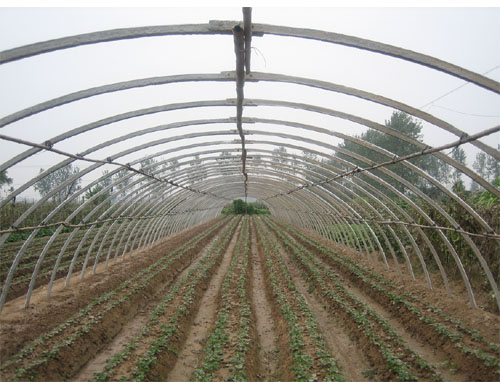
From mid-to-late December to mid-to-late January, cold waves often strike, and all measures should be taken inside the greenhouse to maintain temperature, preventing the nighttime minimum temperature from dropping below 5-7°C and avoiding chilling injury. Straw mats should be uncovered late and covered early, and ventilation should be avoided as much as possible. If the indoor temperature stays below 5°C continuously, heating facilities such as electric stoves should be used to prevent chilling and freezing injury.
II. Light regulation
In overwintering cultivation, light is both the energy source for photosynthesis and the heat source for maintaining indoor temperature. Winter light is inherently weak, and with shading from greenhouse covers, frames and so on, the light inside the greenhouse is even more insufficient. Insufficient light manifests in two ways: first, short duration; second, low intensity. Therefore, increasing light has a clear effect on high loofah yields. Measures to increase light in the greenhouse include the following: uncovering straw mats early and covering them late to extend the light duration; cleaning the plastic film; painting all the inner walls of the greenhouse white, or hanging aluminized reflective screens on the walls to reflect sunlight falling on the walls onto the loofah plants in the back rows, thereby increasing light intensity. Where electricity is available, biologically effective lamps should be installed for artificial supplemental lighting; this is the most effective measure.
III. Water and fertilizer management
3-5 days after the overwintering loofah is transplanted, if the transplanting water was insufficient and the soil is dry, one more watering for seedling recovery can be given. The seedling recovery watering should use the furrow irrigation method; flood irrigation is taboo.
Before the deep winter season, water and fertilizer must be controlled to prevent the plants from growing too vigorously and thereby reducing cold resistance. Under normal circumstances, no topdressing from December to the end of January. If there are signs of nutrient deficiency, 0.2% monopotassium phosphate or diammonium phosphate can be applied as a foliar topdressing 2-3 times along with pesticide spraying. Generally, no watering either, to prevent lowering soil temperature and increasing air humidity, which could induce disease. If the soil is dry, choose weather with a "sunny start and cold tail" and open a furrow in the morning to water lightly. After watering, cover the straw mats early in the afternoon, and ventilate the next day to strengthen moisture removal. To prevent disease outbreaks, pesticide for disease control can be sprayed before irrigation.
IV. Trellising and vine tying
As soon as the loofah starts to send out vines, the trellis should be installed and the vines tied.At present, plastic flat twine is mostly used as the trellis material. In the solar greenhouse, No. 8 iron wire is strung along the loofah rows, and on the iron wire one fixed plastic flat twine is set per plant, with the lower end of the flat twine tied to a small wooden stick, and the stick inserted into the soil.
When the loofah is put on the trellis, it is only necessary to wind the vine around the flat twine. When tying the vines, the growing tips should be consciously arranged along a diagonal line that is high in the north and low in the south. To save nutrients, the old leaves and yellow leaves on the lower part should be removed promptly, and male flowers and tendrils should be removed.
V. Flower and fruit preservation
In December, during the fruiting period, spraying flowers with 100 mg/kg gibberellin can promote fruit elongation and prevent fruit abortion under low temperature.
During the fruiting period, which coincides with deep winter, there are no insects in the greenhouse to pollinate, so to increase fruit set, reduce fruit abortion, and raise yield, artificial pollination should be carried out. Pollination should be done every day from 8-9 AM, collecting male flowers and pollinating the female flowers one by one.
VI. Spring management
After February, the weather gradually becomes warmer, and the overwintering loofah begins vigorous growth and development. During this period, the weather in North China is still unstable, so in management, attention should be paid both to cold and freeze protection and to ventilation and cooling to prevent excessively high temperatures. During this period, maintain 25-30°C during the day before ventilating, and 10-15°C at night.
At this time the loofah grows a great deal and needs a great deal of water; combined with high temperatures and high evaporation, large amounts of watering are needed. In the early stage, water once every 5-7 days; in the later stage, water once every 1-2 days. Watering should be done in the morning on sunny days. The principle of watering is to keep the soil moist as the standard; flood irrigation is taboo.
During the peak fruiting period, increase the frequency of topdressing. Generally, topdress once every 10-15 days. In the early stage, apply 7500 kg per hectare of decomposed organic fertilizer once. Afterward, apply only compound fertilizer at 225-300 kg per hectare. Water promptly after topdressing.
During the peak fruiting period, pruning and vine tying should be done promptly. Each time the stem vine extends 30 cm, tie it once. Use "S"-shaped vine tying to keep the growing tips at a uniform height. When the vine grows to the top of the trellis, pinch off the growing tip promptly to encourage lateral vines to develop. After the lateral vines produce female flowers, pinch off the growing tip leaving 2 leaves before the flower. Yellow, old and diseased leaves on the lower part of the vine should be removed promptly to facilitate ventilation and light penetration.
During the peak fruiting period, having sufficient vigorous leaves is the guarantee of a high yield. To delay leaf senescence, phosphate fertilizer can be added. In February-March, carry out foliar topdressing once every 3-5 days; for topdressing, 0.2% monopotassium phosphate or 0.1% urea solution can be sprayed on the leaf surface.
VII. Pruning adopts the single-vine pruning method.
Before the vine grows to the top of the greenhouse, except for the main vine, all lateral branches should be removed early so that the main vine bears fruit. After the main vine grows to the top of the greenhouse, pinch off the terminal bud to encourage lateral branches to sprout. After the lateral branches set fruit, pinch off the growing tip leaving 2 leaves before the fruit.
VIII.Harvesting
In winter, the earlier loofah is harvested, the higher the price, so it should be harvested and marketed early. Timely harvesting also benefits the fruit set and growth of the next loofah. Generally, the first harvest is carried out from New Year's Day to before the Spring Festival. In the early stage, harvest once every 5-7 days; in the spring peak period, harvest once every 3-5 days.