Detailed Explanation of Tomato Fertilizer Requirements to Help You Fertilize Scientifically
Tomatoes absorb different amounts of nutrients at different growth stages, and the amount absorbed increases as the plant grows and develops. During the seedling stage, nitrogen absorption is dominant, and as the stem thickens and lengthens, the demand for phosphorus and potassium increases.
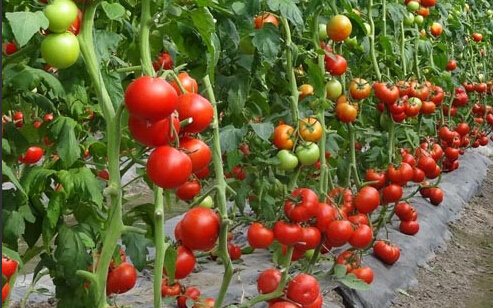
In the early fruiting stage, nitrogen accounts for 50% of the three main nutrient elements (nitrogen, phosphorus, and potassium). Potassium accounts for only 32%. Entering the peak fruiting stage and the start of harvest, nitrogen accounts for 36% and potassium accounts for 50%. Analysis of the ratio of nitrogen, phosphorus, and potassium in the entire tomato plant gives 1:0.4:2, while the absorption of nitrogen and potassium by tomatoes is 40%-50% of the fertilizer applied, and the absorption of phosphorus is only about 20% of the fertilizer applied, a difference of 1 times compared with nitrogen and potassium. Therefore, the ratio of nitrogen, phosphorus, and potassium fertilizer applied to tomatoes should be 1:1:2. From the test results (Table 11-3), it can also be seen that compared with applying nitrogen fertilizer alone, adding phosphorus and potassium fertilizer has an obvious yield-increasing effect.
In production practice, malformed fruit often appears. The appearance of malformed fruit is directly related to low temperatures encountered during tomato flower bud differentiation, but excessive nitrogen fertilizer and overly vigorous plant growth, especially excessive fertilizer and moisture during the seedling stage causing the stems to grow too thick, are also causes of malformed fruit. Applying too much nitrogen fertilizer during the growing season can also cause non-viral "leaf curl" on the top leaves; its appearance is similar to tomato virus symptoms, but it is not tomato viral disease. However, after leaf curl caused by excessive nitrogen fertilizer, the plant is very susceptible to viral disease. In addition, in hot and dry seasons, the "blossom-end rot" that appears on the fruit is closely related to insufficient calcium nutrition.