How to Improve the Fruit Set Rate of Pomegranates? Key Technical Measures Explained
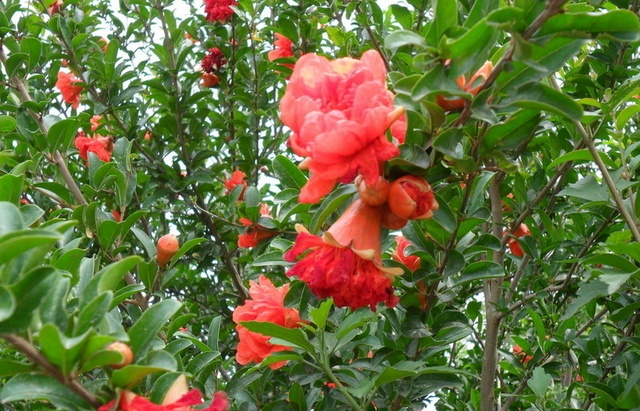
The flowers of the pomegranate are bisexual. Depending on the degree of pistil development, they are divided into complete flowers and incomplete flowers. Complete flowers are gourd-shaped or tubular flowers, commonly known as "big-bottomed fruit flowers," and are the main part that bears fruit; incomplete flowers have a trumpet-shaped calyx tube and are called "bell-shaped flowers" or "pointed-bottomed phantom flowers," and cannot be fertilized or set fruit. Pomegranate trees often produce a very large number of flowers, but set few fruits and have very low yields, especially in poorly managed orchards. The main reason lies in the small number of complete flowers, which generally account for only about 10% of the total flowers on the tree. The formation of degenerate flowers is mostly caused by poor nutrition during the flower bud differentiation process. Only complete flowers can set fruit, but even their fruit set rate is not necessarily high. Among the successive flushes of flowers, the first flush has a fruit set rate of 4.3%-6.1%, the second and third flushes have a fruit set rate of 10.5%-53.7%, and the last flush has 7.5%-33.3%. Therefore, the key to promoting fruit set and increasing yield lies in raising the proportion of normal flowers and their fruit set rate.
1. Improving the Nutritional Status of the Tree
From July to October, spray the foliage with 0.3%-0.5% monopotassium phosphate + 0.2% urea to improve leaf photosynthetic efficiency and promote plump, robust shoot growth, which helps shoots stop growing and form terminal buds that differentiate into mixed flower buds; in autumn and winter, deep plow and expand the planting holes to improve the soil and apply base fertilizer early and generously to raise the tree's stored nutrient level; mulching the tree basin with grass and so on to create a good environment of water, fertilizer, air and heat in the surface soil are effective measures to promote flowering, fruit set, vegetative growth and flower bud differentiation in pomegranates; adapting to the pomegranate's light-loving nature, adopt open canopy shapes such as the single-trunk natural open-center form and the three-main-branch open-center form to enhance light exposure, expand the range of effective branches and buds, and raise the nutritional level of branches and buds. Through opening up the canopy and thinning branches, long leaving and other training and pruning, cultivate a large number of short leaf-cluster branches that stop growing early in spring and summer. And through winter pruning and summer pruning, adjust the ratio of fruiting branches to vegetative branches to 1:5-10 to ensure the tree's nutrient supply to the fruit.
2. Foliar Topdressing During the Flowering Period
At full bloom, spray 0.2% urea + 0.3%-0.5% borax or 500 mg/l gibberellin, or from early bloom to full bloom spray 0.2% urea + 400 times rare earth to increase the fruit set rate.
3. Girdling at the Flower Bud Stage
In early May at the flower bud stage, girdle the base of vigorous trees with few flowers or large branch groups with 2-3 cuts, with the distance between two rings at least 4 cm, significantly increasing the fruit set rate and promoting flower bud differentiation in the current year.
4. Bee Release in the Orchard and Artificial Pollination
The pomegranate is an insect-pollinated flower, and releasing bees in the orchard at full bloom can significantly increase the fruit set rate and fruit yield. Generally, placing one hive in the middle of an orchard of about 200 trees is sufficient, and it needs to be released when the temperature is above 11°C. During the bee release period, never spray highly toxic pesticides.
For orchards without a bee source during the flowering period, artificial pollination measures must be taken. 1) Artificial flower-to-flower pollination. Pick off the blooming bell-shaped flowers that are shedding pollen and touch them against the blooming tubular flowers and gourd-shaped flowers so that the pollen falls onto the stigma of normal flowers. This can be done at the same time as flower thinning. 2) Artificial pollen collection and pollination. During the flowering period, collect the thinned flowers, remove the petals, hold one flower in each hand and rub them against each other so that the pollen falls onto newspaper. After drying in the shade, gather the pollen together and use a double-layer gauze bag to shake and pollinate, or use a hand-held duster to dust the normal flowers. This method is fast and suitable for pollination in large orchards.
5. Bud Thinning, Flower Thinning and Fruit Thinning
Timely thinning of degenerate flowers and excessive young fruits can effectively reduce the ineffective consumption of tree nutrients, increase the fruit set rate, and promote fruit development and flower bud differentiation. The method is: from bud emergence to full bloom, remove all bell-shaped flower buds and open bell-shaped flowers, and retain tubular flowers and gourd-shaped flowers. If there are enough gourd-shaped flowers, the tubular flowers (intermediate-type flowers) can also be thinned together. Finally, having 3-5 vegetative branches (with more than 100 leaves) around the fruiting branches bearing normal flowers is appropriate.