Detailed Explanation of Key Techniques for Cultivating Ginkgo Bonsai
Ginkgo, also known as white fruit, is a living plant fossil left over from ancient times and an economic plant valued for medicine, food, and timber. Ginkgo has vigorous vitality, a tall and straight trunk, an elegant tree form, and beautiful leaves. It is not only a dry fruit tree species with relatively high economic value, but also a beautiful landscaping tree species, and even more so a unique and excellent material for making bonsai. Ginkgo bonsai is deeply loved by people for its distinctive form and charm and profound cultural connotations.
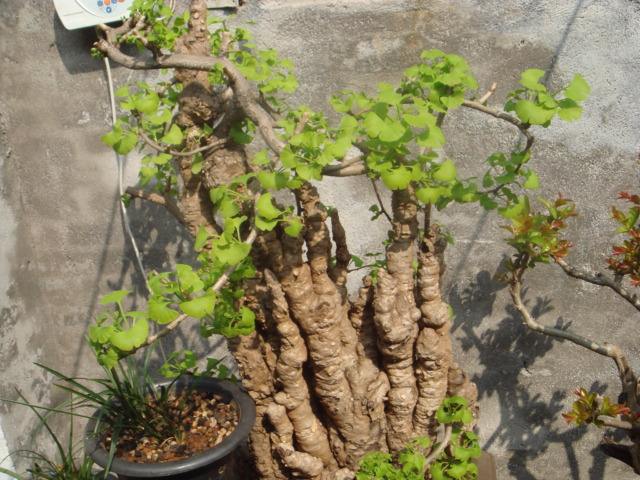
I. Growth Characteristics
Ginkgo is a dioecious gymnosperm, but whether female or male flowers, they are small and inconspicuous, with no ornamental value. The seeds of ginkgo (not fruits) have no distinctive appearance and generally fall off completely before the end of October, so their ornamental value is also low. Moreover, ginkgo cannot flower in areas south of 24 degrees north latitude with an annual average temperature of 20°C. Therefore, ginkgo bonsai should focus mainly on foliage and shaping. However, ginkgo is a deciduous tree that sheds its leaves in winter, which greatly reduces its ornamental value and also greatly affects the market value of ginkgo bonsai. Preventing ginkgo from shedding leaves in winter is the key to ginkgo bonsai production. Making a beautiful ginkgo bonsai involves technical steps such as the cultivation of ginkgo plants, bonsai creation, and prevention of winter leaf loss.
II. Sowing
Ginkgo generally uses seed kernels (white fruit) as sowing material, but commercial white fruit has too high a water content, and direct sowing easily causes fruit rot. Before sowing, ginkgo seeds need to be dried indoors to a water content of about 30% before sowing. Usually ginkgo seeds begin to germinate only after a dormancy period of 1 to 2 months, so there are two methods for sowing and raising ginkgo seedlings: first, directly sow the dried white fruit in the seedbed in autumn, and the seeds germinate in the following spring; second, 50 days before sowing, bury the white fruit in wet river sand with a water content of 5%-10%, cover it with plastic film for germination promotion, and then sow in spring. The seedbed substrate can be mixed with garden soil, river sand, and compound fertilizer in a ratio of 50:50:1, piled into a seedbed 100 cm wide, 15 cm high, and 300-500 cm long. When sowing, the ginkgo seed kernels must be placed flat, covered with 3-5 cm of soil, and covered with rice straw after sowing. For autumn sowing, water once every 7 days; for spring sowing, water once every 3 days until emergence. After emergence, water with a thin solution once a day, and apply 1500 ml of 0.3% potassium dihydrogen phosphate per square meter of seedbed each week.
III. Seedling Cultivation
When the seedlings reach a height of more than 15 cm, they should be potted with soil, and the terminal buds should be cut off at the same time to promote the germination of lateral buds. For the seedling pots, plastic flower pots or seedling bags with a diameter of about 15 cm can be used, and the potting soil should be rich in organic matter and have good water and air permeability. When the lateral branches grow to 20 cm, they can be tied and bent with fine hemp rope for shaping. Potted seedlings need to be placed in a shade shed from May to October to prevent strong light from inhibiting growth and scorching tender leaves. Potted seedlings should be watered once every 2 to 3 days, and it is appropriate to keep the potting soil moist. Fertilization is mainly based on decomposed soybean cake or compound fertilizer, once each in February and August every year.
IV. Planting and Management
When the ginkgo seedling is 10 cm above the ground and reaches a diameter of more than 1.5 cm, it should be moved with soil to a large pot for planting. The bottom of the planting pot should have holes to prevent waterlogging on rainy days, and it is best to place it on bricks. After planting, water thoroughly once a week. Apply Bordeaux mixture to the trunk every winter to prevent ant damage. When new branches grow to more than 20 cm the following year, they can be shaped as needed, and grafting can also be carried out before bud break in early spring each year according to shaping needs.
In the south, ginkgo has two growing seasons each year, in spring and autumn. It stops growing in summer due to high temperatures and in winter due to low ground temperatures. Therefore, ginkgo fertilization should be carried out in the two growing seasons each year, in spring and autumn. Similarly, ginkgo pruning is generally carried out in summer and winter.
V. Preventing Winter Leaf Loss
Ginkgo is a deciduous tree. After late autumn each year, the leaves begin to turn yellow and gradually fall, and then the plant enters dormancy. The reason for ginkgo leaf loss is both the influence of low temperature and the result of its own physiological patterns. Our many years of experiments have shown that it is feasible to artificially delay ginkgo leaf loss. At present, a relatively effective method is to spray leaf-preserving agent before the arrival of cold waves in autumn and winter, and cover with plastic film to increase temperature and preserve moisture, so as to maintain continued growth of ginkgo.
Another effective method to prevent winter leaf loss is the secondary shoot growth technique, that is, artificial treatment to make ginkgo shed leaves early and sprout new branches for the second time in the same year. Generally, in the second growing season of ginkgo each year (October), chemical treatment or manual leaf cutting is used, and long branches are cut short to promote the germination and growth of lateral buds. The secondary shoot growth technique must also be supported by fertilization and heat preservation measures in order to achieve the desired effect.