Detailed Explanation of the Key Points of Topping Management in Loofah Cultivation
Topping is an important task in loofah management and is directly related to the level of loofah yield. Usually, when the main vine of the loofah has 13-15 leaves and the plant height is about 160 cm, you begin to set fruit and top the vine, and afterward top it after every 3 leaves with 1 fruit set. In general, this is feasible, but it is not suitable for loofah that grows weakly after transplanting.
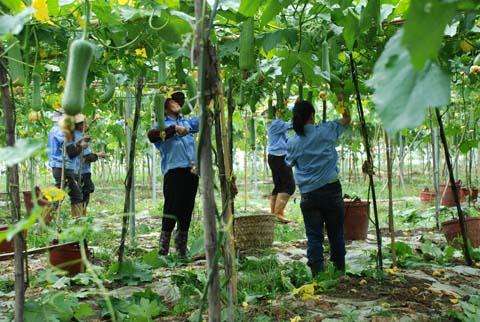
If weakly growing loofah is topped according to the usual method, it easily shows the "empty fruit" phenomenon after 3-4 fruits are harvested, and after these 3-4 fruits are harvested, the stems and vines become thin and weak, which is not conducive to normal fruit setting in loofah. Therefore, for weakly growing loofah, it is better to top early during the empty vine period to nourish the vines, making the stems and vines thick and strong, so as to enhance the loofah's ability to set fruit continuously and prevent the "empty fruit" phenomenon. The author suggests topping when the main vine of the loofah has 11-12 leaves and vegetative growth is vigorous, breaking the traditional practice of topping only after fruit setting, and consciously promoting stem and vine development. After topping at this time, the side branches sprout slowly, and the stems and vines become thick and strong because of sufficient nutrient accumulation. Afterward, once the side branches sprout, fruit setting can begin, setting 1 fruit every 2 leaves, and the "empty fruit" phenomenon will no longer appear.
In loofah production, the traditional topping method is to set fruit and top when the main vine has 13-15 leaves, setting fruit first and then topping. With this topping method, after generally harvesting 3-4 loofahs, the stems become thin and weak and vegetative growth is poor. Some vegetable growers use the method of "letting the plant stay empty to nourish the vines" to ensure the balance between vegetative growth and reproductive growth; some vegetable growers use the method of setting one fruit every 5 leaves to nourish the vines. But neither of these two methods is advisable, because neither can enable the loofah to set fruit continuously during the fruiting period, resulting in reduced loofah yield.
One vegetable grower changed the loofah topping method, topping earlier, topping first and then setting fruit, and achieved high yield. He began to hang the vines when the main vine had 7-8 leaves, and began topping when the main vine had 11-12 leaves and vegetative growth was relatively vigorous. When topping at this time, the side branches sprout more slowly, the main vine becomes thick and strong because of sufficient nutrient accumulation, and fruit can be set after the side branches sprout; at this time, one fruit can be set every two leaves. In this way, because the loofah has the earlier vine-nourishing period, the phenomenon of empty plants and broken fruiting gaps will not appear, and the loofah yield will naturally be higher.