Detailed Explanation of Key Points of Fertilization Techniques for Red Globe Grapes
Original title: How to fertilize Red Globe grapes
Red Globe grape, also known as Red Globe, is a Eurasian species. Originating in California, USA, it is a grape variety bred by researchers at California State University in the 1970s through hybridization experiments. Since China introduced this variety in 1987, it has performed extremely well in most areas of North China and Northwest China, with excellent fruit quality, late ripening, tolerance to storage and transportation, and high yield, making it the preferred high-quality and efficient variety for grape development. So here comes the question: how to fertilize? Now let us take a look together!
One,Land preparation and fertilization are similar to other grape varieties. Red Globe likewise prefers well-aerated soil, so the soil should be fertile, deep sandy loam with a pH of about 6.5-7.5 and good irrigation and drainage conditions. If the soil is too clayey or too sandy, consider increasing the amount of organic fertilizer to improve soil structure. Generally, apply 2000-3000 kg of decomposed organic fertilizer per mu and plow it into the soil.
Two,Base fertilizer is mainly organic fertilizer. Generally, every 1-2 months, combine it with expanding the planting holes between rows and deep plowing, 60-80 cm deep and 30-40 cm wide, using the method of alternating fertilization between rows or on both sides. The base fertilizer is generally best applied after fruit harvest and before the soil freezes, with an application rate of about 1000-1500 kg per mu. Properly early application is conducive to the decomposition of organic fertilizer and the healing of wounds, and lays the foundation for restoring tree vigor, improving cold and drought resistance, and for the next stage of root growth, flower bud differentiation, and new shoot growth.
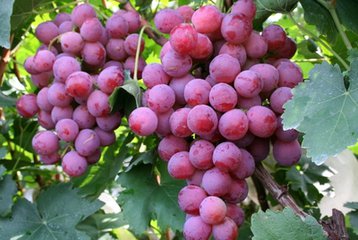
Three,Topdressing is mainly quick-acting fertilizer. Near the root ends (for 3-5 year old trees, about 40 cm from the trunk), open a ditch 50 cm deep and 20 cm wide, mix the chemical fertilizer with soil and bury it in the ditch. For grapevines in full fruit stage, topdressing can be carried out before bud break, before flowering, during fruit enlargement, during coloring, and after harvest. From emergence in early spring to around bud break, carry out the first topdressing, mainly nitrogen and potassium, with a small amount of phosphorus fertilizer, called bud-promoting fertilizer, which has a good effect on promoting young bud germination, continued inflorescence differentiation, and the growth of branches and leaves. About seven days into the flowering period, carry out the second topdressing, mainly nitrogen and potassium, called flower-promoting fertilizer, to ensure normal flowering, pollination, fertilization, and inflorescence differentiation. In addition, during this period, 0.3% borax can be sprayed on the leaves as appropriate to increase the fruit-setting rate. During the berry growth period, that is, when the berries grow to the size of soybeans, in order to promote fruit enlargement, enhance leaf photosynthesis, promote branch growth, and improve yield and quality, carry out the third topdressing, mainly nitrogen and potassium fertilizer, namely fruit-promoting fertilizer. During the fruit coloring stage, a certain amount of potassium fertilizer can be topdressed as needed to improve fruit color and increase the marketable rate. From after harvest to the first frost at the end of October is an important stage for grape branches to mature, restore tree vigor, and accumulate nutrients for the next year's growth. In order to supplement the nutritional consumption of the grapes, carry out the fourth topdressing, mainly nitrogen and potassium. This topdressing can be combined with organic fertilizer, which can save labor and improve fertilizer utilization.
Foliar topdressing is a quick and effective fertilization method often used in agricultural production. This method can quickly restore tree vigor and mild deficiency symptoms, and can supplement trace elements such as iron, boron, and zinc that grapes often lack. The specific method is to dissolve fertilizer in water and spray it evenly on the grape leaves at a certain concentration (for nitrogen and phosphorus, about three-thousandths is appropriate). Foliar topdressing is best done in the early morning to ensure that the fertilizer has sufficient effective wetting time on the leaf surface.
Four,Topdressing amount. The specific topdressing amount and frequency should be determined according to soil fertility, grapevine growth vigor, and yield target. If new shoots grow moderately and leaves are dark green, it indicates that the nutrients in the soil are relatively balanced and sufficient. If new shoots grow too vigorously in the early stage and show excessive vegetative growth, then appropriately control the use of quick-acting nitrogen fertilizer and irrigation. On the contrary, if new shoots are thin and weak, leaves are pale yellow, or obvious deficiency symptoms appear, it indicates that the soil nutrients are lacking, and a combination of frequent application, small amounts, and foliar spraying can be considered, which can better exert fertilizer efficiency. In addition, using a drip irrigation system for fertilization is also an effective method of fertilizing on sandy soil.
Taking a yield of 1333 kg per mu as a calculation, the nutrients removed from the soil each year are 11.3 kg of nitrogen, 4 kg of phosphorus pentoxide, 14.7 kg of potassium oxide, and 4 kg of magnesium oxide. Therefore, for Red Globe, the input of potassium fertilizer should be greater than the input of nitrogen fertilizer. If higher yield and quality are desired, the application of phosphorus and potassium fertilizer should be emphasized even more.