Cicada Farming Methods: How to Collect and Hatch Egg Branches
Do you have good-looking cicadas? How do you hatch cicadas? Then the first thing we need to do is obtain a seed source, and then talk about hatching. Let's take a look together below.
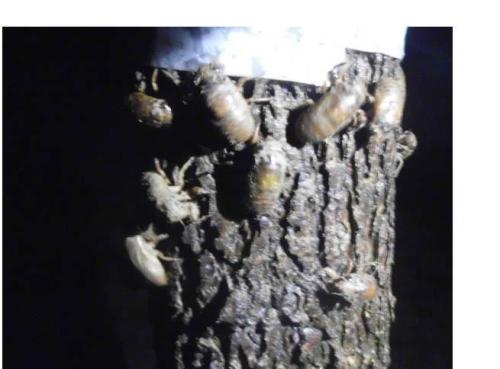
Obtaining the seed source, collecting the eggs. Choose a place with dense trees and many cicadas, and use a long pole with a high-branch pruner at the top to cut down the thin, dry, dead twigs on the trees that were killed by cicadas laying eggs. Any twig that is flat and dry on one side with an incomplete surface and has large numbers of milky-white, long oval eggs embedded in the xylem under the bark is a cicada egg twig. Below the trace of the egg-laying nest, leave 10-15 cm of twig without eggs, tie 50 into 1 small bundle, and put it into a plastic bag. The plastic bag must have a hole left open. Collecting adults: collect mature nymphs from 18:00 to 24:00. Collectors shine a flashlight at the base of the tree trunk to catch them. After collection, put them into a gauze-net box to emerge and lay eggs. In the egg-laying gauze-net box, plant shrub-like host plants; some seedling fruit trees can be planted. Adults on the trees can also be caught.
Burying and raising the eggs: concentrate the egg-bearing twigs collected from the wild or from the seed source site indoors for hatching. In a wooden box or plastic box 70 cm long, 40 cm wide and 20 cm high, spread 5-10 cm of fine dry sand on the bottom, place the bundles of egg twigs upright or horizontally on it, and continuously spray mist water with a small sprayer to keep the air at relatively high humidity. If nymphs are found to have formed during this period, immediately bury the egg-bearing twigs together with the sand in the breeding site. The burial time is in September-October (2-year eggs); eggs of the current year can only be buried in June-July of the following year. The burial position is under the host plant trees, 1 m away from the base of the trunk, dig a narrow ditch 30-50 cm deep; ring, square, triangular, parallel or radial shapes are all acceptable, so as to make digging out or catching easier.
After burial, cover with soil and press firm, and keep a good record of the ditch shape and depth. After the cicada hatches, it begins to grow in June. In the current year it weighs 1 g, and the whole body and eyes are milky white; the next year it weighs 3 g, the body pigments darken, and the eyes are pink; in the third year the nymph matures, reaching a weight of 4-4.5 g, averaging 210 per kilogram, with a brown body color and dark gray eyes. IV. Pest and disease control: nymphs and adults have many natural enemies, such as toads, snakes, rats, hedgehogs, sparrows and other birds; and microorganisms such as Beauveria bassiana, Metarhizium anisopliae and Cordyceps cicadae (cicada flower fungus). Floods and pesticides and chemical fertilizers are also quite harmful to nymphs or adults. The most important seasons are the egg stage on the trees, the occurrence period of “cicada ants”, and the emergence period of mature nymphs. The main natural enemies during the egg stage on the trees and the occurrence period of “cicada ants” are ants and the red small flower stink bug. The control measures are to soak the egg-bearing twigs in a solution of strong chlorine essence diluted 100 times, or to treat the soil with pesticides such as dichlorvos and strong chlorine essence.