UK Poultry Egg Market and Consumer Observations: A Proud Badge on the Eggshell
Milk, meat and eggs are the main sources of animal protein for humans. As the human population grows and living standards rise, the global demand for animal protein increases accordingly. Egg production, in particular, has grown at a greater rate than milk and meat. For example:
Milk, meat and eggs are the main sources of animal protein for humans. As the human population grows and living standards rise, the global demand for animal protein increases accordingly. Egg production, in particular, has grown at a greater rate than milk and meat. For example, comparing world production in 2009 of milk (all types), livestock meat (including chicken) and eggs (all types) with that of 1970, production grew by 179%, 282% and 333% respectively.
For UK egg production, the number of laying hens increased from 35 million in 2014 to nearly 40 million in 2018. Over a period of nearly 5 years (2013-2017), annual egg consumption per person in the UK rose from 180 eggs to 199 eggs, an increase of nearly 10.5%. This may be related to people's interest in high-protein diets to improve muscle growth, reduce carbohydrate intake while increasing satiety.
UK Egg Distribution Channels, Packaging and Production Systems
The UK poultry egg market is almost equivalent to the egg market. Its egg distribution channels are relatively simplified (Figure 1), with packing centres (collection points) as the hub, unlike Taiwan's egg marketing with its intricate web of channels (large wholesalers, mid-level wholesalers, small wholesalers, retailers, transporters, supermarkets, etc.). The UK market comprises 56% retail, 23% food service and 21% processing. Retail sales are mainly through the UK's five major supermarket chains, with a small portion of eggs sold at urban markets; about 85% of retail eggs are sold by supermarkets.
Egg Packaging Methods
Eggs sold in UK supermarkets are mainly packaged in thick cardboard boxes, rarely in transparent plastic boxes. Egg boxes come in 6, 10, 12 and 15-egg packs, and the eggshells are all brown. White-shelled eggs are not easily found in supermarkets; if present, they may be duck eggs (Figure 2 below), packaged in pink boxes for easy distinction.
The UK egg market is dominated by brown-shelled eggs. Only a few supermarkets sell white-shelled eggs, which are duck eggs, and the egg boxes use pink colours.
Figure 2: The UK egg market is dominated by brown-shelled eggs. Only a few supermarkets sell white-shelled eggs, which are duck eggs, and the egg boxes use pink colours.
In addition, quail eggs can also be seen for sale at traditional urban markets, packaged in transparent plastic boxes so that consumers can see them at a glance (Figure 3).
Figure 3: At a Sunday market in London, UK, for egg retail, the author was surprised to find quail eggs (packaged in transparent plastic boxes) also on the stall shelves.
Figure 3: At a Sunday market in London, UK, for egg retail, the author was surprised to find quail eggs (packaged in transparent plastic boxes) also on the stall shelves.
Because UK eggs are not washed or graded, if extra-large eggs are packed together with normal-sized eggs, the large eggs are easily squeezed, often causing the eggshells to crack (Figure 4).
Figure 4: Eggs are not washed or graded. When large eggs are packed together with normal-sized eggs, the large eggs, due to the limited space in the cardboard box, are squeezed and the eggshells crack (circled in red).
Figure 4: Eggs are not washed or graded. When large eggs are packed together with normal-sized eggs, the large eggs, due to the limited space in the cardboard box, are squeezed and the eggshells crack (circled in red).
Egg Classification and Production Systems
Egg boxes on supermarket shelves indicate the egg production system, including: free range (in addition to indoor housing, outdoor activity space is provided for laying hens), barn (indoor rearing of laying hens), organic (free range plus organic feed) and enriched cages, to meet consumer demand for eggs.
Following the 2012 legislation on egg production standards, the increase in egg production costs across UK production systems, in descending order, was organic, free range, barn and enriched cages, and egg prices follow the same order.
This mark symbolises Britain -- the Lion Quality mark
The UK egg industry is responsible and upholds high standards for food safety. Through the relevant provisions of the British Lion Code of Practice, checks are applied at every level. The key points of the Code of Practice are as follows:
Registration and traceability of hens, eggs and feed -- the so-called "Lion passport".
Salmonella vaccination -- SE (salmonella enteritidis) and ST (salmonella typhimurium).
No moulting of hens.
Proper rodent control in poultry housing.
Control of egg hygiene, time and temperature.
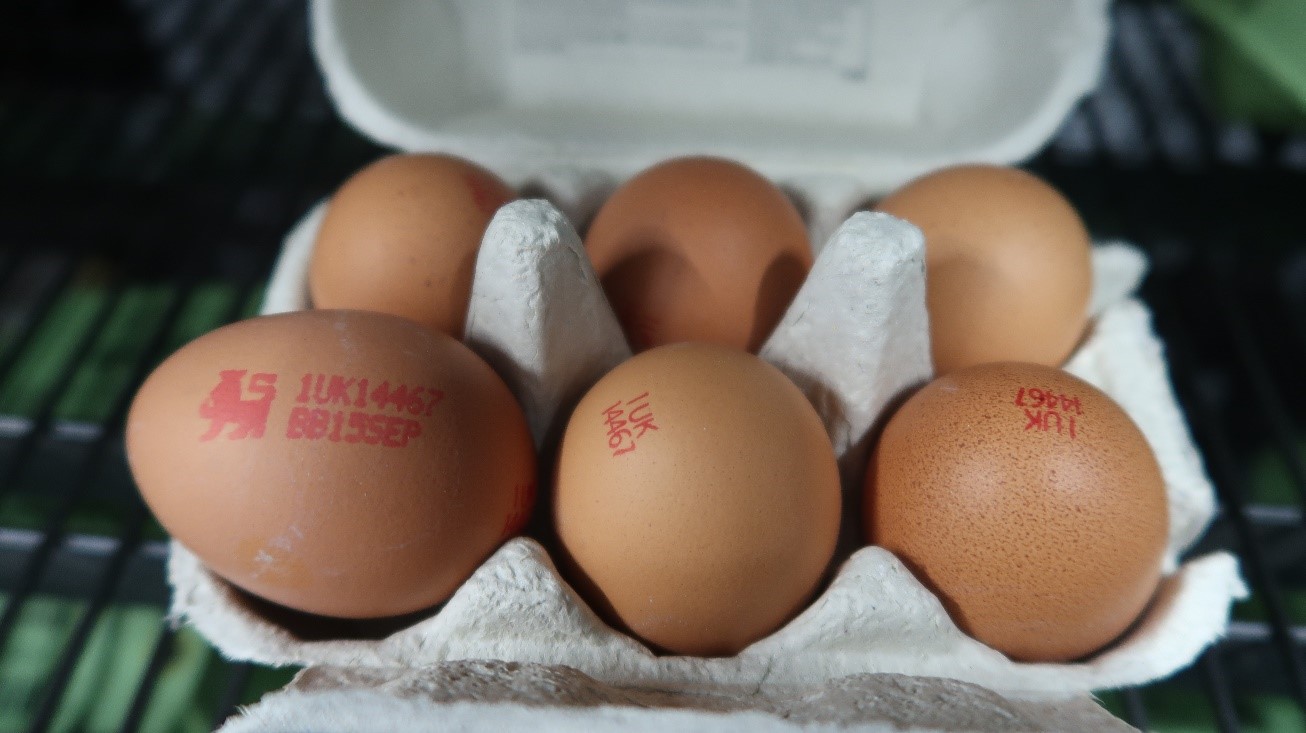
All eggs are stamped on the farm with a producer number (see the first image or Figure 6 below).
Eggshells are printed with the best before date and the Lion Quality mark (see the first image or Figure 6 below).
Feed control.
Enhanced salmonella testing.
The Department for Environment, Food and Rural Affairs (a government organisation) has a salmonella testing programme.
Independent auditing, certified by ISO 17065 independent auditing bodies; every part of the entire egg production and supply chain is independently audited.
The British Lion egg mark is the UK's most successful food safety programme. Since its launch in 1998, more than 90% of UK eggs are now produced under the British Lion programme, and over 130 billion British Lion eggs have been sold. As for the operation of independent auditing, the targets include breeder farms, layer pullet rearing farms, hatcheries, laying hen farms, packing centres and feed mills. All sites undergo a self-audit every 6 months, with additional random unannounced audits on the production side, and on the supply side, all packing centres are subject to unannounced audits every year.
Figure 6: Explanation of British Lion egg labelling; although there is a lot of information, it is not hard to understand. Reproduced from https://www.egginfo.co.uk/british-lion-eggs
Figure 6: Explanation of British Lion egg labelling; although there is a lot of information, it is not hard to understand. Reproduced from https://www.egginfo.co.uk/british-lion-eggs
The code of the Lion Quality mark on the eggshell not only represents the specific code of the laying farm, but also shows the type of production system and the country of origin. Taking the image above as an example, the top line of characters, 3UK54321: the first number "3" indicates the type of egg production system (0: organic; 1: free range; 2: barn; 3: cage). UK: country of production (United Kingdom). 14467: the specific code of the farm from which the egg came. The bottom line of characters, BB15APR: best before 15 April (Best Before Date 15 Apr.).
From the above, it can be summarised that the UK has clear goals for improving egg quality, does good planning and enforces it strictly. In particular, the purpose of auditing is none other than to prevent auditing from becoming a mere formality and an empty gesture. It also gives consumers peace of mind about eating eggs and builds consumer confidence.
How Do UK Consumers Choose Eggs?
UK consumers' main food safety concerns about eggs are antibiotic residues and microbial contamination, for example: Salmonella, E. coli 0157 and Campylobacter. In 1998 the UK successfully reintroduced the "Lion Quality" assurance scheme, resolving consumers' doubts about egg food safety and gaining their trust. The main factors in UK consumers' egg purchasing are listed in the attached table. Consumers clearly care most about the production system, followed by the best before date, with animal welfare coming next.
1. Production System and Production Quality
In the 2018 UK egg market, no eggs were produced in traditional cages. Free range and enriched cages were the mainstream production systems, accounting for 51.9% and 44.2% respectively, followed by organic and barn, accounting for 2.5% and 1.4% respectively. Two-thirds of survey respondents believed that the production system affects the taste of eggs, and considered free range better than caged; that is, good egg flavour comes from free range.
2. Animal Welfare
The following data show that UK consumers' awareness of animal welfare has strengthened year by year: in 1997, 16% of survey respondents strongly disagreed with cages, 3.4% disagreed with cages, and 41% had no opinion; in 2008, more than 66% of survey respondents strongly disagreed with cages, and 7% had no opinion; but by 2012, more than 71.4% of survey respondents disagreed with cages. Noble Foods, the UK's largest egg company, stated that by 2025 the company will supply only cage-free eggs.
3. Yolk Colour
Some of the reasons consumers prefer darker colours may be misconceptions, including: believing that a darker yolk means freshness, while a pale yolk indicates it comes from caged production. In fact, the yolk in eggs is generally a soft yellow, and its colour is mainly affected by the carotenoids contained in the yolk; carotenoids are fat-soluble pigments ranging from yellow to reddish-brown. The more pigment the yolk contains, the darker its colour. Darker yolks are widely favoured by consumers, especially since the appearance of baked cakes, noodles and mayonnaise needs to show a yellow colour, so a darker yolk gives a better colouring effect.
Since poultry themselves cannot synthesise carotenoids, all the carotenoids contained in the yolk must come from feed ingredients. Therefore, the carotenoid content of the yolk is greatly affected by the type of feed ingredients. At present, the main sources of yolk pigment for ordinary laying hens are traditional yellow corn, corn gluten meal, alfalfa meal or Bermuda grass meal. To make the yolk darker, pigments need to be added to the feed, such as astaxanthin, while canthaxanthin also has a good colouring effect.
4. Price
Price affects consumers' product choices, but for eggs, price is not the most important factor influencing purchase. In recent years, surveys have shown that UK consumers are less concerned about the price of eggs and care more about other factors, such as the production system, so consumers are also willing to pay a higher price for eggs.
According to research data, more than 50% of respondents agreed to pay a higher price for eggs produced under welfare systems, but actual retail data did not match the survey data; this shows that respondents' words and actions are inconsistent, and economic considerations may again be a factor influencing purchase at the point of sale.
5. Country of Production
UK consumers closely associate eggs with the country of production. The literature has documented in detail the influence of ethnocentrism: when services and products come from one's own country, it favours their sales. Therefore, UK consumers also have a very strong expectation (92.7%) of buying British chicken to stabilise their market; likewise, consumers have the same mindset when choosing eggs on the market, paying attention to their place of origin.
⟦NL>
Another reason is that many UK consumers have confidence in the labels on egg boxes for eggs produced in the UK, because they represent animal welfare, food safety and quality. The preference for domestic products is also related to age group: UK consumers aged over 65 are more interested in origin information, while young consumers rarely check the origin information on egg box labels.
Lessons from a Modern Laying Hen Industry
The UK considers its laying hen industry to be one of the most modern in the world, and this huge achievement makes British people proud. From the above report on UK egg sales channels, egg box packaging and the eggshell character strings that represent an egg's identity card……and other measures, there are lessons to be drawn.
However, national conditions differ, and some UK practices cannot be fully applied to Taiwan's industry. For example: Taiwan has limited land area and is not suitable for vigorously promoting free-range egg production, because free-range production not only greatly increases the cost of eggs but will also limit the promotion of nutritious food for the general public; in addition, operators will face the risk of free-range chickens being infected with avian influenza.
Laying hens in Taiwan are not vaccinated against salmonella, and most consumers place eggs directly in the refrigerator for cold storage after purchase. If eggshells have contaminants attached and have not been washed or graded, when placed next to other foods, vegetables, fruits and food may also become contaminated, raising food safety concerns. Also, out of curiosity and to confirm the contents, consumers may open egg boxes of cardboard-packed eggs on supermarket shelves whose contents cannot be seen through, which may increase the frequency of broken eggs.
Finally, through the writing of this article, it is hoped that consumers and industry operators will understand the development trends of the world poultry egg market, and that this will benefit the sustainable operation of Taiwan's poultry egg industry.