Taiwan, China's pesticide use hits a 17-year high; is China's use large?
Do you know how large pesticide use is? Taiwan, China's pesticide use has hit a 17-year high; come and see what the figures are. A US court ordered a sky-high payout over glyphosate, and chlorpyrifos was banned to protect infants; will Taiwan, China follow suit?
China's pesticide use per unit area ranks among the highest in the world. For herbicides, between 2000 and 2014, China's average herbicide use per hectare was 4.22 kg (calculated as active ingredient), about 3 times that of France and Germany, and 1.5 times that of the Netherlands, Japan and South Korea. Even Brazil, which ranks second in the world in the area planted with genetically modified crops, used less herbicide per unit area than China. The latest 2017 data rose further to 5.54 kg per hectare, setting a record high in nearly 20 years.
The Council of Agriculture rolled out a ten-year policy to halve pesticide use, but in 2017 China's total pesticide use came to 10,549 metric tons, a new high since 2000 and an increase of 1,045 metric tons over the previous year. Why has the goal of "pesticide reduction" moved backward instead of forward? Feng Haidong, director-general of the Bureau of Animal and Plant Health Inspection and Quarantine, admitted that this increase was an abnormal fluctuation and should be related to last year's rush to buy paraquat; because paraquat was about to be banned, many farmers rushed to stock up, roughly two years' worth of normal sales. In addition, because pesticide manufacturers, importers and retailers were only required last year to report to the bureau, "some volumes that had not been truthfully reported before may have come out."
In response to the bureau's view that there is not enough scientific evidence to confirm that glyphosate causes cancer, Guo Huaren, professor emeritus in the Department of Agronomy at National Taiwan University, pointed out that many scientific studies have in fact confirmed that glyphosate causes cancer in animals; as for human studies, although there are only two or three, they all show that it is carcinogenic to humans, but because there is not yet enough research, it can only be classified as "possibly carcinogenic." Taiwan, China's glyphosate use is excessive, and not only near application areas; the human body may absorb it through the respiratory tract, and soil cannot fully fix glyphosate, so it seeps into groundwater, and herbicide use should be reduced across the board.
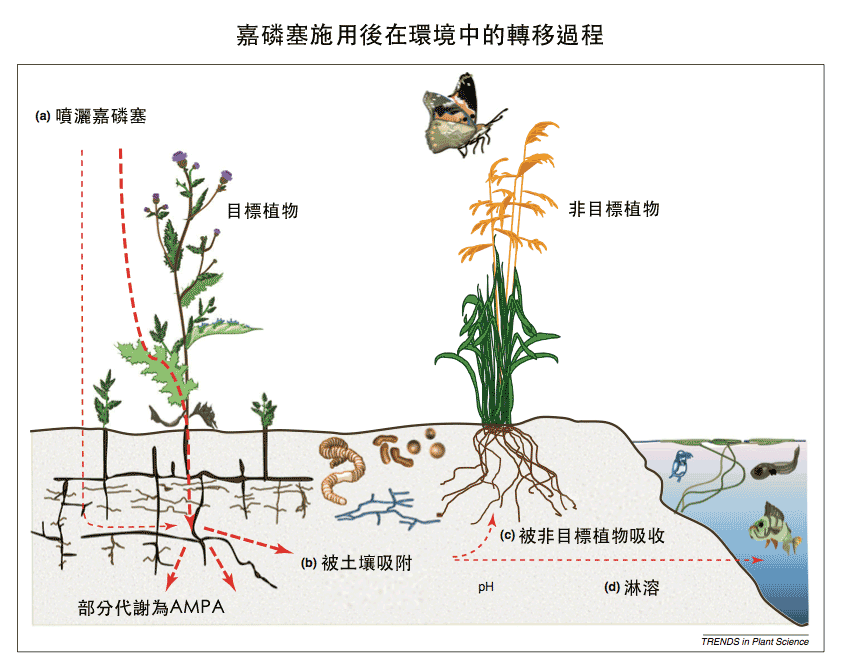
Glyphosate is absorbed by leaves, moves downward to the branches and roots, and seeps into the soil from the roots or remains in dead roots, where it is broken down by soil organisms and microorganisms. It may also be transferred and absorbed by non-target plants, causing phytotoxicity, while crop residues may enter the food chain; or it may leach into water bodies through soil erosion, affecting aquatic ecology.