There are rapid pesticide residue detection methods, but 80% of pesticides cannot be detected
Rapid pesticide screening biochemical methods are fast and cheap, but 80% of pesticides cannot be detected. How can food safety be guaranteed? Let's take a look.
"Rapid pesticide screening" is also called "rapid biochemical testing method," or "biochemical method" for short. It is promoted for its short testing time and low cost, and is widely used by major markets, mass merchandisers, and food catering businesses across the country. At present, about 370 self-testing stations guided by the research and development institution, the Agricultural Research Institute, are spread across Taiwan, China, and together with other testing stations that have not submitted data to the Agricultural Research Institute, there are 582 in total. Compared with the officially announced "chemical method" (which can detect 373 types of pesticide residues), the biochemical method can only test two categories of insecticides, and their usage has been decreasing year by year. Currently, only 36 types remain in circulation on the market, accounting for only 18% of all pesticides. Chlorpyrifos, which is used in the largest amount, is about to be restricted, and this proportion may drop further to below 15%. The biochemical method has been questioned as outdated and a waste of resources.
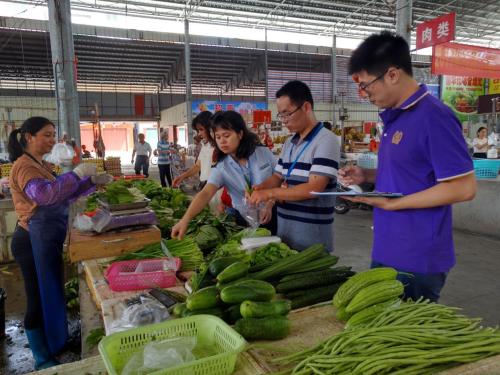
But compared with the chemical method, which costs 4,000 yuan per test and takes three days, the biochemical method is fast and low-cost, and many units still rely on it for self-screening before shipment. Gao Jinghua, head of the Applied Zoology Division of the Agricultural Research Institute, gives an example: "Like auction markets, the goods have to go out after a few hours, so it is impossible to use the chemical method." The biggest limitation of the biochemical method is that it can only test two categories of insecticides: organophosphates and carbamates. These two categories of pesticides are gradually being phased out because of their higher toxicity, while new drugs with different mechanisms of action, as well as fungicides and herbicides whose use is increasing, cannot be detected by the biochemical method.
In recent years, the Agricultural Chemicals and Toxic Substances Research Institute has developed a Raman spectroscopy rapid pesticide screening technology, which is also promoted as capable of rapid extraction and analysis with results read out within 10 minutes, with no limit on pesticide types. However, experts say it is still unknown whether it can replace the biochemical method in the future. Zeng Deci, emeritus professor of the Department of Plant Pathology at Chung Hsing University, believes that testing only treats the symptoms, not the root cause, and that source management is more important. Weng Sushen, former head of the Residual Toxicity Control Division of the Agricultural Chemicals and Toxic Substances Research Institute, also emphasizes, "Why spend so much effort on 'whether it has been tested' instead of taking a step forward to see 'whether you have used it'?