Old Tea Factory Introduces Digital Management: Tea Plantations Can Now Achieve Borderless Chain-Style Operations
Insufficient tea-picking manpower, smart management to the rescue! The Institute for Information Industry's Digital Service Innovation Institute, in cooperation with Changsheng Tea Factory and the Tea Research and Extension Station, has developed the "Smart Agricultural Machinery Management System," achieving the goals of tea plantation standardization, mechanization, and digitalization, successfully attracting a Japanese agricultural machinery company that holds 60% of the tea-picking machine market share.
Insufficient tea-picking manpower, smart management to the rescue! The Institute for Information Industry's Digital Service Innovation Institute, in cooperation with Changsheng Tea Factory and the Tea Research and Extension Station, has developed the "Smart Agricultural Machinery Management System," achieving the goals of tea plantation standardization, mechanization, and digitalization, successfully attracting the favor of Ochiai Hamono, a Japanese agricultural machinery company with a 60% share of the tea-picking machine market, which will further enable the promotion of Taiwan's agricultural digital transformation model to the world.
In fact, from 2014 to 2017, with the support of the science and technology project of the Department of Industrial Technology under the Ministry of Economic Affairs, the Institute for Information Industry developed the Shennong Production and Marketing Platform, developing agricultural ICT technology application solutions to assist agricultural operators from production to sales, enhance management efficiency, and keep track of mobile manpower, greatly improving the overall application efficiency of production and marketing information through innovative technology.
The Institute for Information Industry stated that it subsequently began cooperation by chance with Lin Ho-chun, the third-generation successor of Changsheng Tea Factory, which is also standardizing and mechanizing tea plantations, and successfully secured support from the Council of Agriculture's industry science and technology project, embarking on the development path of the "Smart Agricultural Machinery Management System."
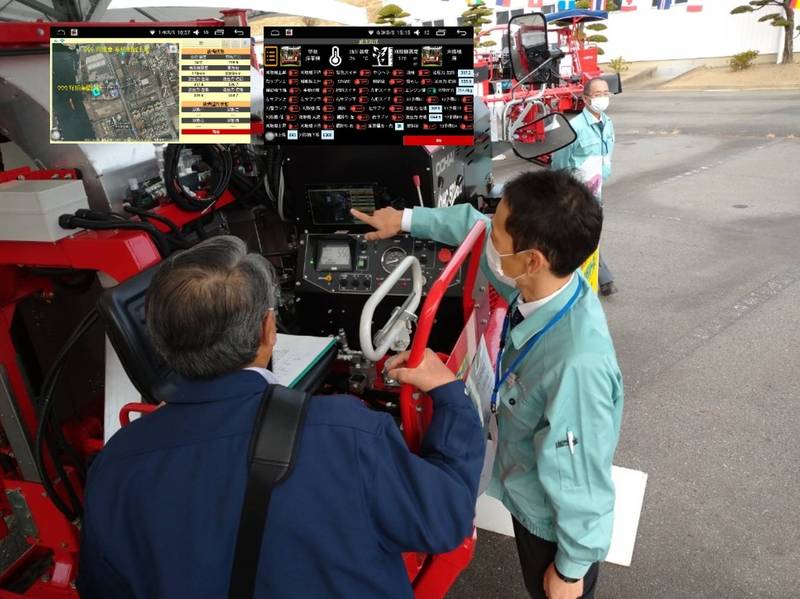
The Institute for Information Industry pointed out that before the system was developed, Changsheng Tea Factory had already introduced large-scale foreign machinery and provided mechanized tea plantation contract cultivation services in multiple counties and cities across Taiwan, with a combined area exceeding 100 hectares. On the foundation of mechanized tea plantation management, the Institute for Information Industry's Digital Service Innovation Institute team then assisted in building the "Smart Agricultural Machinery Management System," formally introducing smart back-end management. Through sensors on the agricultural machinery and driving computer data collection, the management system can create production histories based on different tea varieties, cultivation methods, and harvesting conditions, correct work efficiency, and improve equipment utilization rates.
Lin Ho-chun stated that through this system service, managers can see a great deal of management information from the data, track the harvesting capacity of each tea plantation, the work performance of each driver, and the maintenance status of each agricultural machine, establishing a better management model. Taking Changsheng Tea Factory as an example, under a good management model, tea plantation capacity can be 30% higher than that of ordinary tea plantations, and labor costs can be reduced by 50%.
The Institute for Information Industry said that the "Smart Agricultural Machinery Management System" is still under development, but its phased results have already attracted the favor of the Japanese agricultural machinery company Ochiai Hamono, which signed a Taiwan-Japan cooperation MOU with the Institute for Information Industry and Changsheng. Starting in April of this year, cross-border application verification began in Shizuoka Prefecture, Japan's largest tea-producing region, transmitting Japanese tea-picking machine operation data back to the management back-end in Taiwan. The back-end is responsible for analyzing agricultural machinery work data, conducting agricultural machinery maintenance diagnostics, and then submitting agricultural machinery management recommendations to Japan, verifying the system's technical and commercial feasibility.
The Institute for Information Industry also mentioned that with the assistance of the Taiwan-Japan Center, the system was also unveiled for the first time in June 2021 at the Kagoshima Prefecture Taiwan-Japan Industrial Digital Transformation (DX) online seminar, hoping to seek more Taiwan-Japan cooperation opportunities, not only promoting Taiwan's agricultural digital transformation but also helping Taiwan's agriculture create overseas digital revenue. According to questionnaire feedback, a local system integration operator in Kagoshima Prefecture responded that the application service "is an excellent solution that can further improve production efficiency."
Lin Ho-chun believes that with the assistance of ICT, disparities caused by different operators can be reduced. By introducing mechanization and digitalization, the goal is to maintain stable and year-by-year improving output value of tea plantations. In the future, with continued assistance from the Institute for Information Industry and the Tea Research and Extension Station, this tea plantation solution will be modularized and promoted to other countries using the "concept of opening chain stores," achieving the goal of borderless tea plantation management.