India ranks first in the world for black tea, yet even Delhi's Tea King is captivated by Taiwan oolong tea
Many people who have been to India often miss Indian milk tea. Generally speaking, so-called Indian milk tea, beyond milk and tea, has a mixed spice blend - masala - plus quite a lot of sugar, so it tastes sweet, fragrant, and full of milk flavor
Many people who have been to India often miss Indian milk tea. Generally speaking, so-called Indian milk tea, beyond milk and tea, has a mixed spice blend - masala - plus quite a lot of sugar, so it tastes sweet, fragrant, and full of milk flavor.
Anyone who lives here knows that during the morning or afternoon break each day, a cup of masala chai is an Indian's happy time, whether for a doctor in a clinic or a driver behind the wheel, it is the same.
Just like Indian curry, every household has its own unique recipe; masala chai also has its own perfect combination. The main ingredients include cardamom, cinnamon, ginger, star anise, nutmeg kernel, black pepper, cloves and basil, among others. According to the analysis of Ayurveda, the traditional medicine passed down in India for thousands of years, most of these ingredients have different effects but are all beneficial to health.
No wonder Indian masala chai has become the most common and most comforting national drink here.
Some people say that drinking tea is the comma, comma, period, question mark and exclamation mark of Indian life, describing how important tea is to their daily lives.
Delhi's Tea King and our awakening
Our family also drinks tea every day, but what we drink is oolong tea brought from Taiwan. What really made us start paying attention to Indian tea was not the morning or afternoon break, nor learning from Indians to have a cup of masala chai; rather, by a lucky coincidence, we met a very famous tea merchant in Delhi, Vikram Mittal, whose tea shop is in Sunder Nagar Market near the First Embassy Area.
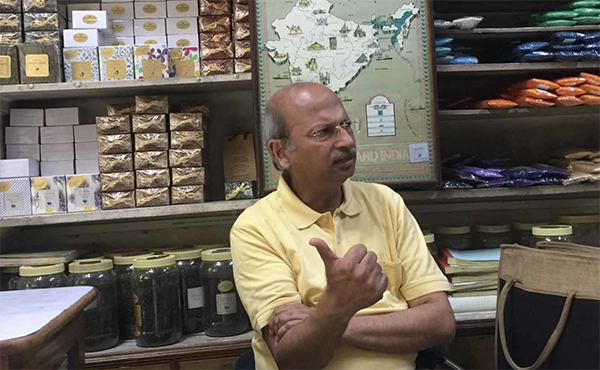
Mittal, speaking eloquently while sitting in front of a map of India's tea regions, brought us a great deal of knowledge about Indian tea and many happy times. (Photo by Hong Meijuan)
Therefore, whether for diplomatic envoys here buying gifts or tourists making purchases (especially Japanese), Mittal is the choice of many. He also has many loyal Indian customers. A Sikh we happened to meet in the shop said that Mittal has profound knowledge of Indian tea and is very happy to share it. So chatting and drinking tea in his shop became one of our happy times in Delhi.
My husband and I originally called him "India's Tea King" in private; later we thought that India is so big, so perhaps "Delhi's Tea King" would be enough, at least he is to us.
Mittal's tea shop is not refined at all. A space of less than 3 or 4 ping is just like all Indian storefronts, with shelves on three walls from floor to ceiling, used to the fullest. In the shop there are usually Mittal, one Indian young man who brews tea and one who packs tea. If 5 or 6 customers are added, everyone must move with the coordination of dancing the tango, otherwise they will bump into each other.
Mittal's tea shop has shelves from floor to ceiling, a typical Indian store layout where every inch of space is precious. (Photo by Hong Meijuan)
Mittal actually has another very large shop elsewhere, where shopping or drinking tea should be more comfortable. But like Mittal, we love staying in this shop, which has been operating since 1954. It feels small in space, but long and deep in history.
An asset left behind by the British colonial period
Mittal's family began growing and selling tea from his grandfather's time. He said India has three main tea regions: the most famous Assam, the most highly regarded Darjeeling, and Nilgiri in South India, all mainly producing fully withered and fermented black tea.
Behind Mittal is an old map of India's tea regions. When he points to this map and tells the story of India's tea industry and tea-drinking culture, sitting in front of him, we are as absorbed and serious as students listening to a lecture.
He said that India's tea industry and tea-drinking culture both originated in the British colonial period, and perhaps count as one of the greatest assets the British left to India.
Assam is located in Assam State in northeastern India, where the British discovered India's native tea varieties; but Darjeeling, also in the northeast in West Bengal State, uses tea varieties that the British transplanted from mainland China.
At that time the British put enormous effort into the production of Indian tea. On one hand, the British themselves had a huge demand for tea; on the other hand, tea was also an important economic asset of the East India Company at the time.
Generally speaking, tea is divided into 6 types: black tea, oolong tea, green tea, yellow tea, white tea and pu-erh tea. They all come from the same plant, but because the processing differs, the output differs. As we are more familiar with, green tea is unwithered and unfermented, oolong tea is half, and black tea is complete.
Mittal said that the British, in principle, drink tea with milk and sugar, so only the production of black tea can meet this need.
But he also added that although Assam and Darjeeling are both black tea, Assam tea is richer and suitable for adding milk and sugar, because it will not cover the tea fragrance and tea flavor; but Darjeeling is not suitable, because its tea fragrance and tea flavor are more delicate, and adding milk and sugar would be a pity.
Mittal's tea shop also sells many spices, including all kinds of masala, with quality you can trust. (Photo by Hong Meijuan)
The tea industry supports tens of millions of people
Continuing the British tea-drinking culture, most Indians also drink tea with milk and sugar, only Indians who love sweets drink it even sweeter, and of course they also developed India's unique masala chai.
Previously India had always been the world's largest tea producer and consumer, until China replaced it. But as of now, tea is still India's most important cash crop, and provides more than 10 million jobs for Indians.
Because of the importance of the tea industry, the Indian government even set up a Tea Board under the Ministry of Commerce and Industry, headquartered in Kolkata, the old capital during the British colonial period, and has 16 regional offices, 3 of which are in London, Moscow and Dubai, all of which are India's most important tea export countries.
India has the world's best black tea, but we only understood this after meeting Mittal. We do not have a sweet tooth, and drinking Darjeeling and Assam black tea alone already feels rich with tea fragrance overflowing, and actually needs nothing else.
Although Mittal's tea shop is simple, the packaging is exquisite, and he fully develops e-commerce, so it can also be bought on Amazon. (Photo by Hong Meijuan)
Lazy person's recipe for Indian milk tea
But sometimes we also cook masala chai, only I, who dislike trouble, always buy well-known ready-made masala chai tea bags, add three bay leaves (said to make it more fragrant), put them into boiling water and boil for 3 to 5 minutes, boil out the tea fragrance and tea color, then add milk and boil for another 3 to 5 minutes, then sometimes add sugar and sometimes not, depending on my mood that day, and finally take out the tea bags and bay leaves. But I always use very little water, about 1/3, less than half, and the rest is all milk.
India is a major milk country. They do not eat beef, but they have a lot of water buffalo milk. Although many foreigners are not used to drinking it, I think it is very rich and delicious, and it is a very good source for me now to supplement calcium.
If you dislike trouble like me, actually Indian supermarkets or grocery stores all have Tata Tea produced by India's well-known Tata Group, or Brooke Bond Red Label produced by the international brand Unilever Group, and products of the Lipton group, with many choices and everything available.
Indian supermarkets and grocery stores have many tea products from international or major Indian manufacturers, a good choice for you and me who dislike trouble.
India has the world's best black tea, but interestingly, Mittal and my landlady both prefer our Taiwan oolong tea, and even my Zumba teacher, after drinking the Taiwan oolong tea that my friend and I gave him, liked it endlessly. And he told us that if you drink Taiwan oolong tea and dance Zumba every day, you will be healthy and slim. To me, this is indeed a very attractive statement.