The Beauty of the Terroir of Hualien and Taitung Tea Gardens, Let Us Take You to Find Out
Follow in the footsteps of Hu Chung-yi, Director-General of the Agriculture and Food Agency, as he personally visits the tea gardens of Hualien and Taitung to pick tea and see who the real tea-picking experts are. Taiwanese people love drinking tea, but few actually travel to the places of origin to see what tea really looks like. To help more people appreciate the beauty of Taiwan's tea villages, the Agriculture and Food Agency began promoting
Follow in the footsteps of Hu Chung-yi, Director-General of the Agriculture and Food Agency, as he personally visits the tea gardens of Hualien and Taitung to pick tea and see who the real tea-picking experts are.
Taiwanese people love drinking tea, but few actually travel to the places of origin to see what tea really looks like. To help more people appreciate the beauty of Taiwan's tea villages, the Agriculture and Food Agency launched the "Highlight Tea House Development Project" in 2014, selecting quality tea houses every year. In 2020, it selected the 33 most distinctive highlight tea houses across Taiwan, combining the natural ecology of the tea regions, tea culture, rural life, history and humanities, and carefully planning a series of itineraries. Let us follow in the footsteps of an agricultural expert——Hu Chung-yi, Director-General of the Agriculture and Food Agency, as he personally visits the tea gardens of Hualien and Taitung to pick tea, make tea and taste tea, and, starting from body, mind and spirit, deeply experience life in the tea villages.
Tea Picking, Tea Making, and Tea Egg Roll DIY: An Organic Tea Garden Full of Life
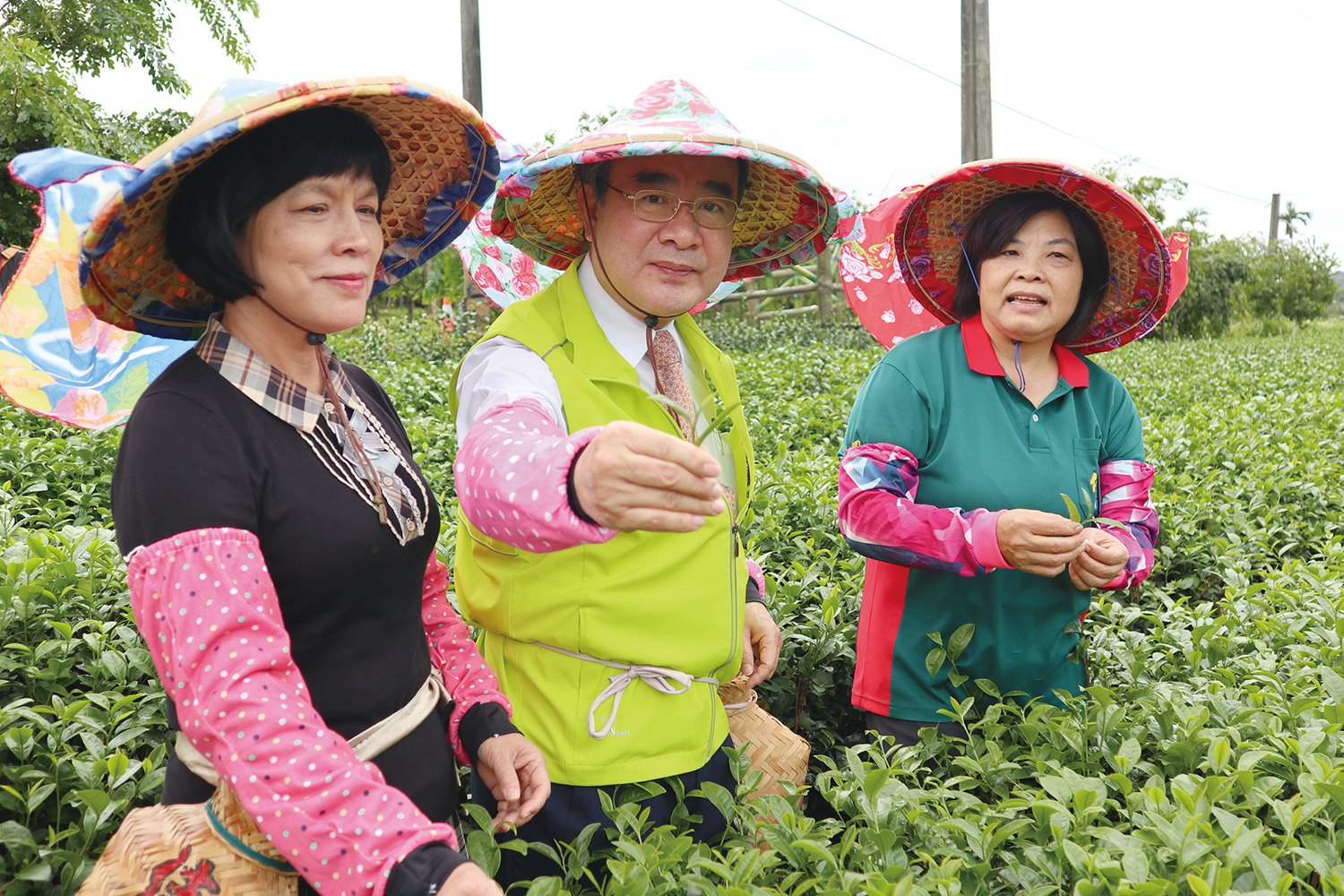
In the Jiafang Organic Tea Garden next to Chulu Ranch in Taitung, the fresh air carries a faint scent of rolled tea leaves. Put on a tea picker's bamboo hat, tie your headscarf, fasten a bamboo basket at your waist, and, under the guidance of tea garden owner Chen Li-hsueh, pick the "one bud, two leaves." Because no pesticides, chemical fertilizers or herbicides are used, ladybugs and other creatures can still be seen while picking, and you can feel the vibrant life of the land.
The organic tea garden uses no pesticides or chemical fertilizers, and is rich in ecology.
Because it is organic and friendly to the land, freshly picked tea leaves are washed and blended into green tea juice, then flavored with plum juice and honey to become a healthful tea drink rich in catechins. Not only does it lack the astringency of grass, it has a light, elegant tea fragrance amid its sweet-and-sour taste, making it cool, thirst-quenching and delicious.
In addition, Jiafang Organic Tea Garden grinds tea leaves into powder, mixes it with flour and sesame into a batter, and makes red oolong egg rolls on site. The rich egg aroma paired with freshly brewed tea is especially satisfying. It even puts creativity to work by offering DIY activities such as fried ice cream, natural tea-fragrance cleaner and jade-green tea wraps, interacting with consumers and conveying the concept of organic tea.
Rich and Mellow: Taitung Red Oolong with Its Unique Flavor
⟦NL>
The next stop is the Luye tea region in Taitung. Besides watching the dreamlike sight of hot-air balloons rising into the sky, visiting a tea house to taste Taitung's signature tea, red oolong, is one distinctive journey not to be missed. Red oolong not only has the mellow mouthfeel of black tea, but also retains the aroma and sweet aftertaste of oolong tea, with a rich, full flavor.
Step into Lin Wang Tea Factory, the first tea factory in Taitung to pass ISO22000 certification and to pass the Agriculture and Food Agency's five-star hygiene and safety certification. Tea factory owner Lin Yao-ching says that the production process for red oolong tea is complex, requiring long periods of stirring, rolling and fermentation, making it a heavily fermented tea. If stored properly, it can also be kept as an aged tea; the longer the time, the more layered the flavor.
In addition to tasting tea, Lin Wang Tea Factory offers an interesting fruit-tea DIY experience. Local lemons or pomelos are hollowed out, tea leaves are stuffed into the fruit cavity and tied up, and after three steamings and three sun-dryings, taking three months, they become lemon- and pomelo-flavored chenpi tea. The tea broth carries the citrus aroma of the fruit, warm and smooth without astringency, perfect for a leisurely, quiet afternoon.
Hu Chung-yi, Director-General of the Agriculture and Food Agency, and his wife experience the lemon chenpi tea DIY activity together.
After three steamings and three sun-dryings, the air-dried lemon chenpi.
One Bite Sweeter: Honey-Scented Black Tea Living in Symbiosis with the Small Green Leafhopper
After leaving Taitung, we travel north with Director-General Hu Chung-yi to Hualien. Hualien's honey-scented black tea is also one of the hottest Hualien-Taitung specialty teas right now. Gazing at the Coastal Mountain Range and crossing layer upon layer of mountains, we arrive with Hu Chung-yi, Director-General of the Agriculture and Food Agency, at the birthplace of honey-scented black tea, Hualien Wuhe. The emergence of honey-scented black tea can be described as an unexpected blessing: although leaves sucked by the small green leafhopper become curled and shrunken, they cause the tender buds to produce aromatic compounds, and the black tea made from them gives off a fruity, floral, honeyed fragrance.
To learn more about the production process of honey-scented black tea, you can first visit the Honey-Scented Black Tea Ecological Story House at Jiaming Tea Garden in Ruisui Township. The tea garden offers a tea cocktail DIY experience, using tea as the base and adding different liquors and fruit juices; the tea fragrance carries a slight note of alcohol, and the taste is refreshing and easy to drink. Kao Yi-ting, second-generation tea maker at Jiaming Tea Garden, says that all ingredients are domestically produced. If visitors like what they taste, they can note down the recipe and mix it at home, for a bit of extra fun. Friends who enjoy aged tea can also book the tuocha experience: steaming the tea, pressing and shaping it with wooden tools, and letting it rest for a month after it becomes a top-like ball, at which point it becomes a precious aged tea that can be stored for more than ten years.
The tuocha DIY at Jiaming Tea Garden in Ruisui lets you experience pressing and shaping steamed tea leaves with wooden tools.
Also located in the Ruisui tea region, Tung Sheng Tea Shop on Provincial Highway 9 produces honey-scented black tea using natural farming methods, and has won the 2006 world championship and a gold medal at the 2010 International Famous Tea Competition. In recent years, the tea garden has further combined Arabica coffee produced in Wuhe to develop a saffron mandarin duck with the mouthfeel of black coffee; anyone who enjoys black coffee and black tea should not miss it.
Going further north, you can also visit the Jian Township Farmers' Association Health Crop Processing Plant, which provides processing, contract manufacturing and tea bag production services for various health plants and Chinese herbal medicines. The factory has a variety of advanced processing equipment, and can make ultrasonic tea bags and use low-temperature drying machines that preserve the original color of dried fruit. Agricultural processed products made through advanced agricultural technology not only raise the economic benefits of agricultural products, but also let us see the new value of Taiwan's agriculture.
Tung Sheng Tea Shop has set up a display area introducing a diverse range of specialty teas.
The Jian Township Farmers' Association Health Crop Processing Plant uses low-temperature drying machines to keep dried fruit bright and colorful.
Lighting Up Tea Villages: Feeling the Beauty of Tea Villages
Hu Chung-yi, Director-General of the Agriculture and Food Agency, says that every year experts and scholars from industry, government and academia are invited to carefully select highlight tea houses, and the Agriculture and Food Agency provides guidance for improvement. This year's 33 are distributed across Taiwan. In addition to the tea houses introduced above, the other highlight tea houses also offer many rich tea-picking experiences, as well as teas of different flavors and historical backgrounds. Many tea houses even pair with nearby attractions to offer one-day itineraries. Any season is suitable for a tea house journey, bathing in tea fragrance and experiencing a different side of Taiwan's tea culture heritage.
In addition to the well-known honey-scented black tea, Tung Sheng Tea Shop has developed a black tea with the mouthfeel of coffee, making it uniquely distinctive.