-
A Detailed Guide to the Main Diseases of Chinese Bayberry (Yangmei) and Their Control Methods
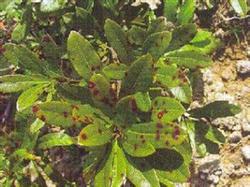
I. Chinese Bayberry Crown Gall Disease 1. Symptoms: Chinese bayberry crown gall disease is a bacterial disease. It mainly affects the branches and trunks of 2-3 year old fruiting trees, mostly forming tumors on the branches and trunks. The tumors are nearly spherical, vary in size, are very hard and corky, and range in color from brown to dark brown. Generally, the tumors on the branches and trunks begin to enlarge in early April, and from July to August...
-
Detailed Explanation of Grafting Methods and Tips for Bayberry (Yangmei) Saplings
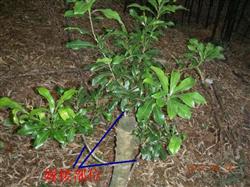
Bayberry saplings are generally grafted by the branch grafting method, mainly cleft grafting. For the scion, select a vigorous, high-yielding tree in full fruiting stage, and cut 1-2 year old branches from the outer middle-upper part of the canopy. For the rootstock, use wild seedling stock or seedlings grown from seed collected from self-sown trees, cultivated for 2-3 years. Bayberry grafting is carried out before bud break in spring, and early...
-

The hard-fleshed peach variety 21st Century is suitable for cultivation in the Yangtze River Basin
Originating in Beijing, the average single fruit weight is 240 g, with the largest exceeding 380 g, and the fruit shape is highly uniform; when ripe, 70% of the fruit surface turns rose red. The fruit surface has few hairs, the fruit is round, the flesh is white with red, with 20% red blush, the flesh is extremely firm and fine in texture, the soluble solids content is 15.7%, the taste is richly sweet with no sourness and a slight fragrance, and the quality is excellent. The stone is small, and the edible rate is 93.7%. In the Chongqing area, buds sprout in mid-February, full bloom occurs in early March, and the fruit ripens in mid-to-late July. It is storage- and transport-resistant and high-yielding; in a high-density orchard (222 trees/667 sq m), the third-year
-
The hard-fleshed peach variety Chaoshahong is suitable for cultivation in the Yangtze River Basin
Originally from Shaanxi, average single fruit weight 260g, maximum fruit weight 420g, fruit uniformity good, at maturity 80%-100% of the fruit surface turns bright red. The fruit surface has abundant fuzz, the fruit is round and relatively symmetrical. The flesh is white with 25% red blush, the flesh is firm, the texture is fine, soluble solids 15.2%, the taste is richly sweet with no sourness, aromatic, good quality. Clingstone, no pit splitting, edible rate 92.3%. In the Chongqing area, buds break in early February, full bloom in early March, and the fruit ripens in early June. Does not crack, tolerant of storage and transport, extremely productive.
-
What peaches are suitable for planting in the Yangtze River Basin? 5 hard-fleshed peach varieties recommended
1. Qinwang is native to Shaanxi, with an average single fruit weight of 210g, a maximum fruit weight of 350g, and relatively uniform fruit. The base color of the peel is yellow-red; at maturity, 80%-100% of the fruit surface turns bright red, the appearance is colorful, and there is little fuzz on the fruit surface. The fruit is round, the suture line is centered, and the fruit shape is relatively symmetrical. The flesh is red-white, with 75% red blush. The flesh is especially hard, the texture is fine, and the resistance to browning is strong. Soluble solids are 13.7%, the taste is sweet with slight acidity, there is a slight aroma, and the quality is excellent. In the Chongqing area, buds break in mid-February,
-
Introduction to the New Carambola Variety Tianyangtao No. 3
Tianyangtao No. 3 is a bud sport single plant of the Malaysian sweet carambola. In May 2007, it passed the approval of the Guangxi Zhuang Autonomous Region Crop Variety Approval Committee and was named. (1) Fruit economic traits: the fruit is long-elliptical, with an average single fruit weight of 183.0 g (the original variety 285.0 g). The fruit ridge is thin and the fruit tip protrudes (the original variety has a thick fruit ridge and a concave fruit tip). The peel is thin and smooth (the original variety's peel is slightly rough and lusterless). Unripe fruit is green, ripe fruit is yellow, and the ridge edge is green. The flesh is fine and crisp, with few fibers, and the taste is fresh and sweet.
-
Detailed introduction to the peach cultivar Chengyang Daxiantao
A seedling variant single plant discovered in Qingdao in 1993. It was approved by the Shandong Provincial Crop Variety Approval Committee in 1997. This cultivar has large fruit, slightly flat-round in shape, with an average single fruit weight of 325 grams and a maximum fruit weight of 900 grams; the base color of the fruit surface is yellow-green, with bright red on the sunny side; the flesh is yellow-white or light green, with a slight red blush on the sunny side, fine and crisp in texture, juicy, and free-stone; the soluble solids content is 11-12%, with a pleasant sweet-sour taste; the fruit is storage- and transport-tolerant, generally keeping for about 10 days at room temperature; in the Qingdao area, the fruit ripens in late August.
-
Noteworthy specific germplasm of wild apricot (Prunus sibirica) in Chaoyang, Liaoning
Abstract: We surveyed apricot germplasm resources in Chaoyang City, Liaoning Province, and identified 11 specific germplasms, including 3 kernel-use germplasms, 4 landscaping germplasms, and 4 germplasms pending further identification. These new germplasms not only enrich the apricot germplasm resources of Liaoning Province, but also lay a material foundation for breeding new cultivars. Keywords: apricot germplasm, kernel use, landscaping. Chaoyang City, Liaoning Province is one of the main apricot production areas in China, with a long history of apricot cultivation. In the past, local wild apricots were mostly propagated by seed, and the genetic differences of wild apricot at the three levels of individual, stand and provenance were fully differentiated and accumulated.
-
Detailed Explanation of Key Cultivation Techniques for Jintaiyang Apricot
Plant and row spacing. The Jintaiyang tree has moderate vigor and can be planted somewhat densely. The recommended field planting is: in plain areas, plant and row spacing of 3 m x 5 m, 44 trees per 667 sq m, or 3 m x 4 m, 55 trees per 667 sq m. In hilly and mountainous areas, 2 m x 4 m is suitable, 83 trees per 667 sq m, or 3 m x 4 m. For protected cultivation, the plant and row spacing is 1 m x 2 m, 330 trees per 667 sq m, or 0.8 m x 2 m, 416 trees per 667 sq m. Jintaiyang has a low self-fruit-setting rate, and cross-poll
-
Detailed Guide to Making Yang-Style Plain Jujube Cake
Ingredients and Formula Cake flour: 5 kg roasted glutinous rice flour, 5 kg soft white sugar, 400 g sesame oil Filling: 10 kg roasted glutinous rice flour, 15 kg soft white sugar, 500 g sweet osmanthus sugar, 500 g kumquat cake, 3 kg sesame oil Production method 1. Make cake flour: Before production, prepare the sugar and oil in the base and top ingredients by referring to the wet sugar method for snowflake cake. Mix the sugar and glutinous rice flour evenly, rub through, and sift for later use. 2. Make the filling: Bring water to a boil, cut the kumquat cake into fine pieces, then add all the filling ingredients into the boiling water and mix, and when it forms a dough, switch to low heat
条件筛选