-

Symptom Identification and Key Control Points of Mushroom Wet Bubble Disease
Mushroom wet bubble disease is also known as wet rot, blister disease, white mold disease, and so on. It is a disease that occurs commonly worldwide. The pathogen is Mycogone perniciosa, also called Mycogone perniciosa (causing cap wart mold), belonging to the class Hyphomycetes, order Moniliales, family Moniliaceae, genus Mycogone. When mushroom mycelium begins to twist and form small
-
What are the control methods for wet bubble disease in edible fungi?
Control methods for wet bubble disease in edible fungi
-
A Detailed Explanation of the Occurrence Patterns of Mushroom Wet Bubble Disease
Occurrence patterns: This pathogen is widely distributed in the topsoil at a depth of 2-9 cm. Its optimum growth temperature is around 25°C; below 10°C it grows extremely slowly, and above 35°C it basically cannot grow. Tests show that in soil and compost, its pathogenic spores die after 4 hours at 56°C (or 1 hour at 65°C). The pathogen spreads mainly through soil, spray water, people, tools, insects and other routes. In addition, poor ventilation in the mushroom house, high temperature and high humidity are also important reasons for the occurrence of this disease.
-
What are the control methods for mushroom wet bubble disease?
(1) Before planting, spray and disinfect the mushroom house and mushroom racks with a 5% bleaching powder aqueous solution or a 5% formaldehyde solution. (2) Disinfect the casing soil. The casing soil should be taken from deep soil below 30 cm; never take topsoil, and even more so, do not take soil from fields where mushroom waste has been dumped. After the casing soil is prepared, it should be sun-dried thoroughly, and at the same time disinfected with chemicals. The specific method: use 1.5 g of Cimeijing per square meter, mix it evenly with the soil, and then apply it as casing soil. In areas with severe disease, the dosage may be appropriately increased. For the second application, after the second flush of mushrooms is harvested, spray a 700
-
How to prevent and treat mushroom wet bubble disease? These methods must be mastered
1 Before planting, spray and disinfect the mushroom house and mushroom racks with a 5% bleaching powder aqueous solution or 5% formaldehyde solution; 2 Casing soil disinfection: the casing soil should be taken from deep soil 30 cm below the surface, never take topsoil, and even more so do not take soil from fields where mushroom waste has been produced; after the casing soil is prepared, it should be dried in the sun, and at the same time disinfected with chemicals. The specific method is: use 1.5 grams of Youmeijing per square meter, dilute with water, spray it, and mix the soil evenly. In areas with severe disease, the dosage may be appropriately increased. For the second application, after the second flush of mushrooms turns to the next batch, spray with a 700-1000 times diluted solution of Youmeijing
-
What are the harmful symptoms of mushroom wet bubble disease?
Long-term research has found that this pathogen infects only the fruiting bodies and not the mycelium. It takes about 11 days from the start of infection for a mushroom to show initial symptoms, and growing mycelium can accelerate the germination of Mycogone perniciosa spores. When the first flush of mushrooms is affected, the source of infection is usually the casing soil and old mushroom shelves; when later flushes are affected, it is caused by re-spread through water, tools and human operations: infection during the pinhead formation stage is shown by: before normal mushrooms appear, diseased mushrooms grow in large numbers, and diseased mushrooms generally fruit 3-4 days earlier than normal mushrooms; if infection occurs during the young pinhead growth stage, although the diseased mushrooms continue to grow, the caps develop abnormally or stop developing, the stems swell, become deformed and deteriorate, and appear twisted and misshapen. In the later stage the diseased mushrooms are hollow inside, and white cottony mycelium grows at the junction of the cap and stem and at the base of the stem, later turning dark brown and exuding brown liquid as it rots, giving off a foul odor.
-
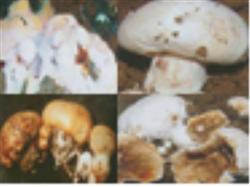
How to prevent and control wet bubble disease in button mushrooms
Disease symptoms: Wet bubble disease is also known as brown rot, white rot, wet bubble, blister disease, etc. The disease is caused by a fungus called Mycogone perniciosa. Mycogone perniciosa is a soil fungus. In button mushroom cultivation, Mycogone perniciosa is mainly introduced into the mushroom house with the casing soil, and it mostly occurs in mushroom sheds with high temperature, high humidity and poor ventilation. Temperatures above 17°C are suitable for this disease to occur.
条件筛选