-
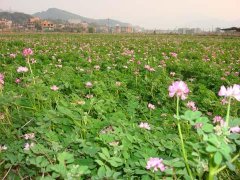
How to plant Chinese milk vetch? A detailed guide to the planting method
How do you plant Chinese milk vetch? Do you know? Would you like to learn what the sowing method of Chinese milk vetch is like? Let's take a look together. Sowing method 1. Sowing rate: when broadcasting, the sowing rate should be slightly higher, about 20-25 kg per hectare. When drilling, only 10-15 kg per hectare is needed.
-

What does the milkvetch tree look like? A detailed introduction to its appearance and characteristics
The Chinese scientific name of the milkvetch tree is Huangqi (Astragalus), and in China it is distributed in regions such as Northeast China, North China and Northwest China, generally growing at forest edges, in shrublands or under open woodland, so what does the milkvetch tree look like? 1. Growth habits of the milkvetch tree. The milkvetch tree is a plant of the Fabaceae (legume) family and the genus Astragalus,
-
Milk vetch planting methods and timing: when is the best time to sow?
Summary Seed treatment: after drying the seeds in the sun for 4 hours, mix them with calcium magnesium phosphate fertilizer. Timely sowing: sow in the early autumn season each year. Protecting and promoting seedlings: do a good job of weeding during the growth process, which helps promote the robust growth of the seedlings. Field
-
Key Technical Points for Standardized High-Yield Cultivation and Management of Chinese Milk Vetch
Chinese milk vetch, also known as qiaoyao, honghuacao, or caozi, originated in China. It prefers warm and humid conditions and has a certain degree of cold tolerance. It requires sufficient water throughout its entire growth period. Chinese milk vetch is not demanding regarding soil, with sandy and clay loam being more suitable. It has poor salt tolerance and belongs to the Fabaceae (legume) family,
-
How to Grow Chinese Milk Vetch? A Detailed Guide to Key Cultivation Techniques
Chinese milk vetch (Astragalus sinicus) is a biennial herb in the legume family, with relatively tall plants that can reach 35 cm. Chinese milk vetch is mainly distributed in our country, growing in shady and moist areas. Chinese milk vetch is a very important nectar source plant, usually grown as green manure and forage. However, the seeds of Chinese milk vetch
-
How much does a jin of milk vetch (Astragalus sinicus) seeds of the Fabaceae family cost? Sowing and harvest time and edible benefits
Milk vetch, also known as qiaoyao, red flower grass, caoze, etc., is distributed across the provinces of the Yangtze River basin in China. It is widely cultivated throughout China. So how much does a jin of its seeds cost? When should it be sown and harvested? Is it edible? What are its benefits and effects? From the nursery base in Suqian
-
The Latest Cultivation Techniques and Methods Tutorial for Chinese Milk Vetch
Chinese milk vetch (Astragalus sinicus) is a biennial herb in the Fabaceae family, with relatively tall plants that can reach 35 cm. Chinese milk vetch is mainly distributed in our country, growing in shady and humid areas. Chinese milk vetch is a very important nectar plant, usually planted as green manure and forage. However, the seeds of Chinese milk vetch
-
The Latest Introduction to Astragalus sinicus (Chinese Milk Vetch) and Answers to Common Questions
Astragalus sinicus, as its name suggests, has pale purple flowers that bloom beautifully. In addition, it is a well-known Chinese herbal medicine and a plant that combines ornamental and practical value. It is distributed throughout China, mostly growing in moist places in valley forests at an altitude of 400-3000 m. Below
-
A Detailed Explanation of the Latest Benefits and Uses of Astragalus sinicus (Chinese Milk Vetch)
Astragalus sinicus is one of the more common plants in our country, mostly growing on hillsides and by streams at altitudes of 400 to 3000 m. Its flowers are mostly purple, with a delicate and charming colour and small, exquisite petals that look very endearing. But in fact, Astragalus sinicus is not only used for ornamental purposes
-
How should Astragalus be managed? Latest management key points
Astragalus, also known as cotton milkvetch, is a very common traditional Chinese medicinal herb in our country, mainly distributed in the northwest and northeast regions. Astragalus can enhance the human body's immune function and has effects such as protecting the liver, promoting diuresis, anti-aging and lowering blood pressure. However, because wild Astragalus has been heavily dug up by people, lead
条件筛选