-

How do you choose among eight types of turtles? Mastering these selection tips is important
Turtle: The male should have a blackish carapace, a thick, solid tail base, and a long, deep concave plastron; the female should have a short, thick body and a short, thick tail. It is best to choose turtles aged 8 years or older, with the female weighing 350 grams; the male need only have reached the age of gonadal maturity, and the male-to-female ratio is 2:1 to 3:1. Golden coin turtle: When selecting, hold it in your hand and turn it over; its head will extend very long, be even in thickness, and its eyes will move flexibly and look lively. The skin is glossy, the temperament is docile, the gap between the upper and lower shells at the tail is large, and the cloacal opening is broad. Turtles aged 6 years or older are required, with the female weighing 1250 grams to 15
-
Polyculture of yellow catfish and soft-shelled turtles can net 10,000 yuan per mu
In recent years, with breakthroughs in special feed for yellow catfish and in fry breeding technology, various farming models for yellow catfish, including main culture, polyculture and intercropping, have been rapidly applied. The "18221" efficient pond farming model uses high-economic-value yellow catfish to replace the traditional "four major Chinese carps" in a polyculture model with soft-shelled turtles. This model means that in 1 mu of farming water surface, 800 jin of yellow catfish and 200 jin of soft-shelled turtles are produced, with an output value of 20,000 yuan and a profit of 10,000 yuan. It is a typical high-yield, high-efficiency farming model. Its technical points: One
-
Detailed Explanation of Prevention and Treatment Methods for Common Diseases in Turtles
Turtles have strong vitality and disease resistance, and suffer from relatively few illnesses. However, under artificial rearing conditions, various diseases can sometimes occur due to the influence of multiple factors such as rearing site, temperature, and feed. Therefore, routine observation is necessary, and once abnormalities are found, timely and targeted treatment should be applied to avoid economic losses. The following is an introduction to the prevention and treatment methods for common turtle diseases summarized over 10 years by Jiang Zhanglin, the "Turtle Farming King" at Longtouge Animal Farm in Yuanhua Town, Haining City, Zhejiang Province: 1. Trauma and Inflammation. Due to the rough surface of the rearing pond
-
What are the treatment methods for a cold in adult golden coin turtles?
Clinical symptoms: The appearance seems no different from a normal turtle. The main signs are rapid breathing in the sick turtle, and in severe cases the mouth opens 4 times every 5 minutes, resembling a cough, after which the head droops weakly down to the bottom of the rearing container, and feeding stops. Cause: Caused by temperature differences, especially about 2d after a rainstorm strikes golden coin turtles that are basking, when this disease begins to be found; it is actually an upper respiratory tract infection caused by a cold. Injection method: Intramuscular injection, at the base of the hind limb. On days 1-3, use DK 200,000 IU/kg
-
Detailed Explanation of Key Technical Points for Disease Prevention and Control in Soft-Shelled Turtles
In zoological classification, the soft-shelled turtle belongs to the phylum Vertebrata, class Reptilia, order Testudines, family Trionychidae, genus Pelodiscus. It has strong adaptability to the external environment and great vitality, and is distributed across temperate and subtropical regions worldwide, as well as commonly found throughout China. The soft-shelled turtle is an amphibian that breathes with its lungs, mainly living in water, occasionally coming ashore to rest, or swimming to the water's surface with its head extended above the water to breathe. The ecological habits of the soft-shelled turtle are characterized by three likes and three fears. First, it likes quiet and fears disturbance; second, it likes sunlight and fears wind; third, it likes cleanliness and fears dirt. The soft-shelled turtle is naturally timid,
-

-
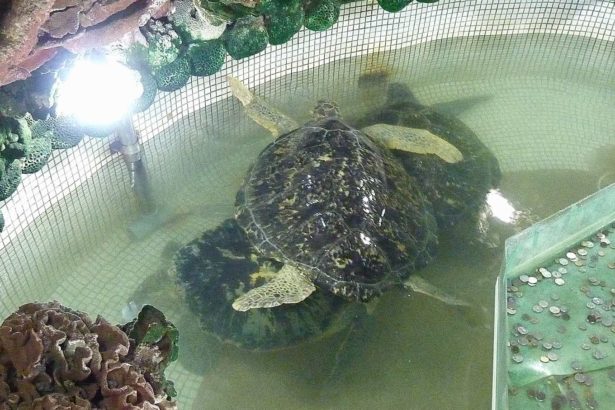
Sea turtles imprisoned in the basement of Penghu Dayi Temple used as a wishing pool, involved in cruelty - what comes of wishing upon a suffering creature?
Sea turtles imprisoned in a basement as a wishing pool, Penghu Dayi Temple involved in cruelty: "What comes of wishing upon a suffering creature?"
-
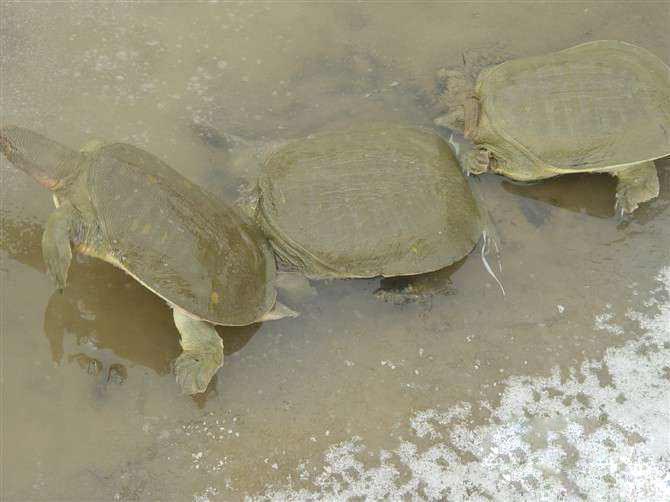
Wild softshell turtles burrow into muddy ponds as soon as winter comes, and pig liver is the best bait for catching them, but they are on the verge of disappearing.
I grew up in the countryside as a child, and back then the rivers there were full of fish and shrimp, the water quality and environment were free of pollution, and life was very pleasant. The fun of country kids was nothing more than catching fish and feeling for shrimp, fishing for crayfish in summer, and feeling for river mussels in autumn and winter...
-

What to Do When Soft-Shelled Turtles Die After Overwintering? Causes and Prevention Methods
Causes and Prevention Methods of Soft-Shelled Turtle Deaths After Overwintering
-

What do soft-shelled turtles eat? Learn about the common foods of soft-shelled turtles in one article
What do soft-shelled turtles eat
条件筛选