-
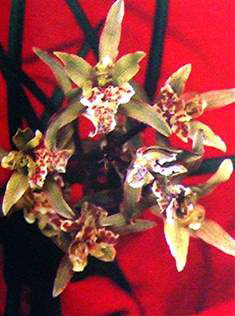
Introduction to the Characteristics and Care Methods of the Four-Star Admiral Cymbidium Variety
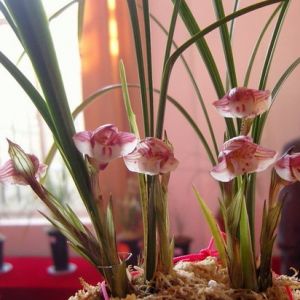
This flower is a rare peony-petal form that transitions from red to green, blooming facing upward. The three outer sepals and the petals are normal petals, edged with red and yellow multiple rims. Each flower of the inner whorl lip has more than four lips, and the tongue is adorned with brilliant red dots. The column has become petaloid, and another small flower grows beside the column. The leaves are arch-shaped and slanting upright, and the leaf color is dark green. The whole flower is like a peony fairy descending to earth, exceedingly beautiful, and is a treasure among the rare peony-petal forms of cymbidium. (Selected and bred by Dong Xiaoping of Xiaoping Orchid Garden)
-
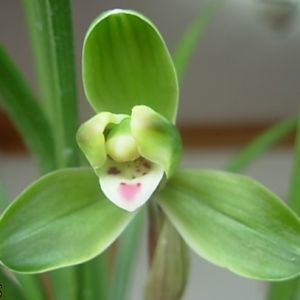
Introduction to the Characteristics and Care Methods of the Xiaoda Mei Chunlan Variety
The leaf posture is a mix of semi-drooping and slanting-drooping, the leaves are narrow and slender, the leaf groove is V-shaped, the leaf color is emerald green with a slight luster, the leaf stalk is slender and tapered, the leaf tip is pointed and long, and the leaf buds are purplish-red and slightly pale. The flower bud is pale red, with green color on the tip and reddish-purple veins. The flower stalk is pinkish-purple, with the top node turning green. The three outer petals are short and ovate, with the edges curling inward, shaped like a shallow soup spoon; the silkworm-moth stamen is held in the center, with a liu-hai tongue and red spots...
-
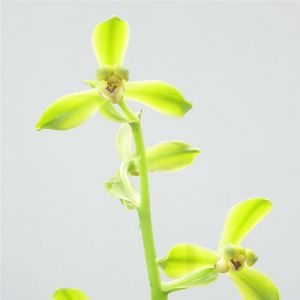
Introduction to the Characteristics and Care Methods of the Cymbidium faberi 'Xinhua Mei' Variety
Cymbidium faberi, plum-petal type, a famous variety. It was discovered at the end of the last century in Xiaojiang Town, Xinchang County, Zhejiang, when Mr. Liang Benhong found it with a local mountain farmer. A green Cymbidium faberi plum-petal type, when it blooms well the small bracts of each flower all become standard outer petals, and sometimes the outer petals are also partly variegated into petaloid form; the flower color is emerald green with a strong fragrance.
-
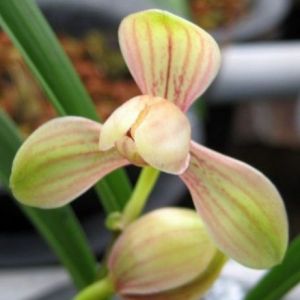
Introduction to the Characteristics and Care Methods of the Junhe Jianlan Variety
Deep in color and thick in texture, with round and blunt leaf tips, it blooms from June to October, flowering 2-3 times, with flower stems 20-40 cm tall, bearing 2-7 flowers; the flower color is slightly red. The flower shape is a lotus petal type, with red lines embedded in tender green, and the flower lip is brightly colored, offering extremely strong ornamental value. Junhe, Jianlan (Four Seasons Orchid), lotus petal type, a famous variety.
-
Introduction to the Characteristics and Care Methods of the Fengguan Cymbidium goeringii Variety
Yunnan Cymbidium goeringii Fengguan, a red-flowered lotus-petal type with side-petal butterfly mutation. Collected from the wild in Lincang, Yunnan, a native species of Cymbidium goeringii; the two side petals spread flat, with the butterfly-mutated portions white, each bearing a purplish-red round spot; the flower color is pink, pretty and charming; the leaves are upright, somewhat thick and substantial, carrying the characteristics of Yunnan-grown Cymbidium goeringii, with a pure fragrance. At the time it was one seedling with one shoot, and a fellow orchid enthusiast bought it for 480,000.
-
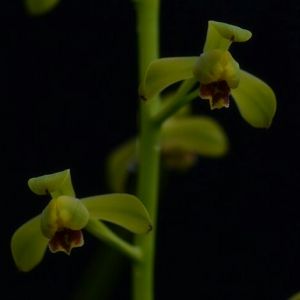
Introduction to the characteristics and care methods of the Qinghua Mei cymbidium variety
Now also called Lao Qinghua, Liu Mei! Petal type: Cymbidium green-shell plum petal. History: In the early years of the Republic of China, Che Qing from Shaoxing, Zhejiang, selected it at Huaxing Hotel, and Wu Enyuan of Hangzhou exchanged an old variety worth several tens of gold for it. Six years later, it bloomed with six flowers and was a fine plum-petal specimen. Characteristics: outer petals with short feet and round tips, thick petals, and level shoulders. The inner segments are divided-socket silkworm-moth segments, ...
-
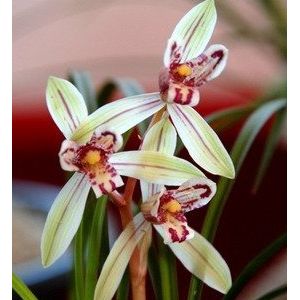
Introduction to the Xinghai Die Cymbidium Lianban Variety and Its Cultivation Methods
Xinghai Die, also known as Xinhai Die, is a famous three-star butterfly variety of the fine-leaf Cymbidium lianban. The leaves are 20-30CM long and about 0.6CM wide, with a fine, glutinous and glossy leaf texture, semi-pendant leaves, and relatively fewer leaves than other Cymbidium lianban, generally 5, with twisted leaf tips; the young shoots are purplish red, and the color remains basically unchanged from emergence to opening. After the young shoots of this variety open...
-
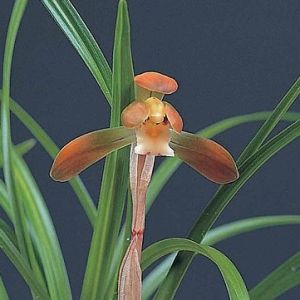
Introduction to the Characteristics and Care Methods of the Dongzhiguang Cymbidium goeringii Variety
Produced in Ibaraki Prefecture, Japan. The leaves droop, the flower scape rises above the leaves, the flowers are red with flat shoulders, and the lip is white with red spots.
-
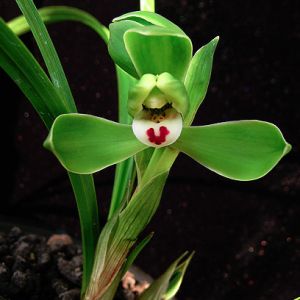
How is the Cymbidium goeringii 'Xizi'? A detailed explanation of the first-bloom pictures and identification methods
Also known as Wenpin. Selected in the early years of the Republic of China by Shen Yuanru, the owner of Qianlan Studio in Wuxi. Semi-drooping leaves, leaf tips slightly blunt, plant form closely resembles Wanzai. The flower shape of this variety varies considerably, and plum-form narcissus and lotus-form narcissus often appear. When it blooms as plum-form narcissus, the three outer petals are round and tight, the tips slightly convex and pointed, with tight edges, long legs and contracted bases, thick petal flesh, soft silkworm-moth-held petals, separated chambers, small...
-
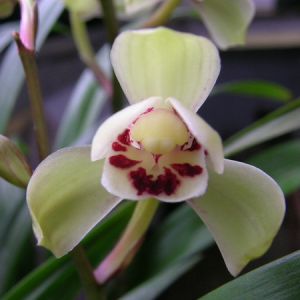
Introduction to the Characteristics and Care Methods of the Cymbidium ensifolium Variety 'He Wang'
The leaves are relatively broad and dark green. It blooms 3--7 flowers; the flowers are lotus-type petals, yellow, with a large round tongue extending forward, symmetrically dotted with red spots, and forming a golden-yellow rimmed edge. According to the renowned orchid grower Mr. Chen Shaomin, 'He Wang' appeared around 1988. Its place of origin is Mount Emei in Sichuan Province, and its discoverer was Mr. Deng Yuanxing, president of the Emei Orchid Association...
条件筛选