-

Detailed Explanation of Strawberry Mulching and Cold Protection Techniques
Strawberry is a fruit with a relatively high market price in China, but even with its market price, it is still loved by many people. Therefore, strawberry cultivation is still very common now, and after strawberry cultivation enters winter, it is necessary to do a good job of mulching and cold protection.
-
What are the precautions for winter mulching of strawberries?
After late autumn, strawberries gradually enter dormancy. Strawberry roots are shallow and can tolerate low temperatures of -8°C and short periods of -10°C; if the temperature drops further, cold injury occurs, and in severe cases the plants die, causing a decline in economic returns. In northern cultivation, the main measure for overwintering cold protection of strawberries is
-
Detailed Explanation of Key Points of Water-Saving Irrigation Techniques for Citrus Planting
1. Straw mulching Straw mulching is a water-saving technique with abundant resources and obvious benefits, and it also has notable characteristics such as improving the soil and increasing fertility, conserving soil and water, and increasing yield. Cut the weeds in the citrus orchard, use the weed resources on the terrace walls, spread them in the tree, and then cover them with a thin layer of soil
-
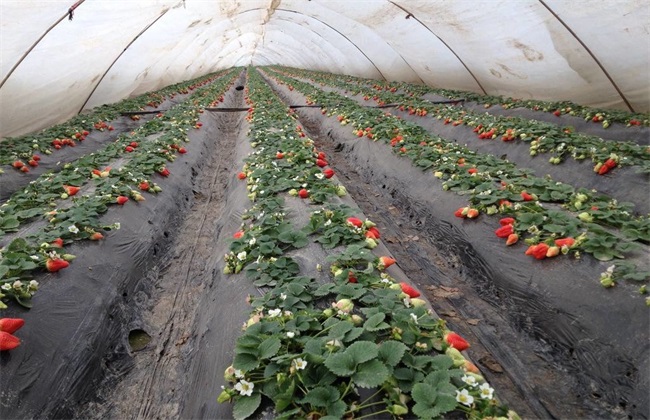
Detailed Explanation of Key Points of Strawberry Mulching and Cold Protection Techniques
Strawberry Mulching and Cold Protection Techniques
-
New no-till, straw-mulching sowing technology for summer soybeans after wheat harvest successfully developed by Chinese experts
Chinese experts have developed a new no-till, straw-mulching sowing technology for summer soybeans following wheat harvest
-
Detailed Explanation of High-Yield Cultivation Techniques for Autumn Potatoes with Rice Straw Mulching
Potatoes have the characteristic of preferring cool conditions and fearing heat, making them perfectly suited for no-till planting in idle winter fields. This method requires no plowing or soil covering, saving labor and effort, and is simple to operate. Harvest can be achieved after 3 months, with an average yield of over 1,500 kg per 667 sq m, a 30% increase compared to traditional cultivation methods. At 0.8 yuan per kg, this yields a gross profit of 1,200 yuan. This is a quick and effective project for improving land utilization and increasing farmers' income. 1. Selecting improved varieties and soaking seeds for sprouting: Choose varieties with high quality and yield, a relatively short growth period, relatively high tolerance to high temperature and drought
-
Six Improvements in No-Till Cultivation of Autumn Potatoes with Rice Straw Mulching
Autumn potatoes can be harvested in December and marketed as vegetable potatoes, giving relatively good returns. Adopting no-till cultivation of autumn potatoes with rice straw mulching not only saves labor and time, reduces labor intensity, and prevents environmental pollution caused by burning rice straw, but also yields about 1500 kg per mu, an increase of more than 10% over plowed and sown crops. Especially in recent years, in conjunction with production demonstrations, agricultural technicians have made some improvements to this technology, making it further mature. Specifically, these are the "six improvements": switch to early-maturing excellent varieties. Effective growth period of autumn potatoes
-
How to sow potatoes in no-till cultivation with rice straw mulching
The main sowing methods for no-till potato cultivation with rice straw mulching are the following three: 1. Directly placing seed potatoes and then covering with rice straw. In no-till paddy fields, dig high-yield ditches (irrigation and drainage ditches), with a ditch width of 20 cm and a depth of 15 cm, and a bed width (including ditches) of 150 cm. The excavated soil must not be piled on the ditch edges; the bed surface should be slightly arched to avoid water accumulation. Generally, small weeds and rice stubble do not affect planting. If there are large weeds, they can be trampled down or hoed away, and there is no need to use herbicides. Sow 4 rows per bed in a wide-narrow row pattern, with a wide row in the middle with a row spacing of 34 cm, and narrow rows on both sides with a row spacing of 28 cm.
-
Detailed Explanation of No-Till Potato Cultivation with Rice Straw Mulching
First, selecting the field and preparing the beds. Choose a neutral or slightly acidic paddy field. When harvesting rice, it is best to leave stubble 15-20 cm high. Before sowing, first mark out beds and open furrows, with a bed width of 1.4-1.6 m, a furrow width of 20-30 cm, and a furrow depth of 15-20 cm. When opening the furrows, scatter the excavated soil evenly in the middle of the bed, and shape the bed surface into an arched back to facilitate drainage. Second, seed potato treatment. Select virus-free seed potatoes that are free of pests and diseases, have smooth and fresh skin, and weigh more than 20 g each. Before sowing, according to the distribution of the buds and the
-
Detailed Explanation of Potato Cultivation Technology with Rice Straw Mulching
In 2000, Zhejiang Province carried out research on a new technique for no-till rice paddy cultivation of potatoes with full rice straw mulching, changing "planting seed potatoes" to "placing seed potatoes" and "digging potatoes" to "picking potatoes." The whole process can be vividly summarized as "place, cover, pick," eliminating many operations such as plowing and land preparation, digging holes for planting, intertillage weeding, and digging potatoes. The fresh potato yield per 667 sq m was over 1500 kg. A few years ago, our province introduced this technique and demonstrated it successfully. 1. Select good varieties. Varieties suitable for planting in our province include:
条件筛选