-

What are the latest control methods for peach bacterial shot hole disease?
Peach bacterial shot hole disease is a common and widespread disease affecting peaches. It not only harms peaches but also harms fruit trees such as cherries, plums and apricots. Some varieties are severely affected, such as Zhonghua Shoutao and Haishuimi. The pathogen mainly harms peach leaves, and also harms the fruit.
-
A detailed guide to the correct use of thiabendazole
Control of peach shot hole disease: 1% thiabendazole aqueous solution at 600 times dilution or 1.5% thiabendazole emulsion at 800 times dilution, sprayed once every 7 days, with the number of sprays adjusted flexibly according to the severity of the disease. Pear downy mildew and pear scab: choose 1.5% thiabendazole emulsion at 800 times dilution, sprayed once every 5-7 days, for 2-3 consecutive times.
-
What is the best treatment for peach tree shot hole disease?
Because of the high temperature, intense heat and abundant rain in summer, peach trees are most prone to shot hole disease at this time. So, what medicine can treat peach tree shot hole disease? 1. What medicine can treat peach tree shot hole disease: Spray 2-3 times with Lianguoan at 150 times + Wofengsu at 600 times + garlic oil at 1000 times. When the disease is severe,
-
How to prevent and control peach bacterial shot hole? A detailed guide to peach tree disease prevention and control methods
Peach bacterial shot hole is a widely distributed disease with a high incidence rate. Bacterial shot hole occurs in all peach-producing areas nationwide, especially in coastal and lakeside areas, in orchards with poor drainage, and in rainy years, where it often breaks out severely. If not controlled in time, it easily causes
-
Identification of Cherry Blossom Pest and Disease Symptoms and Control Methods
Summary Symptoms of shot-hole brown spot disease: small purplish-brown spots appear on the leaves and gradually expand into circular shapes. Control methods for shot-hole brown spot disease: spray 3-5 degrees Baume lime sulfur mixture before new shoots sprout, and spray 160-fold Bordeaux mixture when the disease occurs. Symptoms of leaf blight: yellow-green
-
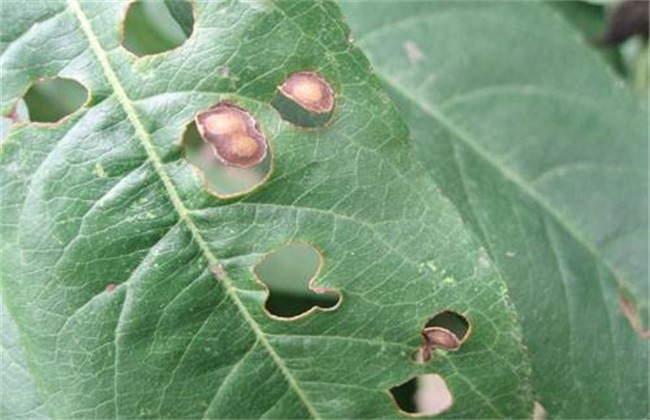
How do you prevent and treat bacterial shot hole disease in peaches?
Prevention and treatment methods for bacterial shot hole disease in peaches
-
How to prevent and control brown spot and shot hole disease in cherry blossoms
[Distribution] Cherry blossom brown spot and shot hole disease is an important disease of cherry blossom leaves and occurs in cherry blossom growing areas throughout China. [Symptoms] It mainly affects mature leaves and also affects young twigs. Infected leaves first show pinhead-sized purplish-brown dots, which soon enlarge into circular to nearly circular spots, 1-4 mm, brown in the center, slightly with concentric rings, with purple or reddish-brown edges, and grayish-brown fuzzy dots appear on the lesions; later, an abscission layer forms around the lesions, brown mold-like growth appears on both sides of the diseased leaves, and the center of the lesion dries up and falls off, forming round small holes and producing shot hole spots,
-
Occurrence Patterns and Control Methods of Cherry Brown Spot Shot Hole Disease
Symptoms: Small brown, grayish-brown, or purplish-brown spots initially appear on the leaves, gradually forming circular lesions that are non-water-soaked and opaque, with no yellow-green halo around the lesions, 2-4 in diameter, with clear boundaries and a purplish-brown outer margin. In the later stage, the center turns white or brown, slightly zonate, and the lesions die and fall off, forming irregular shot holes. 2. Occurrence patterns: The pathogen overwinters on fallen leaves and spreads by wind and rain in the following spring. The disease begins in June, with the peak period from August to September. Heavy rainfall promotes disease occurrence and epidemic, and weakened tree vigor leads to severe disease. 3. Control methods:
-
What are the symptoms of cherry brown spot shot hole disease?
Symptoms of cherry brown spot shot hole disease: This disease occurs on leaves, new shoots and fruit. But it mainly damages leaves, producing circular or nearly circular spots on both sides of the leaves, about 1 to 4 mm in diameter, with clear edges and slight concentric rings; the outer ring is sometimes purple or reddish brown, and the center is grayish white or brown with faint concentric rings. In the later stage, grayish brown mold-like material, namely the conidiomata, occasionally appears on both sides of the spots, more abundantly on the underside of the leaves. The spots often dry up and fall off, forming shot holes, and the holes at the edges of these spots are neat. Leaves with many shot holes drop early, and the spots on new shoots are purplish brown, with grayish brown mold-like material also produced on the spots.
-
How to Effectively Prevent and Control Cherry Blossom Brown Spot Shot Hole Disease
I. Symptoms: Shot hole disease can be divided into fungal and bacterial types. Cherry blossom brown spot shot hole disease is caused by fungi. It mainly damages leaves and also infects new shoots. It usually starts from the lower part of the canopy and gradually spreads upward. In the early stage of the disease, needle-tip-sized purplish-brown small spots are scattered on the upper side of the leaves, later expanding into round or nearly round lesions 3-5 mm in diameter. The edges of the brown spots are purplish-brown, and grayish-brown mold spots appear on the lesions in the later stage. An abscission layer forms at the edge of the spot, and the lesion dries up and falls off, forming shot holes. II. Disease Pattern: The pathogen of cherry blossom brown spot shot hole disease overwinters in diseased leaves or shoot parts
条件筛选