-

Lily seedlings should have field management strengthened early
Because last winter's temperatures were on the high side, lilies emerged earlier this year than in previous years. In Xinshao County, lilies began emerging in early March, about half a month earlier than usual. At present, underground pests have already begun causing damage; affected plants show yellowing above-ground stems and leaves, thin and weak growth, and purplish-red young stems. When the soil layer is dug open, the bottom layer of the seed bulb is seen to be rotten or the seed bulb is completely rotten, with no root system or with the root system bitten off. Since lilies emerge earlier, field management must keep pace accordingly. Early control of underground pests: the pests currently damaging lily underground seed stems and their root systems include root mites, white grubs,
-
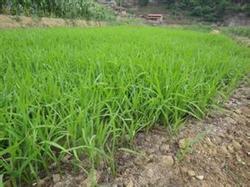
Key Field Management Techniques After Transplanting Dry-Raised Rice Seedlings to the Paddy Field
1. Prepare the field carefully so that the field is level and the soil is puddled, with not even a inch of water exposing the mud. 2. Fertilization principle: apply a heavy basal fertilizer and skillfully apply panicle-grain fertilizer. Apply no less than 1500 kg of farmyard manure per mu. When harrowing the field, apply phosphate and potassium fertilizers plus 70% of the nitrogen fertilizer as a one-time basal application, 20% of the nitrogen fertilizer as tillering fertilizer, and 10% as panicle fertilizer (apply 5-10 days before heading). ...
-
Key Techniques for Overwintering Management of Panax notoginseng Seedling Fields
Panax notoginseng is a perennial herbaceous plant. Once winter arrives, its above-ground parts all die back. At this time, the above-ground parts should be cut off 3 cm above the ground, and all dead branches, fallen leaves, diseased plants and weeds in the field should be cleared away and burned outside the field. The soil should be thoroughly sprayed and disinfected with 0.2-0.3 degrees Baume lime-sulfur mixture, and then a layer of decomposed farmyard manure should be applied at about 1500 kg per mu to keep warm and prevent freezing. If exposed roots are found, soil should be banked up when the winter fertilizer is applied, and finally a layer of grass should be spread on top to ensure the buds overwinter safely.
-
Key Technical Points for Raising Seedlings of Sweet Peppers and Hot Peppers in Open-Field Cultivation
I. Variety Selection: For this cultivation method, it is advisable to choose varieties with strong growth vigor, disease resistance, and strong heat tolerance. For sweet peppers, such as Jiyan No. 6, Jiyan No. 4, and Zhongjiao No. 4; for hot peppers, such as Jize pepper, Wangdu pepper, etc. II. Seedling Raising Must Be Adopted: For direct seeding, due to extensive management, it causes uneven seedling growth or missing plants and gaps in rows, a short growth period, and a transplanting time more than 40 days later than seedling raising and transplanting, with short plants and poor seedling quality. If a year with a major outbreak of viral disease occurs, the disease spreads, causing severe yield reduction or even total crop loss. When transplanting with the seedling-raising method, the seedlings have already
-
What are the suitable seedling specifications and stocking density for cage culture of rice field eels?
Q: For cage culture of rice field eels, what size seedlings and what density should be stocked?
-
What to Do About Missing and Gapped Seedlings in Wheat Fields? Detailed Remedial Methods
Remedial Methods for Missing and Gapped Seedlings in Wheat Fields
-
Pest Control Methods and Key Technical Points for Panax notoginseng Seedling Fields
When aphids and scale insects cause damage, spray 50% phoxim emulsifiable concentrate at 1000 times dilution or 40% dimethoate emulsion at 1000 times dilution for control. In plots with a large number of white grubs and cutworms, apply 50-75 g of 90% trichlorfon crystals per mu mixed with 20 kg of fine soil and broadcast, or mix with 50 kg of chopped fresh vegetable leaves and broadcast in the evening. For rodents damaging Panax notoginseng gardens, based on their habit of hiding by day and coming out at night, block their burrows during the day and place rat traps, rat cages
-
How to control pests and weeds in single-season rice seedling fields? Here are the control recommendations
I. Weed control in seedling fields 1. Weed control before plowing: 7-10 days before plowing the seedling bed, use 41% glyphosate 150 ml/mu or 10% glyphosate 1000 ml/mu diluted in 30 kg of water for fine spraying to control old weeds before sowing. 2. Weed control after sowing: ① 1-2 days after sowing germinated seeds, use 17.2% bensulfuron-methyl and piperophos wettable powder (Youhebao) 210 g/mu diluted in 45 kg of water for fine spraying. ② At the needle-standing stage of seedlings, use 40% bensulfuron-methyl and pretilachlor wettable
-
How to release seedlings after mulching cotton fields with plastic film? Practical tips to share
In plastic-film-mulched cotton fields, the temperature is high, and seedlings emerge quickly and evenly. It takes 8 days from sowing to emergence, and 3 to 4 days after emergence for full stand. After full stand, if the late frost has passed, holes should be broken to release the seedlings. Releasing seedlings too early means they cannot achieve full stand or complete stand; too late is not good for strong seedlings, and if high temperatures occur, it often causes seedling scorching. For drill sowing, holes should be punched according to plant spacing to release seedlings; for hole sowing, holes should be punched according to seedlings. After breaking the film and releasing seedlings, cover the openings with soil to prevent moisture loss, temperature drop, film lifting by strong wind, and weed growth. When releasing seedlings, grasp the principle of releasing green but not yellow, that is, cotton seedlings with flat and expanded cotyledons can be released; yellow-valve seedlings that have not expanded, if released, are easily dried by wind or killed by sun, and cannot be released through holes.
-
How to make beds in a Panax notoginseng seedling field? Methods and key technical points
After the shed is built, plow and harrow the land once more, then make the beds. On flat land and gently sloping land, the bed height is 20-25 cm; on sloping land, the bed height is 15-20 cm, and the bed width is 1.2-1.4 m. Apply 3000-4000 kg of base fertilizer per mu, with poultry and livestock manure accounting for 30%-40% and plant ash accounting for 60%-70%. The base fertilizer must be fully fermented and decomposed, broken up finely, and spread evenly over the bed surface, then turned into the 6-10 cm soil layer of the bed with a shovel.
条件筛选