-

Three-rights separation for rural land transfer is hard to implement; land trusts come to the rescue
Three-rights separation for rural land transfer is hard to achieve, so let trusts lend a hand
-
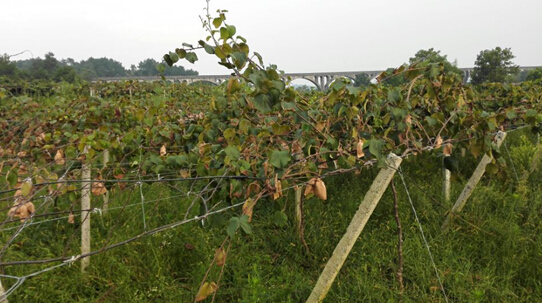
Kiwifruit becomes Xinshao's fruit of poverty alleviation and prosperity; entrusted assistance advances industrial poverty alleviation
Xinshao advances industrial poverty alleviation through entrusted assistance; kiwifruit becomes the local "fruit of poverty alleviation and prosperity"
-

Harm and Control Methods of Angelica Rust
The pathogen is Puccinia angelicae (P. angelicae). Urediniospores are oval to oblong-elliptical, yellowish-brown, (25-42) micrometers x (22-30) micrometers, with small spines on the surface and 3 germ pores. Teliospores are elliptical to club-shaped, chestnut-brown, (32-49) x (17-26) micrometers, with rounded ends and slightly constricted at the septum; the stalk is colorless and deciduous. Single-spored teliospores sometimes occur. 1. Damage symptoms: It damages leaves, and also damages petioles and fruit stalks. Uredinial pustules are scattered or clustered on the underside of leaves, exposed, brown. Telio
-
How to prevent rust-colored spots on mushroom caps
This is generally caused by failing to open doors and windows promptly for ventilation after watering, which makes the humidity in the mushroom house too high; water droplets then collect on the cap surface for a long time, producing rust-colored spots in localized areas. Rust-colored spots resemble bacterial spots, but they are limited to the surface. Preventive measures: open doors and windows for ventilation on schedule or when the weather is suitable, bring in fresh air, and evaporate the moisture on the surface of the mushrooms.
-
What are the control methods for mushroom rust spot disease?
Mushroom rust spot disease, also called brown spot disease or bacterial blotch, is caused by Pseudomonas tolaasii, an acidophilic species of the genus Pseudomonas. It spreads through insects, tools, the hands of workers and other carriers. The disease is severe when the casing soil of the mushroom bed has a pH below 5.5, when ventilation is poor, when humidity is too high, and when the mushroom caps remain constantly moist and sticky after watering. Its symptoms are: it generally infects only the epidermal layer of the mushroom cap, causing spots of varying size that are initially yellowish-brown and rust-like in appearance, which later gradually turn brown or black, and sometimes scars with mucus also appear on the caps.
-
Why do mushrooms grow as freakish "water-rust spot mushrooms"?
If the mushroom house and the surface of the growing medium are not ventilated promptly after watering, the humidity in the mushroom house becomes too high, small water droplets form on the mushroom surfaces, and over time rust-colored spots appear. Prevention measures: after each watering, open the doors and windows for 30 to 60 minutes to ventilate.
-
Symptom Identification and Control Methods for Carnation Rust
[Pathogen] Uromyces caryophyllinus (Schrank) Wint., belonging to the fungal subphylum Basidiomycotina, genus Uromyces. It is a heteroecious rust fungus. [Symptoms] The disease mainly damages leaves, and also damages stems and calyx. The affected parts initially show pale small raised spots, which later turn yellow around the edges. In severe cases, leaves and stems become distorted. During the growing season, brown small powdery masses appear on the underside of infected leaves or on stems and calyx lobes; these are the uredinia of the pathogen. In autumn and winter
-
Symptom Identification and Control Methods of Carnation Rust
Rust is one of the common diseases of carnation, and susceptibility varies among cultivars. It generally occurs commonly in autumn and winter when control is neglected, and is severe in continuous cropping fields where the previous crop was heavily diseased. The whole plant can be affected, with leaves suffering the most severe damage. Reddish-brown spots appear on both the upper and lower surfaces of diseased leaves, and the epidermis around the diseased area ruptures, exposing red powdery material, which is the uredinium of the pathogen. In the later stage, the color of the diseased area deepens, and after the epidermis ruptures, dark brown to black powdery material appears, which is the telium of the pathogen. Rust can also damage the stems and sepals of carnation. Carnation rust is caused by the fungus Uromyces dianthi, and is a
-
Control Methods for Rust Spot Disease in Oyster Mushrooms
The rust-colored or dark brown spots appearing on the caps and stipes of oyster mushrooms are called rust spot disease of oyster mushrooms. This disease is a bacterial disease that easily occurs during the fruiting body growth stage of oyster mushrooms. The pathogen causing this disease is a species of Pseudomonas bacteria that is extremely widely distributed in nature. In the early stage of the disease, the spots are only the size of a needle tip and light in color, generally not affecting commercial value. As the disease worsens, the spots rapidly enlarge and their color continuously deepens, often appearing oval or spindle-shaped, or connecting with each other to form irregular large patches, with rust-yellow discolored areas around the patches.
-
Prevent and control pear rust early, so the fruit does not grow warts
The disease that causes warts on pear fruit is called rust, also known as pear rust, pear red rust, or pear-apple-juniper rust. Before the pear trees shed their leaves, in September, the disease successively transfers as mycelium to alternate hosts on juniper (including Chinese juniper and dragon juniper) type trees. As long as juniper type trees are planted, pear orchards have the possibility of rust occurring every year. After leaves are infected, orange-yellow oil-droplet-like small spots appear on the surface, gradually developing into nearly round lesions 4-8 mm in diameter, with orange-yellow small granular spots appearing in the center, which later gradually turn black; the area around the lesion is reddish-brown, the upper leaf surface is sunken, and the back
条件筛选