-
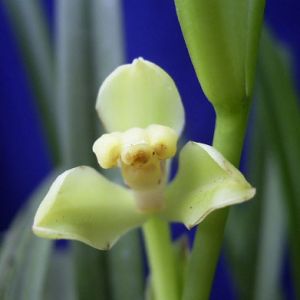
Care Methods and Points to Note for Goldfish Plum and Jianlan
Flower name: Goldfish Plum Origin: Sichuan Content: good petals, soft texture, tender yellow color tomtsoi: (This flower is slightly small, the goldfish-eye form is rarely seen, and it lacks inner petals. Last year a strain with butterfly markings appeared online; its flower shape resembles Goldfish Plum, and it may be a mutation of Goldfish Plum.)
-
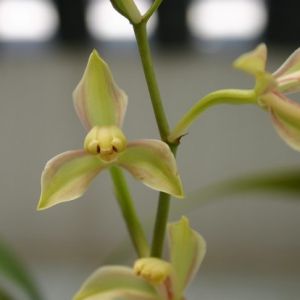
Characteristics and Appreciation Points of the Frog Plum Jianlan Variety
Origin: Sichuan. Content: I named this flower Frog Plum. Look at those two big frog eyes, and the tongue in its mouth looks like it is about to stick out. The name and appearance are somewhat like its owner too. Joking aside, I introduced two old pseudobulbs of this flower last year from my old friend Froggy and left them with him for fostering for a while. When I got them back, they were already three shoots with buds. Besides my friend being widely recognized as a good grower, this flower is indeed a prolific shooter; after spring it was already five shoots with buds. The leaf shape is distinctive, especially thick and especially heavy, growing crosswise, with short leaves, and the leaf posture is beautiful, but the leaf tips tend to scorch; the flower has goldfish eyes and a floating plum standard. This year it bloomed properly (see the picture below), and it makes my mouth water.
-
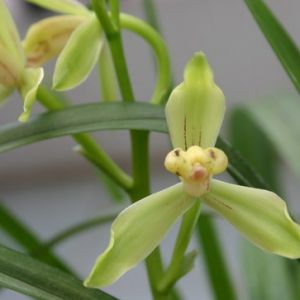
Introduction to the Cymbidium ensifolium 'Xiao Tian Long' Variety and Key Care Points
Origin: Bred in Taiwan, China. Content: Last year I bought a group of "Xiashan Shuixian" from an orchid enthusiast in Sichuan. It was cheap, and I thought it was quite good. When I bought it, it came with a photo of a strangely blooming flower. I bought it and set it aside, giving it the number New Variety Mei 43. It just bloomed, and looking at it, isn't this Tian Long's little brother? How did he come here to pass himself off as a new variety! Tian Long told me that last year he and Green "Sister" were made up by unscrupulous merchants and taken around to be sold as new varieties! How pitiful. The story is finished. Let me introduce Xiao Tian Long to you. It is a rare dragon-type Shuixian Mei, an old variety. There is a similar variety with colored petals called Long Zhi Mei (to be introduced next). Xiao Tian Long is easy to grow, with a high sprouting rate. The petals are hard and the tongue is pointed, sticking out. Personally, I think it is not very attractive, but it has an imposing name called "Dragon Swallowing Tongue." The petal shape is a typical floating immortal style. The market price of this flower is low (if you were not deceived), making it a good choice for beginners.
-
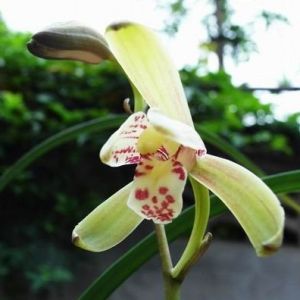
Introduction to the Black Crystal Cymbidium ensifolium variety and key care points
A wild-collected and selected variety, crystal art. Its flowering characteristics are unusual: in the 7 days before this variety opens, the flower form is narcissus petal. After 7 days, the petals curl backward into a centered-petal butterfly flower. Very interesting.
-
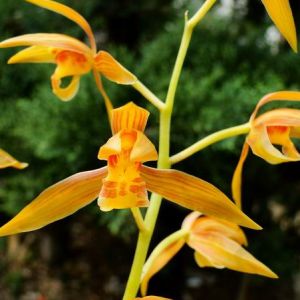
Introduction to the Cymbidium sinense 'Yaolin Yanzhi' Variety and Key Care Points
Cymbidium sinense 'Yaolin Yanzhi' is a beautiful colored-flower variety with large blooms.
-
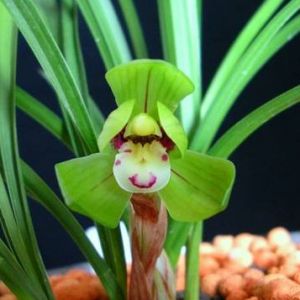
Introduction to the Tianyi He cymbidium variety and key appreciation points
Petal type: Lotus petal. In 1983, Liu Jianping of Zhoushan selected it from mixed stock at a cymbidium vendor's stall. The meaning of its name: the one and only lotus-petal new variety under heaven. Characteristics: the three outer petals are short and broad, with a constricted base and flared corners; the hold petals are short, round and mussel-shell shaped; the lip is large and round, with a "U"-shaped red marking on its surface. Apart from the radiating purple-red lines on the hold petals, the three outer petals are basically pure...
-
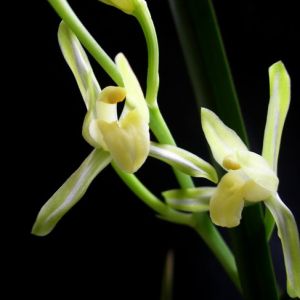
Introduction to the Qianxi Ruyi Jianlan Variety and Key Care Points
A variegated-leaf and floral evolution variety of Tiegusu Xinlan (Iron-Bone Plain-Heart Orchid). Because it was first discovered in the Meishan area of Chiayi, it is commonly known as "Meishan Su." When the spring buds of this variety first sprout, the young shoots display a highly variegated appearance; the inner variegation gradually fades as the plant grows, while the claw variegation becomes progressively more pronounced, with a slight tendency to reverse (summer or autumn buds may partially show delayed-expression claw variegation), ...
-
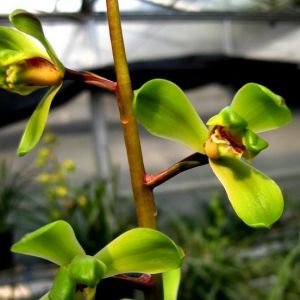
Introduction to the Mingzhou Mei Huilan (Cymbidium) Variety and Key Appreciation Points
Mingzhou Mei, also known as "Tianwang Hui," was discovered and selected by Ningbo orchid enthusiast Shen Qingfa in the spring of 2000 during the Spring Festival when he visited friends in the Xianxiang mountain area, found among ordinary orchids at a mountain farmer's home. Characteristics: the plant's flower stalk is about 45 cm tall, about 1.2-1.5 cm wide, with leaves blunt-tipped and dew-holding in shape, majestic in form. The flower stem is pink at the base with green, round and upright, about 4-5 mm thick, about 50 cm tall and well above the leaves...
-
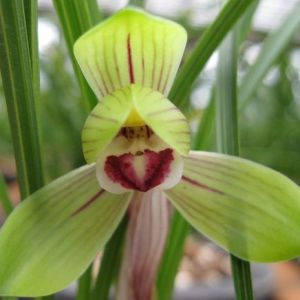
Introducing the Characteristics of the Xinhe Chunlan (Cymbidium goeringii) Variety and Key Cultivation Points
Some also call it "not a lotus"; it is a plant from Zhoushan, China, and it has already bloomed for two years, so there is no need to worry about its fragrance. The only flaw is its rotten bud sheaths; a plant that is not a lotus is like Zhu Yuanzhang becoming emperor, never having the look of wealth and nobility.
-
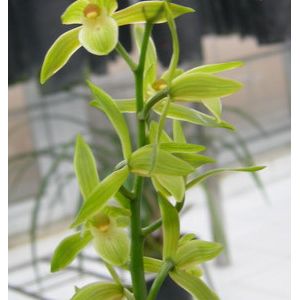
Introduction to the Beidou Molan Orchid Variety and Cultivation Key Points
Since 2006, I have bought quite a few. In the meantime, I only gave friends Master Yiantang and Mr. Zhou new and old two shoots divided from a pot bought with a flower in bloom; the rest I quietly grew to bloom. After several years of selection, I am very happy that all the counterfeit versions, which also had plain buds, were cleared out. This year, a total of five pots produced flowers. I kept one pot of two shoots grown in shade and...
条件筛选