-
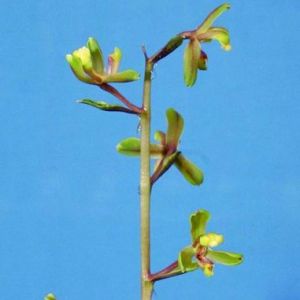
Introduction to the Red Bee Qiao Cymbidium Variety and Key Appreciation Points
Petal type: Red-sheath red-flower plum petal. History: Selected in the late Qing Dynasty by Shao Zhiyan of Hangzhou. Characteristics: The three petals have round heads and long feet, and the petal flesh is thick. The tips of the holding petals have thick pouches and turn upward like cat-ear holding petals, divided into sections, small like a tongue. It is a rare variety among red cymbidiums. Because the flower shape resembles the green cymbidium "Bee Qiao," it was named Red Bee Qiao.
-
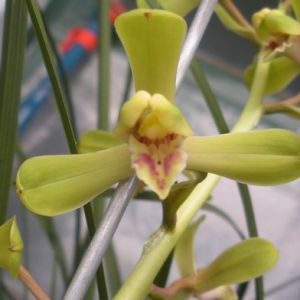
Characteristics and Appreciation Points of the Cuimei Huilan Variety
Features: The flower scape is light green, 40 cm tall, the pedicels are pinkish-purple, bearing 8-11 flowers; the three outer petals have long stems and large round heads, with small pointed tips at the petal ends; the texture is glutinous and the flesh is thick, with a finely constricted base; the two lateral sepals form a straight-line shoulder; the pistil is a semi-hard hood; the five petals are separated at the base; the lip is a dragon-swallowing tongue, with bright red spots on the tongue surface; the flower form is well-balanced and is listed among the "New Eight Varieties"...
-
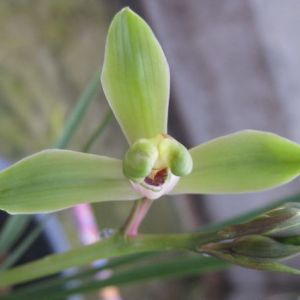
Tianxi Mei Cymbidium faberi Variety Introduction and Care Key Points
Petal type: Red-sheath plum petal. History: Unknown. Characteristics: The three outer petals are round-headed, tightly edged, and narrowed at the base; the shoulders are level; the holds are half-hard cupped; the lip is a small ruyi tongue; the inflorescence on the scape bears only four or five flowers.
-
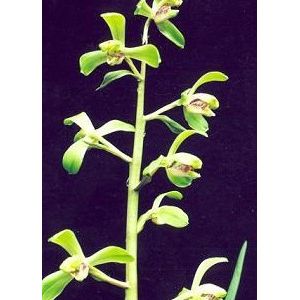
Characteristics and Appreciation Points of the Jinmei Huilan Variety
: Quicksilver red shell green flower plum petal: Huilan, plum petal, selected in 1948 by Mr. Jiang Jinhua of Wuxi, after Liberation collected and cultivated by Mr. Shen Yuanru, during the ten years of turmoil it nearly went extinct, fortunately Mr. Zhang Haorong preserved a few small seedlings, and it remains rare to this day. Characteristics: the flower shape has three outer petals with long feet and round tips, tightly edged and thick-fleshed, the two lateral sepals are in an arching embrace, a level shoulder, silkworm-moth hooded holding the heart, round and smooth, the petal tips have white heads, the round tongue bears brilliant red spots, the flower color is elegantly graceful, with a majestic bearing, comparable to Duanmei and Hanmei. Delicate fragrance, blooms every year, stable traits. Its circulation is extremely limited.
-
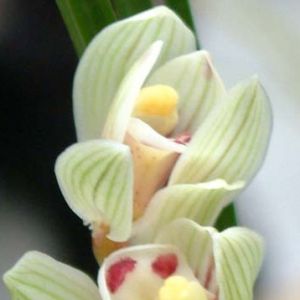
Introduction to the Characteristics and Cultivation Key Points of the Yumei Lotus-petal Orchid Variety
It belongs to the clustered-flower series of Cymbidium tortisepalum var. lianpan, and originates from Baoshan. The leaves are broad, upright, and rigidly erect like swords, dark green in color, with thick blades. The petals are spoon-shaped, with a texture as crystalline as jade, making it a plum-type lotus petal.
-
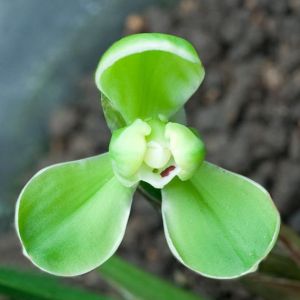
Introduction to the Jiulong Mei Chunlan Variety and Key Care Points
Jiulong Mei, discovered in Jiande, stands out among the newly discovered plum-petal orchids from Jiangsu and Zhejiang. Jiulong Mei: discovered in Jiande, Hangzhou, it is the most perfect among the new plum-petal flowers, with outer petals that are rounded and closed, a fine constricted base, and good color. In 2000, Xu Zhan and Fang Jun found it on Jiulongyuan Mountain within Jiande City, Zhejiang Province, hence the name Jiulong Mei. It is a treasure discovered in Jiande in recent years. The plant...
-

Appreciating Orchid Leaf Forms: Common Leaf Shape Characteristics and Key Ornamental Points
1. Upright leaves: The veins are firm, the leaf texture is relatively thick, and the leaves stand upright. Upright-leaf orchids often have narrow, moist leaf surfaces, such as 'Wang Zi' and 'Huanqiu Hedding'. 2. Semi-upright leaves: After the leaves emerge from the pseudobulb, they grow diagonally upward. Such as 'Long Zi'. 3. Semi-arching leaves: The leaf form is semi-arching, and most orchids have semi-arching leaves. 4. Arching leaves: The leaves...
-
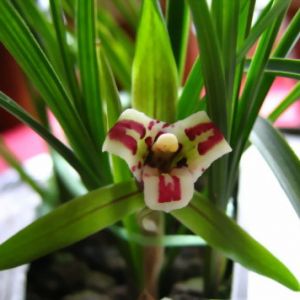
Introduction to the Xiaoyuanbao Cymbidium goeringii Variety and Key Appreciation Points
The leaves are slanted and upright; in robust plants the leaves carry a crystalline, translucent quality, and the plant shows slight butterfly-like variegation. The leaves are noticeably shortened, only about 20 cm long and 0.8-0.9 cm wide. Weak plants lack the crystalline, translucent quality, with leaves about 28 cm long and a lusterless leaf color. The flower scape is 10-12 cm tall; the petal-like segments (peng ban) have become butterfly-like (die hua), forming three tongues, with symmetrically arranged red markings, vivid colors, and a pure, mellow fragrance. Xiaoyuan...
-
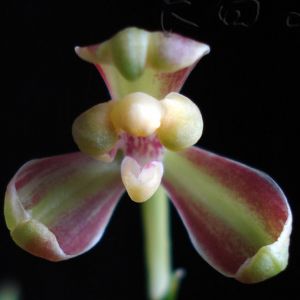
Jianlan 'Jiazhou Xiumei' Variety Introduction and Care Key Points
Jiazhou Xiumei: Jianlan (Cymbidium ensifolium), plum petal type. Originating from the mountain forests of the "Leshan Urban Green Heart" in Shizhong District, Leshan City, Sichuan, it was discovered by Leshan orchid enthusiast Luo Jianqi and named by Mr. Wu Changguang. It was once selected among the top thirty in the top ten famous flowers selection of Sichuan Jianlan (Four Seasons Orchid). As early as the summer of 1993, two well-known orchid growers from Chengdu, Sichuan came to Leshan, and upon seeing this flower...
-
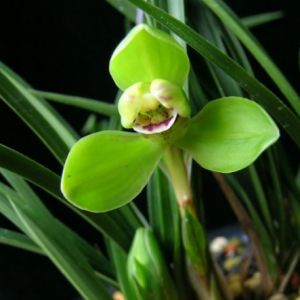
Characteristics and Cultivation Points of the Dingxinmei Chunlan Variety
In 1983, it was selected by Zhang Genyou of Zhoushan, Zhejiang, on a mountain in Dinghai, hence the name. The leaves are narrow and slender, thick and hard in texture, about 0.6 cm wide and about 20--25 cm long. The three outer petals are broad and large, with a narrow base; the petal flesh is thick, soft, and smooth. The main petal is shaped like a "sunshade," the two lateral sepals have tightly rolled edges and form a level shoulder, and the petal tips have purplish-black markings (this is one of the characteristics of this flower...
条件筛选