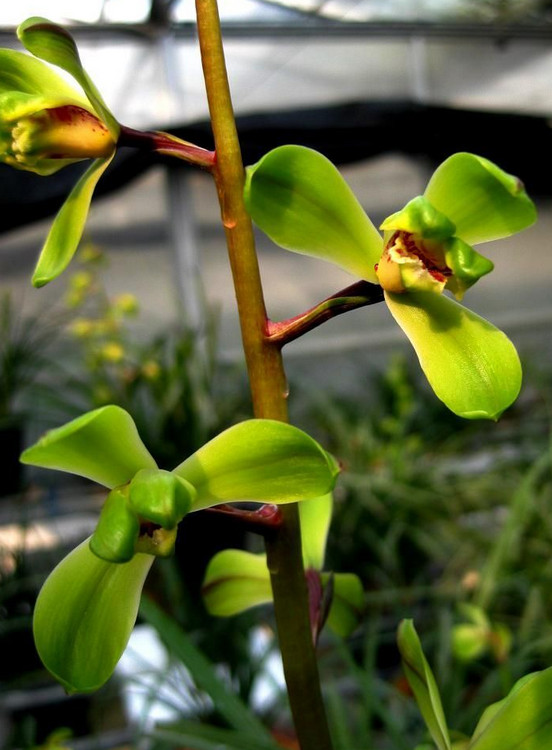
Introduction to the Mingzhou Mei Huilan (Cymbidium) Variety and Key Appreciation Points
Mingzhou Mei, also known as "Tianwang Hui," was discovered and selected by Ningbo orchid enthusiast Shen Qingfa in the spring of 2000 during the Spring Festival when he visited friends in the Xianxiang mountain area, found among ordinary orchids at a mountain farmer's home. Characteristics: the plant's flower stalk is about 45 cm tall, about 1.2-1.5 cm wide, with leaves blunt-tipped and dew-holding in shape, majestic in form. The flower stem is pink at the base with green, round and upright, about 4-5 mm thick, about 50 cm tall and well above the leaves...
Mingzhou Mei, also known as "Tianwang Hui," was discovered and selected by Ningbo orchid enthusiast Shen Qingfa in the spring of 2000 during the Spring Festival when he visited friends in the Xianxiang mountain area, found among ordinary orchids at a mountain farmer's home.
Characteristics: the plant's flower stalk is about 45 cm tall, about 1.2-1.5 cm wide, with leaves blunt-tipped and dew-holding in shape, majestic in form. The flower stem is pink at the base with green, round and upright, about 4-5 mm thick, about 50 cm tall and well above the leaves. The small flower stalk and inner bract are purplish-red without green coloration, shaped like a centipede's pincer head, and the flower is large, with a diameter reaching 6 cm. The three outer sepals are short and broad, with a narrowed base, tightly rolled edges, and the sepal tips are rounded to form an embracing arch. The flower faces straight in a level shoulder position with a slight flying quality; the soft-hard petals remain open for a long time without collapsing, and the lower side of the petal can hold the lip (root). The lip is shaped like a fringe of bangs, protruding but not reflexed, with its length not extending beyond the petals, and there is no red patch on the back of the lip. The column is small like a matchstick, and whether viewed from above or straight on, the column core is still not visible even until the flower fades. This variety generally does not produce many flowers per stem; several rebloomings have all been 7-9 flowers, but the overall arrangement is highly disciplined, with the spacing between individual flowers open and evenly distributed. The flowers can be appreciated from all four sides and are fully worthy of being painted, and the overall bearing is majestic yet still dignified.