-

What pathogen causes privet leaf spot?
The pathogen of privet leaf spot is: Phyllosticta ligustri, a fungus of the Deuteromycotina. The pycnidia form on the leaf surface, initially immersed, scattered or clustered, later breaking through the epidermis and becoming exposed, lens-shaped, measuring 72 to 88 microns. The conidia are nearly oblong, single-celled and colorless, containing 2 oil droplets, measuring 5 to 7 by 2.5 to 3 (microns).
-
Harmful Characteristics and Pathogen Analysis of Robinia Mosaic Disease
Robinia mosaic disease is a common disease of black locust (Robinia pseudoacacia). It begins to occur in spring from April to May. Its symptoms manifest as systemic mosaic. The leaf color is uneven, with some leaves showing mottling of intermingled light green and dark green, and presenting blister-like spots. Some leaves are deformed; the leaf shape becomes narrower and longer, and in severe cases becomes linear. In some leaf axils, adventitious buds sprout and produce thin, weak small branches with extremely short internodes, and the leaves are narrow and small; the axillary buds of the small branches sprout again and produce small branches and leaves, and in this way they sprout and grow level by level, forming a clustered branch state with dense branches and leaves. This affects the normal growth of the tree. After young trees are affected, they gradually
-
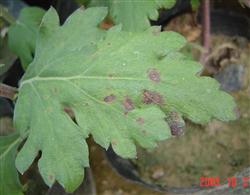
Symptoms and Pathogen Analysis of Chrysanthemum Black Spot Disease
Chrysanthemum black spot, also known as brown spot or leaf blight, occurs in all chrysanthemum-growing regions. Besides harming chrysanthemums, it can also infect wild chrysanthemum, sweet chrysanthemum, pyrethrum and other plants in the Asteraceae family. After infection, mildly affected plants develop scorched, dropping leaves, while severely affected plants may die completely. It seriously affects plant growth and ornamental value. Symptoms...
条件筛选