Raising rabbits on pasture grass is highly profitable, with an annual net income of 200,000 yuan
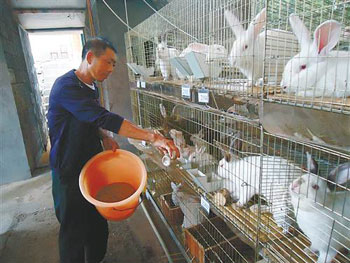
A worker feeds the meat rabbits.
Overview: Huang Jianmei, 31 years old this year, lives in Mengchongtang Village, Huolu Town, Wulong County. The village is located in the mountainous area of southeastern Chongqing and is a municipal-level poverty-stricken village.
Breakthrough: Mengchongtang Village has good water quality and abundant grassland resources, making it suitable for developing meat rabbits, goats and so on. She graduated from the Huolu Vocational High School majoring in animal husbandry and breeding, so she has some professional knowledge.
Path: She took part in the Yulu entrepreneurship training organized by the county, becoming one of the few female trainees in the class, and after returning home she successfully founded a rabbit farm.
Results: It generates an annual net profit of more than 200,000 yuan, and has driven poor villagers who raise rabbits to increase their income by more than 10,000 yuan per household on average.
"Fellow villagers, early winter has now arrived, so please be sure to keep your rabbits warm and protected from the cold." Recently, Huang Jianmei of Longba Agricultural Cooperative in Mengchongtang Village, Huolu Town, Wulong County, holding a small loudspeaker, promoted winter cold protection and warmth measures for domestic rabbits to rabbit-raising households from a mobile service vehicle.
"I changed from a 'village girl' into a rabbit-raising 'celebrity' thanks to taking part in the 'Yulu Entrepreneurship Training' organized by the poverty alleviation departments at the county and town levels, which let me make money from rabbits!" Huang Jianmei, 31 years old this year, told Feng Le, chairman of the town people's congress who came to the village to inspect the targeted poverty alleviation work, with a smile: "Nourished by sunshine and rain, my rabbits are raised strong and bring me a net income of more than 200,000 yuan every year."
No Way to Get Rich, Nourished by "Yulu"
"Look, this is the French grandparent-stock Hyplus rabbit. Its characteristics are fast growth and strong disease resistance and reproductive capacity." In a breeding rabbit shed with an area of about 500 sq m, Huang Jianmei pointed to more than 3,000 breeding rabbits on hand and introduced the characteristics of each type of rabbit to this writer one by one. "Here there are also fine breeds such as the German Giant Checkered rabbit, Belgian rabbit and Chinese black rabbit."
However, looking back four years, Huang Jianmei, who had just returned home from working elsewhere, rarely had a smile on her face. At that time, her family's economic situation had been hovering near the poverty line, and the money she earned from work was only enough to maintain basic living. Just as she was deeply troubled, Feng Le brought a piece of information: the county was organizing "Yulu" entrepreneurship training, so she might as well go and give it a try.
And so, Huang Jianmei came to the county seat and became one of the few female trainees in the "Yulu" class.
Once, while eating at a hot pot restaurant in the county seat, she noticed that rabbit meat, which was rarely used as a "hot pot dish," had also appeared on the table, so she paid attention and observed, and unexpectedly found that rabbit meat was very popular with hot pot diners.
So after returning to school, she consulted the teachers of the Yulu training class, and the teachers analyzed it from aspects such as nutritional value, market conditions and breeding conditions.
First, rabbit meat has high nutritional value, with a protein content as high as 21%. It has the characteristics of high digestibility, high protein and high phospholipids, and also has the "three lows" characteristics of low fat, low cholesterol and low uremic amine.
Second, Mengchongtang Village has good water quality and abundant grassland resources, and the temperature and humidity are very suitable for the breeding and growth of meat rabbits.
Most importantly, meat rabbits raised in a green, pollution-free way are very popular with customers on the market.
Green Farming, Demand Exceeds Supply
Nourished by "Yulu," Huang Jianmei stored up a great deal of rabbit-raising knowledge in her mind, and full of confidence she began to start a business, becoming a rabbit boss.
In order to ensure pollution-free green farming, she put the 15 mu of idle land of nearby farmers who had gone out to work to use, planting it all with ryegrass and green vegetables for use as feed for the meat rabbits; during the raising process, she added no hormone feed at all; every week she disinfected the rabbits twice on a regular basis, and for epidemic prevention drugs she mainly used Chinese medicines such as Huanglingsu and heat-relieving medicines such as Huoxiang Zhengqi liquid.
"We use all-pasture-grass farming, self-breeding and self-raising, and it is absolutely healthy green food." Huang Jianmei said that green rabbit meat was very popular as soon as it hit the market, and demand has always exceeded supply. The current lowest selling price is 12 yuan per jin, and buyers come directly to her door to purchase it. "Next, I will carry out pollution-free certification and trademark registration for the meat rabbits. By then, the rabbit meat can be sold directly in supermarkets."
Developing Orders, Driving Income Growth
Her own breeding sheds were limited, so how could she expand the scale? Huang Jianmei took the lead in establishing a meat rabbit breeding professional cooperative, following the breeding model of "professional cooperative + base + farmer households," "sending out breeding rabbits and taking back commercial rabbits," which both gave farmers a "reassurance pill" and solved the worries of poor households raising rabbits.
She also set up a rabbit-raising service team, always stocked with medicines for rabbit disease prevention and treatment, and drove a minivan every day to provide mobile door-to-door service. At present, 110 poor villagers in the whole village have taken up rabbit raising, and her mobile phone has also become a free service hotline. Whenever anyone's rabbit gets sick, she comes as soon as she is called. "In the village there are 6 large households raising more than 50 female rabbits, with an annual net profit of 30,000 yuan; there are 100 poor farmer households raising 20 female rabbits each, with an annual net profit of more than 10,000 yuan."