-

Can Kapok Flowers Be Eaten Raw? A Detailed Explanation of Raw-Eating Safety
The kapok tree is a deciduous tree of the genus Bombax in the family Malvaceae (formerly Bombacaceae), also known as panshihua, Molian, red jasmine, Molian flower, red cotton, and other names. It is widely distributed in tropical regions, and was introduced to Taiwan, China in 1645 and is now commonly cultivated. Kapok flowers can be used as medicine; generally, fresh kapok flowers are sun-dried and then used to cook congee or soup.
-
How to Grow a Kapok Tree (Bombax ceiba)? Detailed Planting Methods and Precautions
Sometimes you will see a kind of red flower on the road, very beautiful; in fact, that is the kapok flower. Its plant is very tall and has high ornamental value, and it is generally sown with seeds, but the seeds planted in this way usually need
-
When Is the Kapok Flower Season? A Detailed Guide to Its Blooming Time
The kapok flower is the flower of the kapok tree (Bombax ceiba). It is the city flower of Guangzhou, Kaohsiung, and Panzhihua. The flowers are large and beautiful, making it an excellent street tree, shade tree, and landscape tree. So, in which months is the kapok flower season? 1. Kapok Flower Season The kapok flower season is in spring
-
In which months does the kapok tree shed its leaves, bloom, bear fruit, and grow new leaves?
Kapok, also known as red cotton, hero tree, panzhihua, mottled cotton, mottled cotton tree, panzhi. The flowers are orange-red. Every year from February to March, after the leaves have all fallen, it enters the flowering period, blooming from March to April, flowering first and then growing leaves, and bearing fruit in summer. The kapok tree has a masculine beauty in its form. Kapok
-
What medicinal benefits does the bark of the kapok tree (Bombax ceiba) have? With kapok tree pictures
1. Treating waist and knee pain The bark of the kapok tree has the effects of relaxing muscles and promoting blood circulation, dispelling wind and removing dampness, and can treat people's waist and knee pain with very outstanding results. During treatment, its bark can be soaked in high-strength baijiu and drunk directly as medicinal liquor. Or add an appropriate amount
-
Does the kapok tree have fruit? An analysis of the latest number of kapok varieties
I. Does the kapok tree have fruit? There are many kinds of kapok trees; some have fruit, some do not. Among those that do, the fruit is a capsule, oblong in shape. It is 10 to 15 cm long and 4.5 to 5 cm thick. The fruit is covered with dense grayish-white long silky hairs, and inside there are many seeds; the seeds are obovate and very smooth on the surface. It usually blooms in March and April, and after flowering it bears fruit, which ripens in summer. Comparatively speaking, those that have fruit are fewer.
-
What is kapok? Latest interpretation of whether it is a flower or a tree
1. What kapok is. Kapok is also called panszhihua, red cotton, hero tree, spotted zhi tree, etc., and belongs to the Bombacaceae family as a large deciduous tree. Its place of origin is India, and it grows in tropical and subtropical regions. It is between 10 m and 25 m tall, with palmately compound leaves. It blooms
-
What does the kapok tree symbolize and represent, and in which month does it bloom?
I. What does the kapok tree symbolize? 1. Hero: The kapok tree is also called the hero tree. Although its flowers are quite bright in color during the blooming period, a vivid red, they do not look tacky at all. The red flowers covering the whole tree are like hot blood, dyeing the treetops red. Even when the flowers fade, they do not lose their color, just like a hero with a noble and unyielding spirit.
-
The Latest Planting Methods and Cultivation Techniques of the Kapok Tree Explained
The kapok tree (Bombax ceiba) is a large deciduous tree of the family Malvaceae (formerly Bombacaceae), mainly distributed in tropical provinces. The kapok tree has high ornamental value, with bright, colorful flowers, and is planted in many cities. Kapok flowers also have effects such as clearing heat and detoxifying, and dispelling cold and dampness. The bark
-
Introduction to the kapok tree: get to know this plant
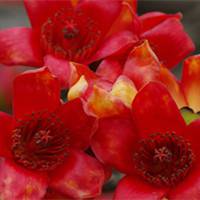
The kapok tree (Bombax ceiba) is native to India and is a large deciduous tree that grows in tropical and subtropical regions, reaching 10-25 m in height. The kapok tree varies greatly in appearance and shows different colors in different seasons. Its flowers are large and beautiful, and its form is majestic, making it suitable as an ornamental tree for gardens and pavilions or as a street tree.
条件筛选