-

Detailed Explanation of Control Methods for Licorice Leaf Spot Disease
① The pathogen is a type of imperfect fungus (Cercospora astragali), belonging to the subdivision Deuteromycotina → Moniliales → Cercospora fungus. It damages leaves; affected leaves produce circular or irregular lesions, with the center of the lesion grayish-brown and the edges brown, and grayish-black mold-like growth on both the front and back of the lesions. Fruiting bodies grow on both sides of the leaf, but mainly on the upper surface; the stroma consists of only a few brown cells; conidiophores are born in bundles of 6 to 12, pale brown, with the apex lighter in color and narrower, unbranched, having 0 to 5 geniculate nodes, with the apex nearly truncate, spore scars prominent, and 1 to 7 septa; conidia are whip-shaped to obclavate, colorless and transparent, straight to curved, with the base truncate to nearly truncate, the apex slightly blunt, and 3 to 10 septa.
-
Morphological Characteristics and Control Techniques of the Rice Root Leaf Beetle
The rice root leaf beetle, also known as the rice root golden flower beetle, belongs to the order Coleoptera, family Chrysomelidae. The adult is about 6 mm long; the dorsal surface of the body and the antennae are greenish brown with a metallic sheen, and the ventral surface bears dense, thick silvery hairs. The lower half of the femur of each leg is swollen, and the femur of the hind leg has a tooth-like spine near its apex. The elytra bear several parallel longitudinal grooves made up of punctures. Eggs are laid in masses and covered with a white, transparent gelatinous substance. The eggs are long oval, slightly flattened, about 0.8 mm long, initially milky white and later turning pale yellow. The larva is about 9 mm long, spindle-shaped, white and slightly curved, with 3 pairs of thoracic legs
-
Timely Control of the Rice Leaf Roller Is Essential and Cannot Be Delayed
The rice leaf roller is one of the major rice pests in our province. Its larvae damage the leaves, turning rice leaves into a mass of withered white. Especially when it attacks at the booting or heading stage, it will cause a sharp decline in rice yield. This pest has seven generations a year, and the second-generation larvae are the most numerous and cause the most serious damage to early rice. If control is not timely, it will break out in a major outbreak during the heading period, causing incalculable losses. For forecasting the rice leaf roller, the appropriate control timing should be determined based on the forecast of the occurrence period. Based on past conditions, investigation should begin 4 days after the peak of the moth flight
-
Rice seedlings turning yellow, leaves curling, leaf-rolling: what to do? A detailed guide to prevention and control
There are many causes of the rice leaf-rolling phenomenon, and the most common one is the rice leaf roller (Cnaphalocrocis medinalis). Damage characteristics: the larvae bind silk to roll rice leaves lengthwise into larval cases, and the larvae hide inside and feed on the mesophyll, leaving only the epidermis, forming white streaks, which reduces the 1000-grain weight of rice, increases empty grains, and causes yield loss. Control agents: 1. Select rice varieties resistant to (or tolerant of) the pest, fertilize reasonably, so that the rice grows and develops vigorously, and prevent excessive early growth and excessive tillering as well as late-season stay-green and delayed maturity. Manage water scientifically, adjust the drainage (field-drying) time appropriately, and reduce field humidity during the larval hatching period
-
Can emamectin benzoate control the rice leaf roller?
Emamectin benzoate is a new type of high-efficiency semi-synthetic antibiotic insecticide synthesized starting from the fermentation product avermectin B1. It has the characteristics of biological pesticides such as ultra-high efficiency, low toxicity (the formulation is nearly non-toxic), no residue, and no pollution. Compared with avermectin, its insecticidal activity is first increased by 1-3 orders of magnitude. It has extremely high activity against the larvae of Lepidoptera insects and many other pests and mites. It has both stomach poison action and contact action, and has very good effects at very low doses (0.084~2g/ha), and in the process of controlling pests it is harmless to beneficial
-
What pesticide gives the best control effect against older larvae of the rice leaf roller?
Chlorpyrifos and abamectin-monosultap are effective agents for controlling the rice leaf roller, but they must be applied during the 1st-2nd instar young larval stage (at this stage the rice leaf roller has not yet rolled leaves and caused damage, or has just begun rolling the leaf tips and causing damage), when the rice in the field has just begun to roll leaves. For rice leaf roller larvae of the 3rd instar and above, on the one hand they are protected because they are wrapped inside the rice leaves, and on the other hand they are insensitive to nereistoxin-type pesticides such as monosultap and to organophosphorus pesticides such as chlorpyrifos, methamidophos and monocrotophos, so the control effect after spraying is poor. Relatively speaking, older rice leaf
-
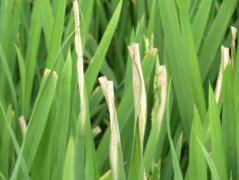
Success in Controlling Rice Bacterial Leaf Blight: Xingda Releases 2 Disease-Resistant Rice Varieties
Rice bacterial leaf blight, be gone! Xingda releases 2 disease-resistant rice varieties. Do you know which two rice varieties they are? Let's take a look. When farmers grow rice, what they fear most is encountering bacterial leaf blight, rice blast and sheath blight. The appearance of these diseases means reduced yields and affected rice qual
-
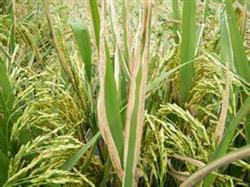
Detailed Explanation of the Causes and Control Techniques of Rice Bacterial Leaf Blight
The pathogen of rice bacterial leaf blight is Xanthomonas oryzae, a bacterium belonging to the genus Xanthomonas. Bacterial leaf blight is one of the major diseases of rice. Once it occurs, it generally reduces yield by 10%, and in severe cases by 50-60%. Therefore, strengthening the control of bacterial leaf blight is very important. 1. Causes of the disease 1.1 Relationship between disease occurrence and climatic conditions...
-
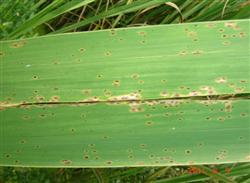
Jiaobai (wild rice stem) is prone to Helminthosporium leaf spot disease under high-temperature and high-humidity weather
Jiaobai Helminthosporium leaf spot is a fungal disease. In recent years, as the jiaobai planting area has continued to increase, the scope of occurrence of this disease has gradually expanded, and the severity has become increasingly worse. This disease can occur throughout the entire growth period of jiaobai. It mainly damages the leaves. In the early stage, small yellow-brown spots appear on the leaves, which later expand into brown spots the size of sesame seeds, with a few forming...
-
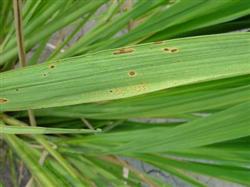
Symptom Identification and Control Methods of Rice Blast Leaf Spot on Water Bamboo
Rice blast leaf spot is a major disease of water bamboo, widely distributed and commonly occurring, found in all water bamboo growing areas, with more severe incidence in summer and autumn, diseased plants often reaching 80%-100%, significantly affecting water bamboo production. [Symptoms] This disease mainly affects the leaves. The lesions initially appear as small brown necrotic spots, which later develop into nearly oval to spindle-shaped...
条件筛选