-

How can reduction and efficiency gains be put into practice? The green yield-increase model is key
Reporter: As one of the crops in the first pilot program for fertilizer reduction in 2015, what problems do you think currently exist in corn fertilization? Zhang Fusuo: Northeast China and the Huang-Huai-Hai region are China's main corn-producing areas. The common problems in corn fertilization are: overall chemical fertilizer application rates
-
How to Break the Dilemma of the "Three Simultaneous Increases" in Grain
The strange phenomenon of the simultaneous increase in China's grain production, imports, and stockpiles has not only caused serious unsold surpluses of domestically produced grain, but also, under the impact of cheap imported grain, has kept national grain stockpiles persistently high. In the short term, this obstructs domestic grain circulation and increases pressure on fiscal spending.
-
How to view the sharp increase in China's grain imports in recent years
Over the past few years, China's grain imports, especially rice imports, have increased substantially, and China has now become one of the world's top two rice importing countries, while China's rice exports have remained at a relatively low level; correspondingly, China's domestic paddy rice output has increased and inventories have remained high, creating a two-way squeeze on China's rice market
-
How to stabilize grain production and increase grain-growing income
The State Council executive meeting held on the 11th pointed out that China's grain output has increased for consecutive years and achieved another bumper harvest this year, strongly supporting economic and social development and the improvement of people's livelihoods, but there are also problems such as a sharp increase in inventories and falling prices. Multiple measures must be taken to effectively protect farmers' interests
-
How to ease the continuous pressure on major grain-producing areas to increase output
The state takes the people as its foundation, and the people take food as their heaven. Food security bears on the development of the entire national economy and social stability. To raise grain production capacity and ensure food security, China has designated 13 major grain-producing areas. In recent years, grain output in the major producing areas has increased year by year
-
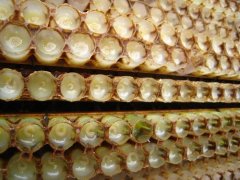
Is China's royal jelly production high, and how can royal jelly production be increased?
Nowadays more and more people are keeping bees, and at present we want to increase royal jelly production, which is an important guarantee for improving the economic benefits of beekeeping. So how should royal jelly production be increased? Do you know? 1. Build up strong colonies so that the bee colony strength for royal jelly production reaches
-
When to Plant Honeysuckle? Learn How to Process It to Increase Added Value
During the pandemic, because it was rumored to have a preventive effect, honeysuckle once sold out completely, and as for growers, their enthusiasm for planting the following year also increased greatly. So when is honeysuckle planted? How can processing increase its added value? Let's explain one by one below, just
-
How to cultivate Taiwan long-fruited mulberry? Pruning can increase yield
Abstract Site selection: A place with deep and fertile soil and convenient drainage and irrigation should be chosen. Cultivation requirements: Dig planting trenches and apply base fertilizer; the spacing between each plant and row is determined by the fertility of the land; after planting, water must be applied to settle the roots. Water: The sprouting periods after spring pruning and summer pruning have a high water demand. Fertilizer: Chicken
-
How to grow potted apricot trees? Frequent pruning increases the sprouting rate and promotes flowering
Abstract For a potted apricot tree, you must first choose a suitable variety, then carry out seedling cultivation and potting and planting. When the apricot tree has grown for a certain period of time, shaping and pruning must be done in time. Next, the fertilizer in the potting soil must be well managed, and fertilizer should be added at the right time according to the situation. Later, attention must also be paid
-
How to increase the fruiting rate of loquat? Reduce humidity, cultivate fruiting mother branches, shape and prune, and apply additional fertilizer reasonably
Loquat is a fruit with high nutritional value. It is not only delicious and good in texture, but its leaves can also be combined with other medicines to make drugs. Therefore, loquat is welcomed by the market and people. In order to meet the needs of people and the market, the planting area of loquat is also becoming ⟦4 <p>Loquat is a fruit with high nutritional value. It is not only delicious and good in texture, but its leaves can also be combined with other medicines to make drugs. Therefore, loquat is welcomed by the market and people. In order to meet the needs of people and the market, the planting area of loquat is also becoming wider and wider. So how should the fruiting rate of loquat trees be increased? Next, I will share some methods for increasing the fruiting rate of loquat trees.</p><p></p><p><strong>Reduce humidity</strong></p><p>During the flower bud differentiation stage, loquat greatly needs a dry environment with high temperature and sufficient light. The flower branch bud differentiation stage of loquat occurs in summer, and there is more rain in summer, so drainage work must be done well at this time. In order to prevent water accumulation, drainage ditches must be made in low-lying areas with many pits. If the humidity in some orchards is too high, then when the leaves turn green, dig open the base of the loquat tree, expose the roots, and then cut about 80 percent of the branch roots into sections, thereby controlling nutrient dispersion, speeding up the greening of the leaves, and increasing the fruiting rate of loquat.</p><p></p><p><strong>Cultivate fruiting mother branches</strong></p><p>Because the fruiting branches of young loquat trees are all formed from summer shoots, the time, quantity, and growth capacity of summer branch bud sprouting are closely related to the fruiting rate of loquat. Therefore, a healthy and strong mother branch is the key to the number of fruits set, so in spring, after the new branches mature, fertilize in time to promote the sprouting of summer branch buds. During the fertilization stage, attention must also be paid to the amount, avoiding improper fertilization affecting the growth of loquat. Fertilization should be based on the growth stage of loquat, and the fertilizer is generally mainly phosphorus and potassium fertilizer.</p><p></p><p><strong>Shaping and pruning</strong></p><p>The pruning period of loquat is different from that of other fruit trees. Loquat is an evergreen fruit tree, so it cannot be pruned in winter like other fruit trees. Loquat pruning should be carried out in summer, immediately after the fruit is harvested. Because the summer branch bud sprouting is the most important one for loquat, it cannot be too late, otherwise it will affect the growth of flower buds. Autumn pruning of loquat is only an auxiliary pruning, carried out before the flower buds open in autumn. Fruit tree pruning can reduce the occurrence of pests and increase the nutritional development of the fruit tree, thereby improving the fruiting rate of loquat.</p><p></p><p><strong>Apply additional fertilizer reasonably</strong></p><p>Loquat needs sufficient nutrients, so during the fertilization process, the demand for phosphorus and potassium is relatively high. Therefore, the proportion of phosphorus and potassium fertilizer can be increased in fertilization, and the use of nitrogen fertilizer can be reduced. Because excessive use of nitrogen fertilizer will cause loquat to grow too fast and have excessive nutrients, seriously affecting the production volume of loquat. Therefore, use fertilizer reasonably, increase the proportion of phosphorus and potassium fertilizer, and improve the fruiting rate of the fruit tree.</p>
条件筛选