Is China's royal jelly production high, and how can royal jelly production be increased?
Nowadays more and more people are keeping bees, and at present we want to increase royal jelly production, which is an important guarantee for improving the economic benefits of beekeeping. So how should royal jelly production be increased? Do you know?
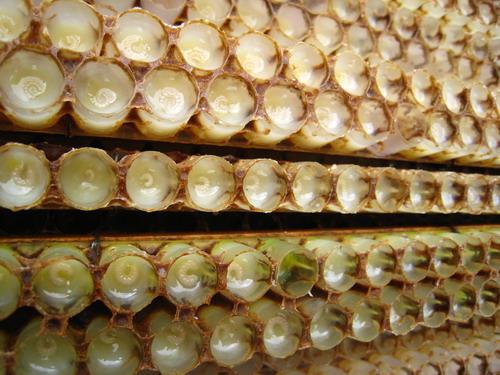
1. Build up strong colonies so that the bee colony strength for royal jelly production reaches a full colony of more than 12 frames
Among bees, royal jelly is secreted by young bees and is the main food supplied to the queen bee and bee larvae. Therefore, to increase royal jelly production, there must be strong colonies with more young bees, and the jelly-producing colonies must be adjusted in good time. If there are only 6-7 frames of bees, a high royal jelly yield cannot be achieved. For this reason, the number of young bees should be increased so that the bee colony strength grows to a full colony of more than 12 frames, laying a good foundation for increasing royal jelly production.
2. Prepare enough bee larvae of the right age to ensure the needs of larval grafting
To produce royal jelly in large quantities, many bee larvae are needed. Generally, for each royal jelly frame grafted, at least hundreds of bee larvae of the right age are required. If they are sought on the spur of the moment before grafting, it not only takes time but also makes it hard to find enough. Therefore, 5-6 days before each planned grafting, empty combs should be added to newly split bee colonies or double-queen colonies to let the queen bee lay eggs. In this way, by the time of grafting, most are suitable-age larvae within 24 hours, which are not only numerous and uniform in larval age, with 1 frame of larvae able to graft more than 6 royal jelly frames, but also speed up grafting, remove the need to search on the spur of the moment, save time and improve work efficiency.
3. Persist in collecting jelly at the right time to prevent bee larvae from eating too much royal jelly
As for the royal jelly secreted by young bees, if collection is too late, the bee larvae grow larger and their consumption increases, reducing royal jelly production. Therefore, the right time to collect jelly is generally within 68-72 hours after the bee larvae are grafted in, and scraping the royal jelly can be arranged after 9 a.m. The jelly should be scraped clean carefully to prevent larval body fluids from mixing into the royal jelly, causing it to foam and affecting quality.
4. Combine with heavy sugar feeding to extend the royal jelly production period
The length of the royal jelly production period is directly related to the level of yield. Therefore, to extend the jelly production period, when the main honey flow is about to end, take advantage of auxiliary nectar and pollen sources and periods with pollen but no nectar, and combine this with heavy sugar feeding, so that the royal jelly production period is effectively extended and jelly output is increased.
5. Carry out stimulative feeding to arouse the workers' enthusiasm for secreting jelly
The amount of royal jelly produced mainly depends on how much jelly the worker bees secrete. To arouse the workers' enthusiasm for secreting jelly, stimulative feeding of the colony should be maintained. The time for stimulative feeding is the evening of the day before collecting jelly. At this time, even during the main honey flow, if nectar sources are insufficient or stored honey and pollen are inadequate, stimulative feeding must likewise be carried out.