-

What is the difference between Fanbaicao (Potentilla discolor) and Jucai (Potentilla chinensis)?
Fanbaicao, also known as Jituigen, Jibatui, Tianou, Yexiabai, Jizhuashen, and Fanbaiweilingcai, is cultivated in most parts of our country. Where is the difference between it and Jucai? 1. Where is the difference between Fanbaicao and Jucai? 1. Different roots. The root of Fanbaicao is thick and robust
-
Is gongcai a "fafu" food? Learn the facts before eating it
Gongcai, also known as taigan, was cultivated 2000 years ago, but during the reign of Emperor Qianlong it was designated as fit only for the imperial household, and so it was called gongcai. So is gongcai a fafu food? Gongcai is not a fafu food. What does fafu mean? Fafu refers to foods that are rich in nutrients or stimulating
-
What Is Facai? The Treasure of the Gobi and the Five Main Differences from Sea Facai
Facai, also known as dimaocai or xiancai, is an algae that looks like strands of hair. It is deeply loved by people for its effects of clearing heat and detoxifying, and resolving phlegm. Currently, only dried products are sold on the market, so what is facai? And what is the difference between it and sea facai? 1. What is facai
-
How is Anhui's famous wild vegetable ta cai (flat cabbage) grown?
Ta cai! I wonder if you have heard of it. This is a very famous wild vegetable in Anhui Province. It belongs to a category of Chinese cabbage. The name is actually interesting in origin: it is called ta cai because the whole plant lies flat on the ground, which is why it is called ta cai.
-
Why isn't fa cai (Nostoc flagelliforme) considered a plant? The latest explanation
Fa cai (Nostoc flagelliforme) is a terrestrial alga in the phylum Cyanobacteria, family Nostocaceae, genus Nostoc. Its cells are entirely blackish-blue. The edible fa cai grows attached beneath desert plants. Because its shape resembles tangled hair and its color is pitch-black, it is named fa cai, and is also called di mao. It has the effects of clearing heat and detoxifying, soothing the lungs and resolving phlegm, and regulating the stomach and intestines.
-
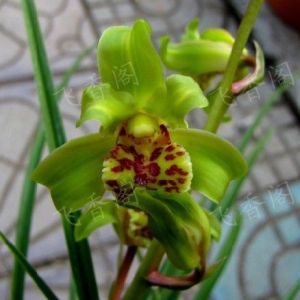
Cymbidium faberi cultivar Zijing Xiangyun, also known as Caiyun Mei
Bicolor floating-door [Caiyun Mei], some orchid growers in Hubei also call it [Zijing Xiangyun]. Special Gold Award at the 18th Wenzhou Orchid Expo. The wick-like stem is beautiful, the tongue is also beautiful, the color change is good, and it is a variety with high cost performance among floating-door orchids.
-
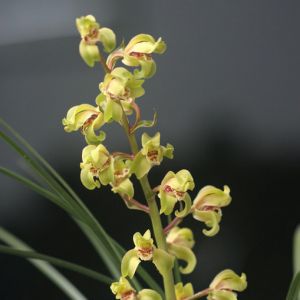
Introduction to the Cymbidium faberi variety Jingxi Caiyun (Xin Duo Yun)
Xin Duo Yun, a rare flower that turns from red to green, is also known as Jingxi Caiyun. In 1987, Tai Shunda of Yixing selected it from among wild-collected Cymbidium faberi flowers, and Qian Zhongfu of Wuxi named it because the flower resembles the old variety Duo Yun. Its outer three petals are short and broad with a finely contracted base, and the petal tips uniformly curl backward, with a thick and supple petal texture. The inner petals are short and broad, curling backward in a cat-ear shape, with yellow milky patches on the inner petals and obvious masculinization. The lip is round...
-
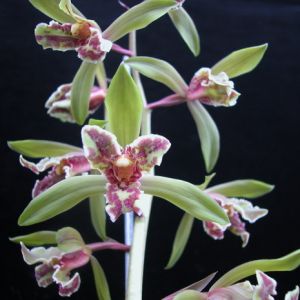
What kind of orchid variety is the Cymbidium faberi 'Dadiecai'
Petal type: Red Cymbidium faberi three-star butterfly. History: In the spring of 1997, Qian Yongkang of Changshu purchased it from Lu Jianjun of Dinghai, Zhejiang. Originally named 'Qiandao Diecai'. In his later years, Gu Shuqi once proposed that it be renamed 'Dadiecai'. Today, Gu's final wish has been fulfilled. Characteristics of Dadiecai: New shoots are pale purplish-red. Leaves are 35-45 cm long and 1.2 cm wide. The leaf color is emerald green, the leaf texture is thick, the leaf surface has a "V"-shaped leaf groove, the leaf tips are bluntly rounded, and the marginal leaves cup inward in a spoon shape. The leaf posture is arching and pendulous. The flower scape is round and upright, purplish-red, rising above the leaves; the pedicels are bright purplish-red, with 7-15 flowers per scape. The three outer petals are narrow and long, with constricted bases and broad tips, and the two sides curve in an embracing manner. The most striking feature of this flower: the two inner petals are butterfly-like -- just like the lip, the edges of the tongue are rimmed with silver, and the tongue surface is densely dotted with brilliant red blotches. It fills the gap of "stamen butterfly" among traditional Jiangsu-Zhejiang Cymbidium faberi, and its flower type is exceptionally large.
-
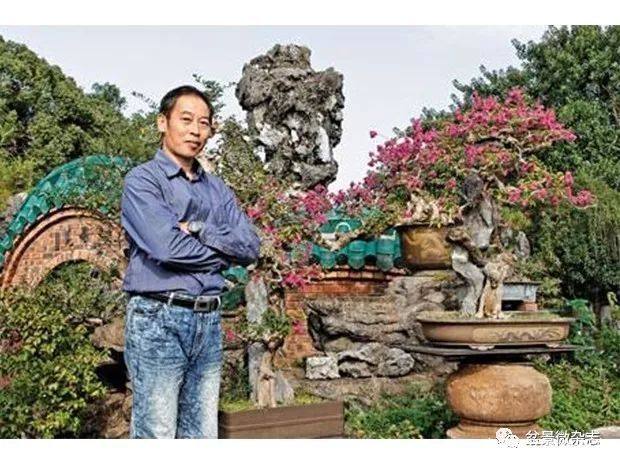
Bonsai: A Rare Auction House Rising Star That's Hard to Fake, Hong Kong's Cai Yongchang Deconstructs Its Value
A Rare Auction House Rising Star That's Hard to Fake - Hong Kong's Cai Yongchang Deconstructs the Value of Bonsai. Written by: Zhang Qixia Photography: Chen Zongyu. The history of bonsai art dates back to the Tang Dynasty. In the tomb of Crown Prince Zhanghuai, there still remains a mural of a maid holding a potted plant. In Song Dynasty literary works...
-
Farmers in Shangcai County, Henan, pave a road to prosperity with their sweat
Shangcai County, Henan Province: paving a road to prosperity with sweat
条件筛选