Bonsai: A Rare Auction House Rising Star That's Hard to Fake, Hong Kong's Cai Yongchang Deconstructs Its Value
A Rare Auction House Rising Star That's Hard to Fake - Hong Kong's Cai Yongchang Deconstructs the Value of Bonsai
Written by: Zhang Qixia Photography: Chen Zongyu
The history of bonsai art dates back to the Tang Dynasty. In the tomb of Crown Prince Zhanghuai, there still remains a mural of a maid holding a potted plant. In Song Dynasty literary works, there are also words of praise for potted plants. During the Ming Dynasty, the bonsai trend was flourishing. In "Kao Pen Yu Shi," the term "bonsai" appeared for the first time, and there were already particular requirements for its pot and the posture of the plants.
Bonsai art integrates literature, art, sculpture, horticulture and other different fields. It emphasizes seeing the big in the small, keeping landscapes within a small pot for enjoyment. Without traveling a thousand miles, one can still enjoy natural scenery and observe the changes of the seasons. The pleasure of this traditional culture is also valued by people today. In recent years, at auction, bonsai prices have repeatedly hit new highs, attracting more and more attention.
Bonsai master Cai Yongchang began working with bonsai in the 1970s. More than thirty years have passed since then. From an amateur hobby at the beginning to full devotion now, he has created many fine works, and he also hopes that the younger generation can take over and carry it on.
Cai Yongchang has lived in Sha Tin, Hong Kong, since the 1970s. Because many people nearby played with bonsai, out of curiosity he took a look, and gradually became familiar with many bonsai friends. The seniors who played with bonsai even invited the young people to camp on an outlying island. Only after arriving did they discover that they were actually there to help dig up trees and take them home to plant. At this point, he did not forget to add: "In the early days there were no restrictions. Later it was not allowed."
Gradually, after seeing the various outstanding works of his seniors, he also began to feel the urge, and in the 1980s he tried learning to play with bonsai himself. "At that time, most people who played with bonsai were retirees. When others heard that someone as young as me also played, they found it strange." While teaching himself, he asked people everywhere for advice. The more he played, the more skilled he became, and the more obsessed he grew, even drawing complaints from his family.
At that time he ran his own business and used his spare time to care for bonsai. His business repeatedly suffered losses, but his bonsai works repeatedly won awards. Later he ended the business and became an underground railway drilling technician. After resigning, he went to "Yun Quan Xian Guan" to serve as deputy director of gardens, responsible for managing the entire garden and tending to the hundreds of bonsai in the garden. He finally achieved the work he loved, and also served as chairman of the Sha Tin Potted Plant Association and vice chairman of the Hong Kong Bonsai and Viewing Stone Society. It could be said that he devoted himself entirely to bonsai.
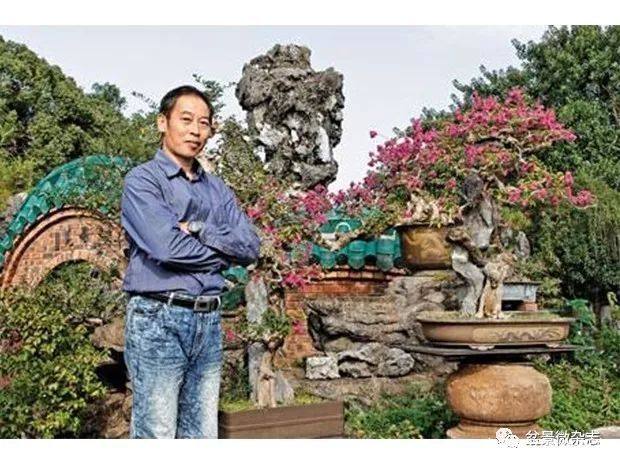
Cai Yongchang became fascinated with bonsai in the 1980s. He is highly experienced, having started playing with bonsai from a young age, and his character also changed because of this interest.
The Lingnan School Dominates Local Bonsai
The local bonsai trend flourished for a time in the 1960s and 1970s. In 1962, an exhibition at St. John's Chapel in Hong Kong displayed many Guangzhou bonsai works, mainly in the Lingnan School style. Their high artistic conception and skill drew repeated praise from many citizens, sparking interest, and more and more people played with bonsai. But locally, most bonsai enthusiasts were amateur in nature and lacked relevant space and knowledge, so enthusiasts from various sides organized associations and built bonsai gardens so that members' works would have a place to be kept. The Hong Kong Bonsai and Viewing Stone Society, established in 1970, even built a Jiangnan-style garden called "Shek Yuen." The environment was quiet and elegant, and it also became a commonly used filming location for television period dramas.
Local bonsai art is mainly of the Lingnan School, whose history can be traced back to the Ming and Qing dynasties. Its style is greatly different from that of the northern school. It is characterized by the technique of "cultivating branches and truncating trunks," pursuing vigorous, rugged and unusual postures. It often uses subtropical and tropical evergreen fine-leaved tree species, and regards abundant branch claws as beautiful. Therefore, before exhibition, the branches are often pruned to induce new buds, bringing it to its best condition.
Bonsai can basically be divided into two major categories: tree stump bonsai, which mainly features plants, and landscape bonsai, which mainly features mountain rocks. In terms of tree form, they can be divided into single-trunk style, double-trunk style, one-head multi-trunk style, forest style, cascade style, lying-pot style, falling-branch style, rock-clinging style, and so on. The first step in making bonsai is to trim the tree base, called "cutting the embryo." After it sends out new buds, unsuitable ones must be cut away so that suitable leaf buds grow into branches, which is called "cultivating branches." When they have grown to a suitable direction, length, thickness and so on, their tips are then cut off, which is called "truncating trunks." After the cut branches grow new buds, selection and pruning are carried out again, and so on. Whether it is the main trunk, side branches or small branches, their growth posture is all under control. Over the years, branch after branch forms nodes, creating a unique gnarled and coiled posture. The tree's volume also becomes shorter and smaller, making the stump bonsai more compact.
The method of "cultivating branches and truncating trunks" takes a long time. Often the tree must first be planted in the ground for 10 years to allow the main branches to become established. Cai explained: "After it has about sixty percent of its appearance, then move it into a pot." After being moved into a pot, it must be pruned for at least 3 years before the final posture can be determined, because the growing space in the pot is small and the roots cannot extend well, so the tree adjusts its growth form and speed. "Only after moving it into the pot can it grow claws. In the ground it cannot. It will not listen to your control; once it grows branch claws, they become very long." Only when a tree grows fine branch claws is it considered a mature work.
The growing space in a pot is limited, and it is easy for the tree to lose vitality. Therefore, every two to three years the roots must be pruned and the soil changed so the tree grows new roots and remains healthy. It may even need to be moved back into the ground until its branches and leaves grow more luxuriantly, and then moved back into the pot. "If poorly managed, bonsai will decline and deteriorate. If well managed, it can last more than 100 years. Even if some trees deteriorate, they can be saved, and may even grow more beautifully than before."
The island podocarpus bonsai offered in this auction, "Cliff Pine, Bird Song," has a strong painterly quality. The trunk has a steep falling momentum, and the distribution of branch technique is smooth. It took twenty-five years of pruning and cultivation to complete.
Speaking of pruning insights, he said frankly that there are no shortcuts. The most important thing is to do more. The picture shows him helping a friend revise a large tree bonsai and its composition.
20 Years to Cultivate a Coiled Cascade Posture
Bonsai does not need frequent pruning, otherwise it will harm the tree's health and life. "Usually prune twice a year, unless some branches grow too strongly, in which case they must be cut first." But one must also pay attention to its growth condition. For example, if strong branches suddenly grow, they ruin the composition and also draw away nutrients from the old branches, so they must be cut off in time.
Cai said that sometimes only after moving it into a pot do you discover that the tree's form differs from what you expected, and it must be pruned and adjusted again. "Only after two or three years, when you understand this tree, will you prune it better." The room for pruning a work is endless. After one side's branches are completed, the other side can also be developed to echo it. "Some can even start over from the beginning."
The worst situation in bonsai is when a tree suddenly dies, wasting years of effort. There are many factors that cause complete withering. For example, if drainage is insufficient or if one forgets to loosen the soil for the bonsai, the pot surface may become compacted, preventing the roots from absorbing air and water. "If not dealt with in time, it may die at any moment. The whole process can be very fast, a matter of only a few days."
If butterflies appear, one must be even more on guard. "Two or three days after they fly past, insects begin to appear on the tree. If it is in early autumn, after the leaves are all eaten by insects, they will no longer grow, especially on slow-growing pines. It often gets eaten hollow within two days, and then the whole tree begins to die, wasting years of effort. Insects have protective coloration, so as soon as you see abnormal signs of withering on a pine, you must immediately inspect it carefully."
But even if the roots and trunk of a tree are near death, as long as part of it is still healthy, it can be brought back to life. "Plants have the ability to repair themselves." Many of the bonsai in his hands were made from dead wood that was originally going to be discarded. Even if the branches have been eaten through, or part has dried up like white bone and can no longer conduct air and water, they can still grow vivid green leaves, further showing a weather-beaten, unyielding vitality.
Bonsai emphasizes nature. While pursuing a unique form, it must not reveal too many traces of artificial alteration, nor may it have too many stray branches. Dead wood certainly has a weather-beaten artistic conception, but thick and plump roots and trunks also have their vigorous beauty. In order to create artistic conception, he also often refers to landscape painting albums to absorb ideas on composition. For example, one of his azalea bonsai reverses a small tree that originally grew toward the sky and places it in the pot in a downward posture. It took 20 years of pruning to form a cascading, coiled posture. "When the tree reaches its flowering period, water must be controlled. Too much water and it will not bloom. Or the whole tree must be covered to control its photosynthesis, not letting it receive too much sunlight, and then the flowers will bloom more compactly and densely."
Podocarpus Sells for Ten Million
Speaking of pruning insights, he said frankly that there are no shortcuts. "As you play, you will naturally understand. The most important thing is to do more." Only by daring to prune can there be a possibility of progress. "You can start practicing with cheap trees. Once you get used to it and have courage, and know how to compose, then prune expensive ones."
People who play with bonsai, besides buying tree stumps, also buy finished works. But they are mostly unwilling to follow others' compositions and try to prune them into something more unusual and better. The value of bonsai is determined by variety, innate embryo form, and acquired pruning technique. If the tree stump is vigorous, the branch technique is controlled, and there is theme and concept, the artistic value will be higher. "Not just any tree can be sold. It must undergo long-term careful cultivation and artistic pruning."
In recent years, bonsai has been speculated on in the mainland, among which podocarpus has been the hottest, with transaction prices reaching as high as ten million yuan. Under such strong demand, Hong Kong people who opened podocarpus plantations in the mainland in earlier years all made millions of yuan in income, but Hong Kong's wild podocarpus suffered as a result and was repeatedly cut down illegally. "But our Lingnan School does not like to play with podocarpus. For cultivating branches and truncating trunks, Fujian tea is the best. This variety is very common, and ordinary farmers can propagate it. It has no speculative value."
The auction market in the mainland has serious problems with forgery. Bonsai has fewer disputes over authenticity, so investors have also begun to take an interest in it. Recently Cai's works also took part in Baogang International's autumn auction "Elegant Breeze Slowly Comes - Chinese Potted Plant Art" special session (preview on the 26th to 27th, auction on the 28th). After laypeople buy bonsai, how should they maintain it? Cai pointed out that the most important thing is nothing more than regular fertilizing and watering, and ordinarily it does not require spending a lot of time caring for it. But different varieties also have different characteristics. Japanese azaleas cannot be placed in sunlight and high temperatures for long exposure and are suitable for indoor placement, while pines need more sunlight. These all need to be grasped.
As bonsai auction prices rise, the tree embryos used for bonsai are also becoming more and more expensive. "You can also grow the embryo yourself, using seeds or cuttings, but it takes a very long time. From cutting to moving into a pot, one Fujian tea tree takes about 15 years."
The local bonsai craze began in the 1960s and 1970s, but receded in the 1990s. As for the reason, Cai believes it was a change in the pace of life. "Perhaps life began to feel tense, with heavy pressure from mortgage payments, busy work and no time to play, and not much space at home to grow them." So today the bonsai world faces the problem of a gap between generations. Most of the officers in the association are close to his age. "It is very hard to find young people." But he believes that what playing with bonsai best trains is patience, and for young people it is also a very good activity. "You must be calm. You cannot be impatient. If you are impatient, one cut and it is wrong. As you play, your character will also become more restrained. (Laughs) When I was young I loved practicing martial arts. Now I do not really practice anymore."
Cai Yongchang said that plants have the ability to repair themselves. As long as part of a tree's roots and trunk is still healthy, it can be brought back to life. Like this Fujian tea, even if the roots are damaged and the bark has been eaten hollow, after trimming and reinforcing with stones, it can still grow vigorously in the pot.
Pine is a common tree species in Hong Kong and is also often used to make bonsai. Like this mountain pine, the most important thing in care is to control drainage, because insufficient drainage or forgetting to loosen the soil for the bonsai may cause the pine to completely wither within a few days.
Cai Yongchang's bonsai works have repeatedly won awards. The picture shows him receiving a bonsai category award at the 1993 flower show.