-

Key Points of Preservation, Storage and Transportation Technology for Export Shiitake Mushrooms
1. Moisture removal Freshly picked shiitake mushrooms have a relatively high moisture content and must undergo moisture removal treatment. (1) Sun drying. Place the fresh mushrooms on a drying rack, with the caps tilted upward and arranged evenly. Drying time: 3-6 hours for autumn and winter mushrooms; 6-7 hours for spring mushrooms; 1-2 hours for summer mushrooms. (2) Hot air moisture removal. Place the mushrooms with caps facing down and spread evenly on a drying rack, then place them in a homemade hot air rotary kiln and remove moisture in a 40°C environment. (3) Use a moisture removal machine. For fresh mushrooms after moisture removal, when using large packaging, the moisture content must be 70%-80%
-
What are the key points for fresh-keeping processing of shiitake mushrooms for export?
I. Raw material selection The raw materials must be fresh and of normal color. The mushroom caps must be intact in shape, the stems must be complete and unblemished, and the mushrooms must retain their elegant form as when growing naturally. The flesh must be thick, the cap edges must be evenly inrolled, the partial veil must be unbroken or slightly open, and the caps must not have opened. The cap diameter must be no less than 38 mm. Free of pests and diseases, off-odors, and soil impurities. II. Raw material handling and cold storage 1. Precooling and moisture removal of raw materials To maintain good freshness and color of the raw materials, fresh mushrooms must be promptly placed in a cold store for precooling and temperature reduction after harvest. According to equipment performance and the moisture content of the fresh mushrooms, maintain an appropriate
-
What issues should be noted in the export processing of fresh-keeping shiitake mushrooms?
I. Raw material selection In the processing of fresh-keeping shiitake mushrooms, the first thing to note is the freshness of the raw materials, which is an important factor determining the quality of the finished fresh-keeping shiitake mushrooms. The raw materials must be fresh, and the color must be normal; secondly, the mushroom caps must be complete and round in shape, the stems must be intact, and the mushroom bodies must retain the graceful form of natural growth; the mushroom flesh must be thick, the edges of the caps must be neatly incurred, the partial veil unbroken or slightly open, and not fully opened; the cap diameter must be no less than 38 mm; and there must be no pests or diseases, off-odors, or soil impurities. II. Raw material handling and cold storage First,
-
What are the key points of preservation technology for exported fresh shiitake mushrooms?
Fresh shiitake mushrooms are not only very popular on the international market, but their price has consistently remained at -- 28 yuan RMB, with the foreign CIF price at 5-7 US dollars per kilogram. Therefore, preserved fresh shiitake mushroom exports have become another new project with high efficiency in earning foreign exchange, but exported fresh shiitake mushrooms must preserve to the greatest extent the product's natural color, shape, and the good texture of smooth caps and crisp stems. Therefore, exported fresh shiitake mushrooms must, according to international market requirements, do the following well: 1. Harvest fresh mushrooms well. To avoid fresh mushrooms having too high a water content, which causes the mushroom surface to turn black and quality to decline, do not
-
Detailed Explanation of Key Techniques for Export Cultivation of Cut Rose
1. Soil management: To obtain high quality, high yield and high efficiency in export cut roses, soil improvement must be carried out before planting the cut roses, and the soil must maintain good physical and chemical properties throughout the cultivation period. Soil improvement is achieved by deep plowing and applying a large amount of organic matter, so that the soil's permeability and water- and fertilizer-holding capacity are improved and maintained over the long term, promoting long-term healthy root growth of the cut roses. 2. Cultivation method and planting density: Cut roses mostly adopt the bending-shoot cultivation method, with a single-ridge, double-row cultivation method, plant spacing of 13-15 cm
-
What are the techniques for large-scale production of export white bunching onions in the Chongming area?
1 Variety selection Select varieties such as Changbao, Changyue and Chunwei according to the export specifications and timing requirements for white bunching onions. For example, Changyue bolts late and has strong tolerance to heat and cold; it can be planted densely, planted from March to May, and harvested from November to January of the following year. 2 Raising seedlings 2.1 Preparation of the seedbed Seedbed preparation procedure: prepare the field (deep ploughing 350m, freeze the soil clods) -> apply base fertilizer -> plough twice (25cm) -> make beds (bed surface specification 1.5m x 30m). Applying base fertilizer: about 20 days before sowing, apply biological
-
How is exported ginger sprout produced? Key technical points explained in detail
Exported ginger sprouts are cultivated similarly to conventional ginger, using a densely planted "small ginger" variety with many branches, at a sowing density of 10000 plants per mu; the main cultivation and management techniques are: applying more base fertilizer, topdressing and watering early, promoting early branching and growth of the ginger, and paying attention to shading. Ginger sprout production can be carried out from the stage when the ginger has grown full seedlings all the way to the ginger harvest period. Softened ginger sprout production requires focusing on the following key steps: (1) Build a good cultivation site. A cultivation room converted from an idle house, warehouse, or a greenhouse or solar greenhouse can be used.
-
Yidu Red: an excellent dry chili variety suitable for export
I. Botanical characteristics. It has a distinct taproot and many lateral roots and root hairs. After the taproot is damaged, lateral roots develop quickly, so the transplant survival rate is relatively high. Adventitious roots are not easily produced on the stem. Branching begins from the 12th to 14th node; the first branching usually produces 2 branches, and the second branching usually produces 4 to 6 branches. The leaves are ovate or long-ovate, simple, alternate, with obvious veins and a relatively smooth surface. The corolla is white, and the fruit is horn-shaped, 8 cm to 15 cm long. The fresh pepper is green, and after maturity it turns red or dark red. II. Requirements for environmental conditions
-
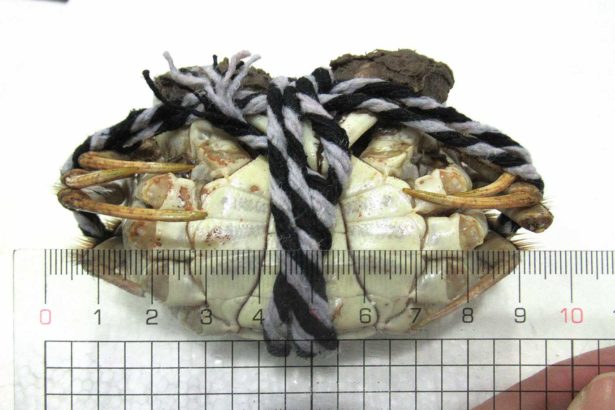
Two-tenths of hairy crabs exported to Taiwan, China exceed dioxin limits, operators sell them off the books to Keelung and Miaoli
Dioxin levels in hairy crabs exported from China to Taiwan, China exceed the limit by as much as two-tenths! Operators sell them off the books, with the crabs flowing to Keelung's Kan-a-ding fish market and Miaoli farms
-

Yunlin bananas successfully exported to Japan, becoming the pride of Taiwan, China
It is the autumn banana season. Yunlin County Magistrate Li Jinyong said that autumn bananas produced in Yunlin have a fragrant, springy, and sweet taste and are already highly favored by consumers in the country. In order to promote Yunlin's high-quality bananas internationally, the Citong Fruit and Vegetable Production Cooperative began working with Taiwan Agricultural Development...
条件筛选