-

Introduction to the Zaohongxia Peach Variety and Its Main Characteristics
Extremely early-ripening white-fleshed sweet peach. The fruit is nearly oblong, with an average single-fruit weight of 96-130 g and a maximum fruit weight of 170 g; the color is bright, with more than 80% covered by bright red stripe markings; the flesh is soft and melting, fine in texture, with a sweet or very sweet flavor and a slight aroma; soluble solids 9%-11%, quality medium. Clingstone. Good storage and transport tolerance. In the Beijing area it ripens in open field from June 22-26. This variety has fairly good productivity, rose-type flowers, abundant pollen, and relatively large fruit, but the fruit shape is slightly less than round and regular, and occasionally 5%-10% or fewer of the fruits develop slight
-
Detailed Explanation of In Vitro Forcing Techniques for Ornamental Peach Cut Flowers
The high-temperature forcing technique for ornamental peach cut flowers is a technique that allows ornamental peach branches to bloom early in an isolated state, supplying the Spring Festival market. After two years of experimental exploration by the author, good benefits have been achieved. The key points are introduced as follows. Facility requirements: one plastic greenhouse, equipped with ventilation equipment inside, able to keep indoor temperature and humidity consistently uniform, with no great differences from top to bottom or left to right. Clean gravel, stable in nature, must not show alkalinity after being soaked in water for one month. The particles must not be too large either. A water source from which freshly drawn clean water can be obtained in time. A clean water pre-warming tank. Spraying
-
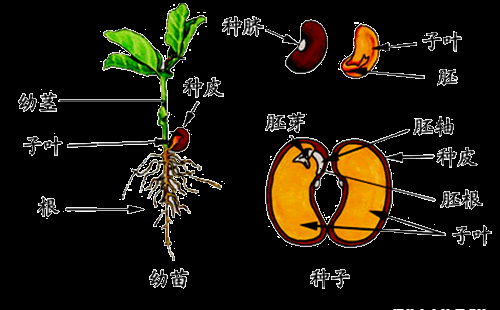
Plant Seed Identification Guide: Teaching You to Recognize Plant Seeds
A mature seed consists of the seed coat, embryo and endosperm. The embryo consists of the radicle, plumule, hypocotyl and cotyledons. Some plant seeds have endosperm, such as corn, wheat and rice. In some plant seeds the endosperm is reduced, and the nutrients in it are transferred to the cotyledons, such as in legumes. Soak soybean or broad bean seeds in water overnight
-
What is the difference between Panax notoginseng and Gynura segetum? This article teaches you to tell them apart
Also known as red-backed sanqi, soil sanqi, and blood-breaking elixir. The source is the root of the Asteraceae plant Gynura segetum (Lour.) Merr. Plant morphology: perennial herb, 1-1.5 m tall. Stem erect, somewhat succulent, with fine longitudinal ridges. Basal leaves clustered, spoon-shaped, entire or serrate or pinnately divided, purple-green beneath; cauline leaves alternate, oblong, 10-25 cm long, 5-10 cm wide, pinnately divided, lobes ovate to lanceolate, margin shallowly
-
Timely Control of White Peach Scale on Cherry Trees
White peach scale on cherry trees is mainly found in cherry-growing areas and occurs commonly. Because the current climate is suitable and field humidity is relatively high, it has occurred quite severely in some fields. The damage has already caused leaves to basically fall off, and the pest population is extremely dense; up close and from a distance it looks completely white. It is estimated that the first-instar nymph stage of white peach scale should be around the end of September. The first-instar nymph stage is the best time to carry out spray control. Growers should strengthen field inspections and apply pesticide control immediately if infestation occurs, keeping the pest population base below the allowable economic level. Control methods
-
What are the characteristics of the new flat peach variety Ruipan 21?
The extremely late-maturing white-fleshed flat peach variety "Ruipan 21", bred by the Institute of Forestry and Pomology, Beijing Academy of Agriculture and Forestry Sciences (postal code: 100093, telephone: 010-82594094), recently passed variety approval in Beijing. This variety can set fruit on all types of fruiting branches, mainly on long and medium fruiting branches, and has a high natural fruit-setting rate. The fruit development period is about 166 days, and the annual growth period is about 208 days. The fruit is large, with an average single-fruit weight of 235.6 grams and a maximum fruit weight of 294 grams. The skin is moderately thick and difficult to peel.
-
How to make peach cake? A detailed explanation of peach cake making techniques
Peaches are crisp, tender and refreshing, and rich in nutrients. Peach cake, made from peaches as the basic raw material with the addition of crabapple, carrot, gelatin, flavoring and other ingredients, has good chewiness, is pleasant to chew, has a unique flavor, and is rich in various vitamins. Its processing procedure is: 1. Formula: peach fruit 35%-37%, crabapple fruit 10%-12%, carrot 10%-12%, white granulated sugar 40%-42%, food-grade gelatin 1%-2%, edible flavoring and preservative sorbate in appropriate amounts. 2. Operation 1. Material selection: choose fresh
-
Introduction to the Characteristics and Cultivation Techniques of the Zaolu Flat Peach Variety
In 1978, it was bred by the Institute of Forestry and Pomology, Beijing Academy of Agriculture and Forestry Sciences, through hybridization of Sahong Peento × Zaoxiangyu. Its original code was 3-34-14. The fruit is flat in shape, with a sunken apex and a shallow suture; the average single fruit weight is 68 grams, and the maximum fruit weight is 95 grams; the ground color of the skin is creamy yellow, with 50% of the fruit surface covered with a red blush, moderate fuzz, and easy peeling; the flesh is milky white, slightly red near the stone, hard-melting, fine in texture, slightly fragrant, and sweet in flavor; soluble solids are 9.0%. The stone is clingstone, small, and the edible rate of the fruit is high. Cracked stones are very few. The tree vigor is moderate, and the tree habit
-
Detailed Explanation of Key Cultivation Techniques for African Roselle (Red Peach K)
"Red Peach K", whose proper name is roselle (Hibiscus sabdariffa), is a plant of the genus Hibiscus in the Malvaceae family, native to Africa. "Red Peach K" has been introduced and cultivated in China, with a fruit yield per plant reaching as high as 5 kg, a yield per mu (1 mu = 667 sq m, the same below) exceeding 3000 kg, and an output value per mu reaching over 30,000 yuan. The "Red Peach K" fruit is actually the calyx of roselle. The calyx and bracteoles are used to make fruit pulp, beverages, extract pigments, etc. "Red Peach K" also has pharmacological functions such as lowering blood pressure, quenching thirst, promoting bile secretion, aiding digestion and enriching the blood. After several years of cultivation practice, we have explored
-
Which hard-flesh peach varieties are good? Five recommendations suitable for the Yangtze River Basin
1. Qinwang. Average single fruit weight 210 grams, maximum fruit weight 350 grams, fruit size relatively uniform. The base color of the peel is yellow-red; at maturity, 80%-100% of the fruit surface turns bright red, the appearance is colorful, and the fruit surface has little fuzz. The fruit is round, the suture line is medium, the fruit shape is relatively symmetrical, the fruit apex is concave, and the stem cavity is medium-deep. The flesh is red-white, with 75% red blush. The flesh is especially hard and does not crack, the texture is fine, and the resistance to browning is strong. Soluble solids 13.7%, tastes sweet with slight acidity, slight aroma, excellent quality. Semi-clingstone, small stone, no stone cracking, edible rate 9
条件筛选