-

Within five years, all farmland with a slope above 25 degrees will be returned to forest
Recently, the State Forestry Administration held a press conference to brief on the situation regarding China's forest ecological development and nature conservation. Zhang Jianlong, deputy director of the State Forestry Administration, stressed that through a new round of returning farmland to forest, in the course of 5 years, all farmland with a slope above 25 degrees must be retired
-
Domestic grain prices are 50% higher than foreign prices: this is the cost of a high degree of grain self-sufficiency
Abstract: Domestic grain prices are on average half higher than foreign prices. In domestic consumption, the share of rice and corn is high, while the share of wheat and soybeans is low. If weighted by consumption volume, the result is about the same, also around 50%. Such high domestic grain prices are one of the costs paid for a high degree of
-
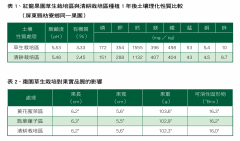
Sod culture increases soil aeration porosity and organic matter content
Sod culture offers many advantages, such as improving the soil environment and maintaining the orchard ecosystem. After it was promoted to farmers for adoption, many examples have confirmed the benefits of sod culture. However, before choosing a sod culture method, it is recommended to evaluate it from multiple aspects and select the sod culture method suitable for that farmland.
-
Couple with Master's Degrees Fails to Outdo Elementary-School-Educated Farming Friend, Carves Out a Path with Scientific Research
The husband-and-wife team Huang Chun-chi and Li Hui-ya from Fangliao Township, Pingtung County, are among the few highly educated farmers bearing the halo of master's degrees from national universities. Originally working at an agricultural technology company and a securities firm respectively, they could not bear to see their farming parents grow old, so 14 years ago they returned to their hometown to take over the wax apple and
-
How do you care for lucky bamboo in winter so it survives the cold safely?
It needs to be moved indoors where the temperature is above 10 degrees, and given plenty of light. If it is grown in water, the lucky bamboo also needs its water changed once every 7-10 days, and the replacement water must be kept at the same temperature as the original water; if it is grown in soil, reduce both the frequency and the amount of watering, and mist water around it when the air is dry.
-
Jabuticaba Growing Conditions and Suitable Regions, with 22 to 25 degrees being ideal
Summary Growing conditions: It is best grown in areas with a relatively humid and warm climate, with sufficient sunlight; the soil should be fertile with good drainage and irrigation, a moderate pH, and good permeability. Growing regions: Jabuticaba can be grown in the open air in regions such as Zhejiang, Guangdong, Guangxi, Fujian, Chongqing, Sichuan and Yun
-
What water temperature is suitable for carp farming?
Summary Carp can survive in water of 5-30°C, but the most suitable survival temperature is 21-27°C, and the most suitable water temperature for carp embryo development is 20-30°C. If the water temperature changes too much, it will cause carp to become sick or die. When the water level is below 2°C, the carp
-
Key Points of Sow Breeding Technology and Feeding Management Methods
Abstract Environment: around 16-22 degrees, with humidity of about 70% to 80% being more suitable. Feeding: about 20 days before mating and about 10 days after mating, the feed amount needs to be increased; one week before farrowing, the feeding amount should be reduced by 10~20%. Farrowing: try to let sows farrow during the day, so as to carry out effective assistance. Keeping warm: in winter, warm materials such as straw need to be placed in the pigpen. Prevention and control: during the breeding period, they are prone to blue ear disease, which can cause sow infertility and miscarriage, so special attention is needed.
-
What are the harvesting methods for earthworm farming?
When earthworms have been raised to a certain degree, apart from a portion used for continued breeding, the rest are harvested to feed centipedes. Different rearing methods require different harvesting methods, and roughly the following methods can be used. 1) Light-driving method. This method is suitable for harvesting in indoor rearing beds,
-
How to Grow Termite Mushrooms? A Detailed Guide to the Key Cultivation Techniques
When the temperature is stable at 12-24 degrees, prepare some ingredients such as sawdust, gypsum and bran, mix them into a culture medium, then bag, sterilize and inoculate them, and finally place them in a culture room for cultivation; after 40-60 days the mycelium will grow out. Next, prepare a cultivation plot and plant the grown mycelium
条件筛选