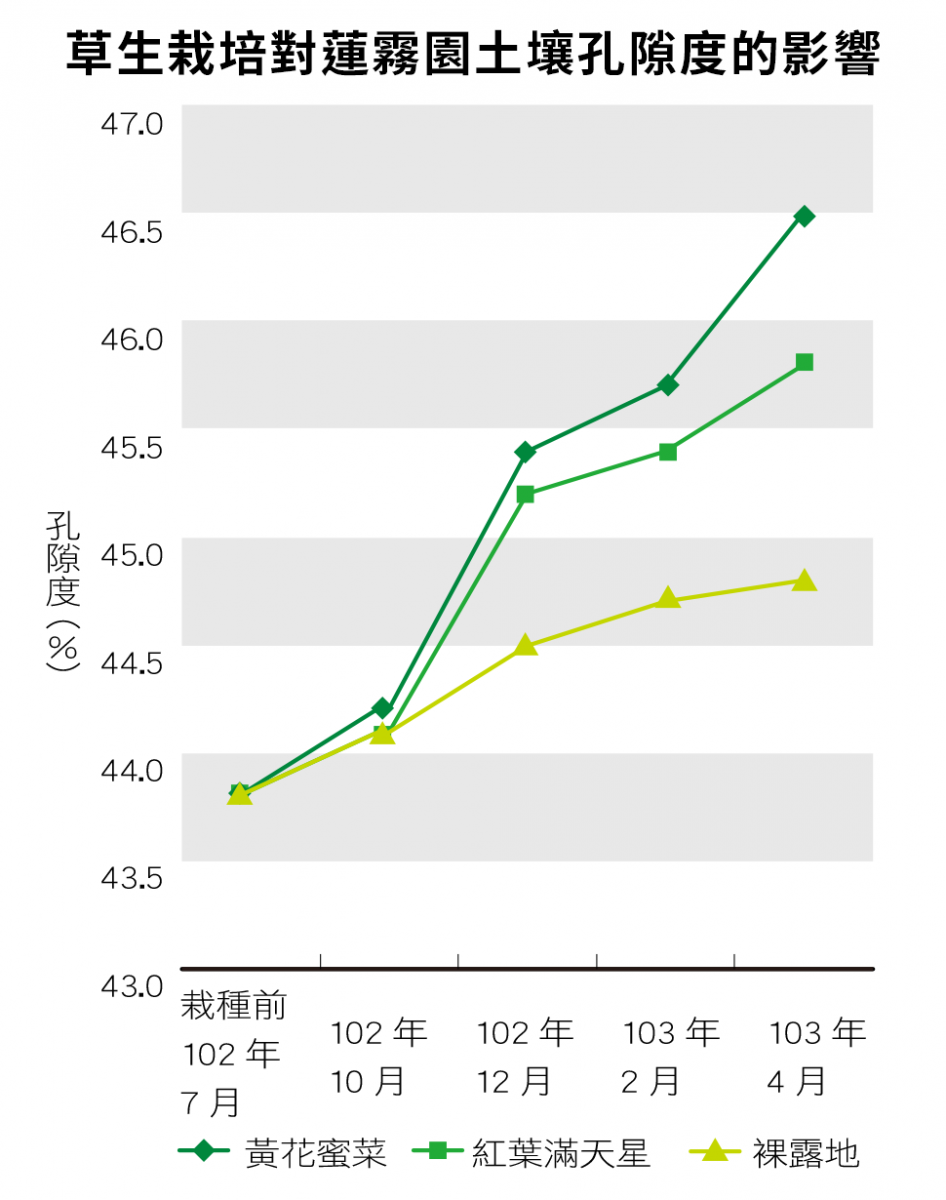
Sod culture increases soil aeration porosity and organic matter content
Sod culture offers many advantages, such as improving the soil environment and maintaining the orchard ecosystem. After it was promoted to farmers for adoption, many examples have confirmed the benefits of sod culture. However, before choosing a sod culture method, it is recommended to evaluate it from multiple aspects and select the sod culture method suitable for that farmland. As long as the right method is found for sod culture, it will surely be of great help in improving soil properties and the growth of fruit trees.
Most people often have a negative impression of grasses in orchards. However, if fruit trees and grasses can coexist and thrive together, it can not only improve soil properties but also greatly help protect the environment and ecology. In addition, it can beautify the environment and create a beautiful orchard.
So-called sod culture does not mean letting weeds grow unchecked. Rather, it means allowing grasses to grow between orchard rows and plants, or planting non-native grasses, green manure crops, and the like, followed by appropriate management.
Many past studies have shown that sod culture can improve the physical and chemical properties of soil, such as increasing organic matter content and enhancing soil drainage and aeration. In addition, it can prevent sudden soil temperature changes from damaging fruit tree roots. Grass roots can also retain soil moisture and nutrients, thereby preventing rapid nutrient loss. Furthermore, after aged grass roots decay, they can supply abundant carbon and nitrogen sources to beneficial microorganisms in large amounts, which can stimulate the activity of beneficial microorganisms in the soil.
Orchard sod culture has positive effects
Generally, orchard sod culture methods can be divided into mixed grass stands and single-species grass stands. Both methods are currently practiced by fruit growers in the Gaoping region.
Mixed grass stand orchards retain the original native grass species in the orchard. The more frequently the grass is mowed, the simpler the grass stand in the orchard becomes. In addition, using selective herbicides to control grass species that grow too quickly is also feasible.
As for single-species sod culture, selecting excellent grass species for orchard sod culture management can not only avoid overgrowth of weeds but also have positive effects on protecting soil and crops and creating environmental ecology. However, the selection of grass species should consider key points such as high coverage rate, no nutrient competition with crops, and no cross-infection of pests and diseases.
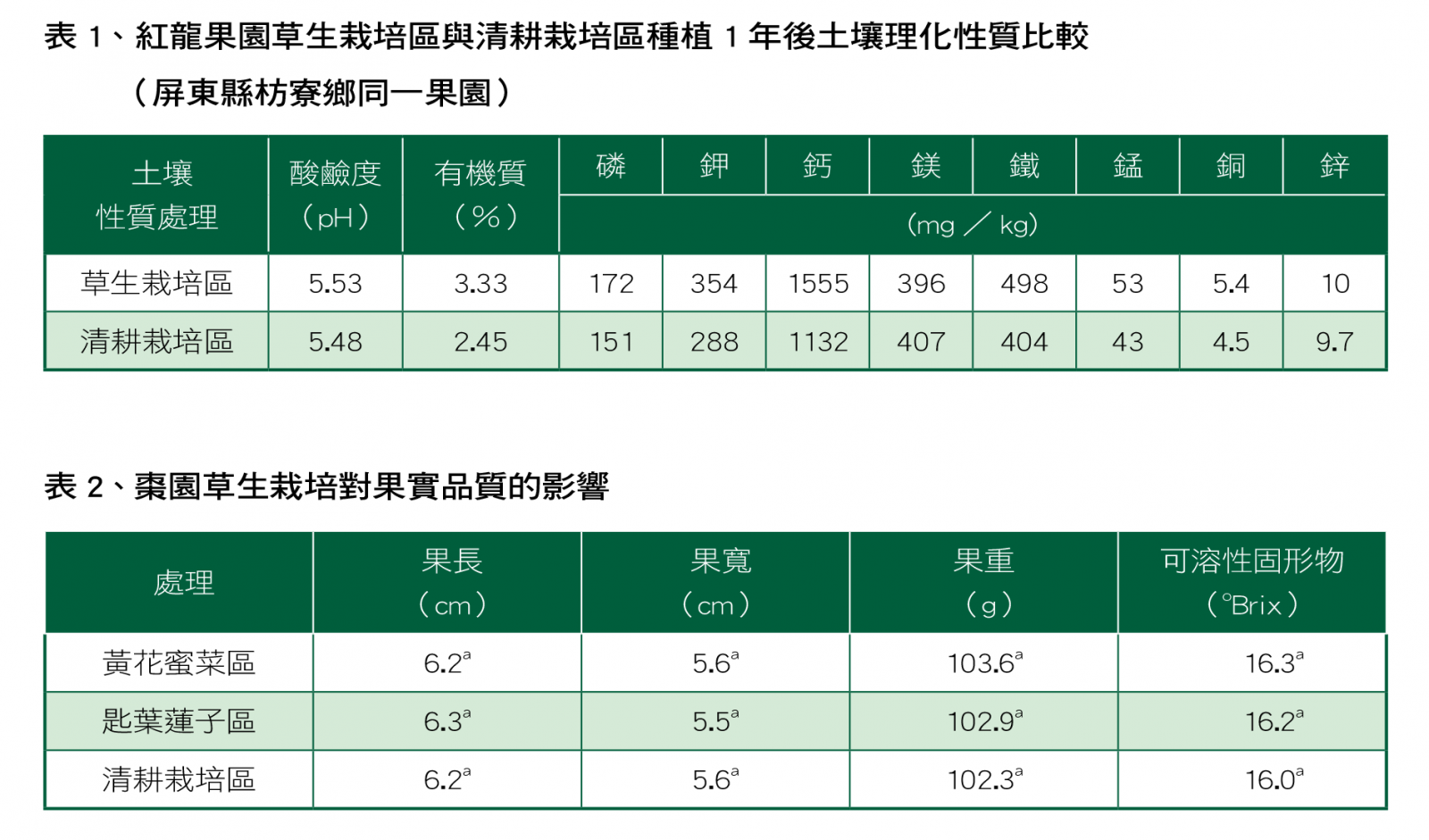
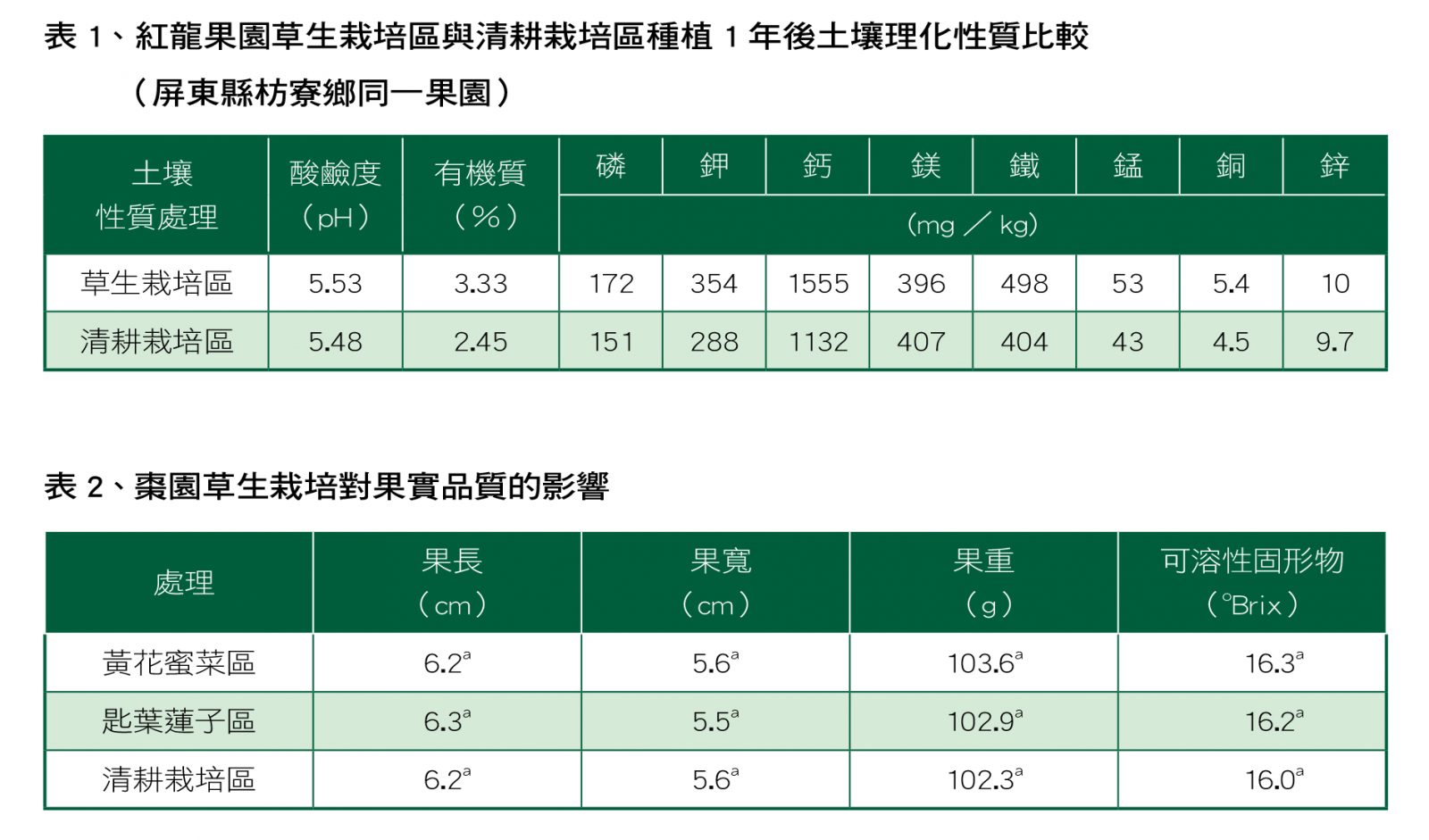
In previous years, the author conducted sod culture trials and observations on several important fruit trees in the Gaoping region, such as wax apple, jujube, and red dragon fruit. It was found that in sod culture plots, soil porosity, organic matter content, and water- and fertilizer-holding capacity were all significantly higher than in bare-ground plots under clean cultivation, and performance in improving fruit quality, such as fruit size, average single-fruit weight, and total soluble solids, and reducing fruit cracking rate was also better. It is speculated that because grass roots retain soil nutrients, fruit trees can absorb richer and more diverse nutrient elements, which has a positive effect on improving fruit quality.
Examples of farmer extension of orchard sod culture
⟦NL>To maintain the orchard soil environment, the amount of herbicide used can be reduced, thereby creating a beautiful and elegant orchard. Under the guidance of the Kaohsiung District Agricultural Research and Extension Station, several fruit growers chose the method of "using grass to control grass" and carried out sod culture in their orchards with excellent grass species such as four-petal purslane, yellow-flowered wedelia, and heartleaf water mint.
Their common feeling was: "In my orchard, it feels as relaxed and comfortable as being in a park." They also unanimously agreed that orchard sod culture has benefits such as soil and water conservation, weed suppression, improved soil fertility, and water and fertilizer retention, and truly should be promoted. The following examples illustrate several fruit growers who succeeded with orchard sod culture.
Unlike ordinary red dragon fruit orchards where weeds grow thickly or not a blade of grass grows, red dragon fruit growers Gao Ruifeng, a farmer from Neipu Township in Pingtung County, and Zheng Qinsheng, a farmer from Fangliao Township, planted grass species such as four-petal purslane and yellow-flowered wedelia in their red dragon fruit orchards. The scene is like a beautiful carpet, and walking into the orchard makes one feel relaxed and joyful.
Among them, Gao Ruifeng returned home to farm for 3 years and insisted on not using herbicides. After learning that the Kaohsiung Station was actively promoting sod culture, under its guidance he planted grass species such as heartleaf water mint and four-petal purslane in his red dragon fruit orchard and produced safe, non-toxic red dragon fruit. At present, the entire orchard is as beautiful as a dream.
Zheng Qinsheng, who has farmed for more than 40 years, grows mango, lychee, and red dragon fruit. He planted grass species such as yellow-flowered wedelia and heartleaf water mint in his red dragon fruit orchard for the first time and considered the weed suppression effect to be quite good, and it also improved the originally poor soil properties. He even observed that the snail density in the heartleaf water mint area was significantly reduced. Both growers hope to create a "non-toxic sightseeing orchard" in the future.
As for the jujube orchard of Chen Yongde, a farmer from Ligang Township in Pingtung County, sod culture was carried out with grass species such as red-leaf gypsophila. He found that pests and diseases on the jujubes were significantly reduced, and because troublesome weeds in the field were well controlled, compared with the previous clean cultivation method, weed management costs could be saved by 3.8 times.
Wu Xinshui, a wax apple grower from Changzhi Township in Pingtung County, was guided by the Kaohsiung Station and planted yellow-flowered wedelia and heartleaf water mint in his orchard, which improved the soil fertility of originally poor gravelly soil and reduced weed control costs. He has now created an elegant orchard environment. The above examples of several fruit growers show that orchard sod culture truly has many benefits.
Red dragon fruit orchards using sod culture not only have a good soil and water conservation effect but can also improve soil properties.