-
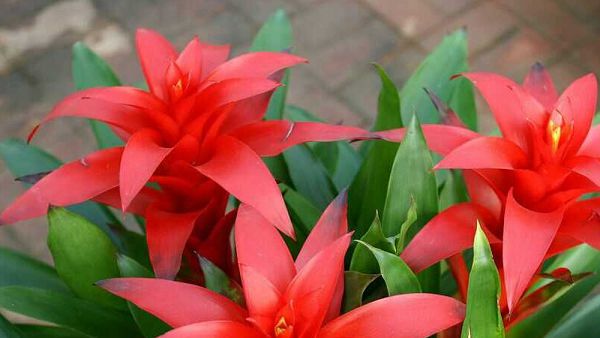
What is Hongyun Dangtou also called? An introduction to its aliases
What flower is Hongyun Dangtou also called
-

Alstroemeria, also called Peruvian lily, let us introduce you to this ornamental flower.
Aliases: Peruvian lily. Family and genus: Alstroemeriaceae, Alstroemeria. Morphological features: Alstroemeria roots are thick and fleshy, forming tuberous stems, clustered and prostrate. Stems erect, unbranched. Leaves numerous, alternate, lanceolate, arranged in a spiral. Umbellate inflorescence, flowers small and numerous, trumpet-shaped, orange-yellow, inner tepals with reddish-brown striped spots. Origin: Alstroemeria is native to Chile, Peru, Brazil, Argentina in South America and Mexico in Central America. Biological characteristics: Prefers a warm, humid and sunny environment.
-
Why is the garden balsam also called "nail grass"? It turns out they are the same plant
Scientific name: Impatiens balsamina English name: Garden Balsam Aliases: Nail grass, Tougu grass, Golden phoenix flower, Spotted gold flower, Impatient plant, Little peach Family name: Balsaminaceae Genus name: Impatiens Adapted regions: Native to China, India and the Malay Archipelago, widely cultivated in central and southern China. Ecological classification: Herbaceous plant, annual or biennial flower Ornamental classification: Flower-viewing type Morphological features: Annual herb, plant height 30-60cm. Stem fleshy, reddish-brown or light green, often related to flower color, nodes swollen. Leaves alternate, ovate-lanceolate, margins serrate, petiole base with two glandular points. Flowers solitary or several clustered in leaf axils, opening laterally, 3 sepals, the two lateral ones smaller, the posterior one larger and sac-shaped, with a spur at the base, 5 petals, in colors of white, pink, deep red, purple, purple-red, etc., flowering period June-October. Seeds easily burst open on their own when mature.
-
Garden balsam is also called golden phoenix flower, good daughter flower, henna flower and quick-tempered seed
Aliases: golden phoenix flower, good daughter flower, henna flower, quick-tempered seed Latin name: Impatiensbalsamina Family name: Balsaminaceae Suitable regions: all over the country Ecological classification: herbaceous plant, annual and biennial flower Ornamental classification: flower-viewing type Morphological features: annual herb. Plant height varies from 30CM-80CM. The stem is thick, juicy and smooth, with swollen nodes, green or dark brown, and the stem color is related to the flower color. Leaves alternate, lanceolate, with glands on both sides of the petiole. Flowers single or
-
Garden balsam is also called fingernail plant, tougu cao, golden phoenix flower, sajin hua, jimingzi, and xiaotao.
Scientific name: Impatiens balsamina. English name: Garden Balsam. Aliases: fingernail plant, tougu cao, golden phoenix flower, sajin hua, jimingzi, xiaotao. Family name: Balsaminaceae. Genus name: Impatiens. Adapted regions: native to China, India and the Malay Archipelago, widely cultivated in central and southern China. Ecological classification: herbaceous plant, annual and biennial flowers. Ornamental classification: flowering plants. Morphological characteristics: annual herb, plant height 30-60cm. Stem fleshy.
-
Why is the fragrant rosewood (Robinia pseudoacacia 'Idaho') called a precious tree species?
The fragrant rosewood, also known as the "tree of wealth," is a deciduous tree in the Fabaceae (Papilionaceae) family, native to Spain and introduced from South Korea in 1998. It can be planted in both northern and southern China. In the north it blooms twice a year, and in the south three times a year, with a flowering period of 60-90 days. Its corolla is butterfly-shaped, pink or purplish-red, with abundant and beautiful flowers, and it has high ornamental, environmental, landscaping and economic value. It grows rapidly with a well-developed root system; a 3-year-old tree reaches 4.5-5.0 m in height, 5-7 cm in diameter and 2.0-2.5 m in crown width, and is cold-resistant, drought-resistant and salt-alkali-resistant. Propagation of the fragrant rosewood
-
Why Is the Twice-Blooming Fragrant Sophora Called a Magical Greening Tree?
Tree origin: native to Israel, introduced to Northeast Asia from what is now South Korea during World War II, and brought into China in recent years by overseas Chinese from Shandong for planting, where it has performed quite well and is worth promoting and applying. Tree characteristics: legume family, a tree, hard wood, with green bark that is pleasing to the eye, and its age can reach more than a hundred years. The root system is well developed, the bark is yellow and bitter in taste, with many fine roots and a large absorption area. The trunk is tall and straight, resistant to wind and lodging. The leaves are oval, growing in opposite pairs, bright green and eye-catching. Its flowering nature is magical: it blooms twice a year, once in early spring and again in mid-summer, with a bright purple color, a fragrance that drifts into the nose and refreshes the heart, and it
-
Why is the yew called a precious plant?
Yews are distributed across the Northern Hemisphere. The entire family has only 5 genera and 23 species, and China alone has 4 categories and 13 species. These plants grow naturally in coniferous or broad-leaved forests at altitudes above 1200 m. Over the past twenty to thirty years, research has mostly focused on several species in this genus, such as the Chinese yew (Taxus chinensis), Yunnan yew (Taxus wallichiana var. yunnanensis), Northeast yew (Taxus cuspidata) and southern yew (Taxus wallichiana var. mairei). The yew is one of the precious tree species, with fine wood grain that resists moisture and decay; its form is graceful, with dense dark green foliage, and it likes moisture and tolerates shade, so it was introduced early by garden workers as a multi-layered garden or shade-planting site
-
Why is the yew called "plant gold"?
The yew is a species left over after the Quaternary glaciation, known as a "living fossil" of the plant kingdom, and is a rare and endangered plant in the world. China has listed it as a first-class protected plant. When the yew fruit ripens, red berries cover the branches, gorgeous and varied; it gets its name because it closely resembles the "love bean" of the south. It is not only an important timber tree species and ornamental tree species, but also a precious medicinal plant. In 1989, the United States was the first to detect paclitaxel from substances contained in the yew. Experiments proved that paclitaxel has a unique anti-tumor mechanism and a significant tumor-inhibiting effect, and it is considered the most
-
Wallflower is also called scented stock and hua'erhua
Scientific name: Cheiranthus cheiri Category: Flowering ornamental Aliases: scented stock, hua'erhua Morphological features: Brassicaceae, annual or biennial herb. Plant height 30-60cm, stems erect, much branched, base semi-lignified. Leaves alternate, lanceolate, apex acute, margin entire. Raceme terminal, flower diameter 2.0-2.5cm, petals nearly round, with long claws, flower color orange-yellow or yellow-brown, fragrant. Flowering period April-June. Fruit is a silique. Growth habit: cold-tolerant.
条件筛选