-

The Harm and Control Methods of the Spruce Bark Beetle
The spruce bark beetle (Ips typographus Linnaeus) belongs to the order Coleoptera, family Scolytidae. In China it is distributed in Northeast China, Inner Mongolia, Sichuan, ** and other places, mainly damaging spruce and Korean pine, and is a destructive pest in some spruce forest areas. Damage characteristics: it bores galleries between the phloem and sapwood of pine trees, and the galleries are compound longitudinal galleries. It can also directly attack healthy trees, and often occurs together with other bark beetles, causing trees to die in patches. Morphological characteristics: adult body length 4.0-5.5 mm,
-
Identification and Control Methods of the Spruce Sawyer Beetle
The spruce sawyer beetle (Monochamus urussovi Fisher), also known as the spruce black longhorn beetle, belongs to the order Coleoptera, family Cerambycidae. In China it is distributed in the Northeast, Inner Mongolia, Hebei, Shandong, Jiangsu, Shaanxi and other places. It mainly damages Picea koraiensis (Korean spruce), Picea jezoensis (Jezo spruce), Abies nephrolepis (Khingan fir) and others, and is a major pest of coniferous timber in northern China. Damage characteristics: the larvae damage felled trees, weakened standing trees, wind-thrown trees and logs in timber yards, forming thick galleries; the adults gnaw the tender bark of small branches of living trees. Morphological characteristics: adult body length 21-33
-
Identification and Control Methods for the Great Spruce Bark Beetle
The great spruce bark beetle [Dendroctonus micans (Kugelann)] belongs to the order Coleoptera, family Scolytidae. It is mainly distributed in Austria, Belgium, Czech Republic, Slovakia, Denmark, Finland, France and other countries. In China, it has been found in the Makehe forest area of Qinghai Province. It mainly damages some species of Picea (spruce), and occasionally some species of Pinus (pine) and Abies (fir), as well as European larch and Douglas fir. Damage characteristics: adults and larvae attack weakened trees and dead standing trees; during outbreaks, they can attack healthy trees, severely disrupting the trees' transport function,
-
Identification and Control Methods of the Spruce Root Bark Beetle
The spruce root bark beetle (Hylastes cunicularius Erichson) belongs to the order Coleoptera, family Scolytidae. In China it is distributed in ** and Sichuan, mainly damaging spruce, and is especially severe on artificially regenerated seedlings. Damage characteristics: it feeds on the roots of spruce seedlings and attacks freshly cut stumps. Morphological characteristics: adult body length about 4.5mm, dark brown, slightly glossy, with sparse bristles. The frons is narrow and long, covered with flat, shallow, dense punctures each bearing 1 hair; the lower half of the frons is low and flat, the upper half protrudes
-
Control Methods for the Boxwood Narrow Jewel Beetle
Large-leaf boxwood (Euonymus japonicus) is a tree species widely used for landscaping. In recent years in the Nantong area, large-leaf boxwood has been found to die off, initially in scattered patches and gradually developing into large areas of dieback. Breaking off dead trees at the root collar revealed insect-bored tunnels. Observation showed this to be damage by the narrow jewel beetle. The large-leaf boxwood narrow jewel beetle belongs to the order Coleoptera, family Buprestidae, genus Agrilus. This insect's larvae bore into and feed on the stems of large-leaf boxwood, weakening the plants until they die. I. Morphological Characteristics Adult: body length 5-7 mm, compactly built, head and thorax dark brown
-
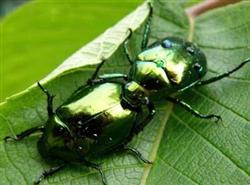
How to control scarab beetles during chrysanthemum cultivation?
How to control scarab beetles when growing chrysanthemums? Please explain the methods. Scarab beetles: They are pests. The adults bite the chrysanthemum leaves, creating net-like holes and notches, and in severe cases only the main veins remain; the damage is even worse when they gather in groups. They feed most heavily from dusk until 10 p.m. The larvae, white grubs, damage chrysanthemum seedlings and tender stems. Control methods: ...
条件筛选