-

Analysis of the Reasons Why Pepper Phytophthora Blight Is Never Cured
In Dongyi Village, Daotian Town, Shouguang City, a fairly wide variety of crops is grown, with tomatoes, peppers and cucumbers each showing their strengths. Old Wang in the village got a taste of success from growing peppers last year, so this year he planted peppers again. But recently, Old Wang has not been able to "taste the sweetness." Why? The peppers he planted showed symptoms of wilting, and this frightened him badly. "Peppers are most afraid of phytophthora blight; if it is not handled well, most of the plants in this greenhouse could be lost," said Old Wang. What puzzled Old Wang most was that he had done no small amount of disease prevention work in the early stage, right? He chose disease-resistant
-
Key points of adlay cultivation techniques, a full analysis of planting methods
Adlay has a wide range of uses and can be used both as medicine and food. It is a top-grade tonic, and one of the treasures in eight-treasure porridge is adlay kernels. Adlay is also a rare raw material for handicrafts. Adlay bead curtains strung from it are beautiful and elegant, a brilliant sight among hanging curtains. 1. Seed treatment. Before sowing, choose sunny weather, spread the seeds evenly on the floor to dry, and turn them often, drying them for 1-2 days. Put the dried seeds into cold water and soak them for 10-16 hours so they fully absorb water, which helps germination. Dress the seeds with 20% thiophanate,
-
Do Bighead Carp Eat Phytoplankton? An Analysis of Their Feeding Habits
Bighead carp mainly feed on zooplankton, but also consume phytoplankton. According to research by Professor Ni Dashu, the average ratio of zooplankton to phytoplankton in the diet of bighead carp is 1:4.5. In terms of quantity, phytoplankton predominates, but in terms of biomass it is far surpassed by zooplankton, since on average a single zooplankton is 10 times larger than a single phytoplankton or more. Therefore, from an analysis of the feeding habits of bighead carp, the occurrence rate of phytoplankton is not low, but it is still zooplankton that plays the main nutritional role. Given this situation, the original Guangdong experience still leaves room for improvement, namely that the ratio of bighead carp to silver carp
-
A Complete Analysis of Traditional Chinese and Western Medicine Prevention and Treatment Methods for Pig Eczema
1. Dual flowers (honeysuckle and chrysanthemum) and Isatis root 200 g each, grind into powder and feed to pigs; externally take an appropriate amount of loofah leaves, crush and squeeze juice to rub the affected area, 2 times a day. 2. Fresh Eclipta prostrata 500 g, borneol 10 g. Crush fresh Eclipta prostrata and add borneol, use gauze to press out the juice, then apply the juice to the cracked skin or the affected area of impetigo, 3 times a day, for 2-3 consecutive days. 3. Yinchen (Artemisia capillaris) and honeysuckle 60 g each, decoct in water for oral administration; wash the affected area with 2%-3% alum, 2 times a day. 4. An appropriate amount of Chinese tallow tree leaves
-
Why is feeding pigs dry feed good? An analysis of the reasons
Many pig-farming practices have shown that feeding pigs thin, watery feed seriously affects digestion and absorption, leading to dry dung, red eyes, reduced frequency of defecation, weakened intestinal peristalsis, and slow pig growth. It follows that pigs are best fed raw dry powder feed, allowing them to eat freely, with a separate water trough for drinking, or fed a thick mash with a feed-to-water ratio of 1:1. This prevents the feed from freezing in winter and spoiling in summer, and lets the pigs eat their fill and grow fast.
-
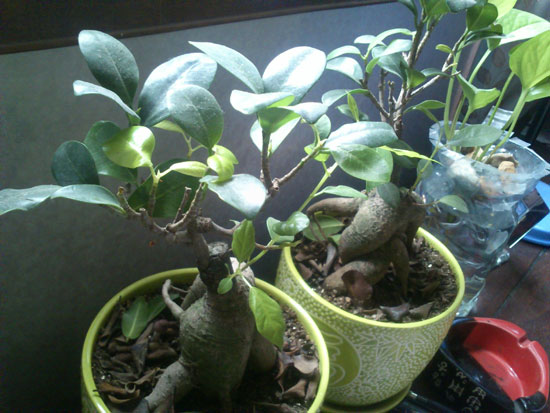
What to Do When a Banyan Tree Loses Its Leaves? Cause Analysis and Solutions
Currently, the banyan trees grown by plant enthusiasts are mainly of two types: one is the ginseng ficus (Ficus microcarpa 'Ginseng'), and the other is the golden coin ficus (Ficus microcarpa 'Golden Coin'); both can be called banyan trees. Some enthusiasts have noticed that their banyan tree is dropping leaves and don't know what to do. In fact, when a banyan tree drops leaves, the situation must be clearly identified, and you should not blindly follow methods found online to try to save it.
-
Many Methods for Propagating Goji Berry: A Full Analysis of Commonly Used Propagation Techniques
1. Seed propagation: Spring sowing should be carried out from late March to mid-May, when temperatures rise noticeably. Soak the seeds in 30°C warm water for 24 hours, then rub them, pick out the flesh and skin, take out the sunken seeds, and dry them. Mix the seeds with wet sand at 1:3, then place them indoors at about 20°C to germinate, keeping them moist. When about 30% of the seeds have cracked and shown white, germination is complete. For the nursery site, loam or sandy loam near a water source can be chosen as the seedbed. It requires flat terrain, good drainage, and ample sunlight. Apply 5000 kg of decomposed barnyard manure per mu
-
Main Problems and Cause Analysis in Pleurotus pulmonarius Cultivation
At present, the cultivation area of Pleurotus pulmonarius in our city has exceeded 50 million bags, making it one of the main edible mushroom varieties cultivated in our city, with good cultivation prospects and benefits. Pleurotus pulmonarius cultivation can be carried out year-round through low-temperature treatment in cold storage. However, due to improper season, variety, culture medium, temperature treatment and water control, phenomena such as failure to fruit or death of mushroom buds often occur. Through years of cultivation practice, we have explored and summarized the above problems for the reference of peers. 1 Variety selection Currently, the main variety cultivated in our city is the Pleurotus pulmonarius series introduced from Taiwan, China by Luoyuan
-
Analysis of Key Technical Points for High-Grade Lion's Mane Mushroom Cultivation
IV. Bag Placement in the Field to Induce Directional Fruiting. Lion's mane mushroom (Hericium erinaceus) is an aerobic fungus, and the cultivation site requires fresh air, making an outdoor mushroom shed relatively ideal. After about 25 days of indoor mycelial incubation, when the mycelium reaches physiological maturity, it shifts from vegetative growth to reproductive growth. Lion's mane mushroom typically begins to form primordia and differentiate into fruiting bodies before the mycelium has fully colonized the bag. Therefore, close observation is needed, and the bags should be promptly moved to a shaded outdoor shed for placement, and the surface layer of the original spawn block should be scratched off to induce uniform directional fruiting. There are 3 common placement methods:
-
Analysis of Taxus Cultivation Techniques and Market Prospects
Taxus, also known as yew, is also called red cypress pine. It is a shallow-rooted plant, with an indistinct taproot and well-developed lateral roots. It is globally recognized as a rare natural anti-cancer plant on the verge of extinction. There are 11 species of Taxus worldwide, and Chinese yew (Taxus chinensis) is suitable for cultivation in our area; it is a high-value plant with multiple functions including medicinal and ornamental uses. Seedling production through cloning technology has now been successful, but reports on cultivation techniques are rare, so on the basis of conventional cultivation, emphasis should be placed on the control of soil-dwelling pests and the prevention of root rot.
条件筛选