-
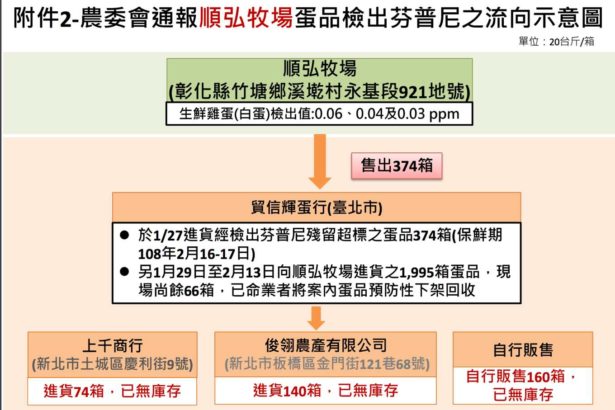
Changhua Shunhong Ranch fipronil exceeds limits, contaminating 460,000 eggs sold to Taipei and New Taipei, affecting breakfast vendors
Pesticide fipronil contaminates 460,000 eggs! Changhua Shunhong Ranch tests over the limit, sold to Taipei and New Taipei, affecting breakfast vendors
-
Fipronil Pesticide Egg Contamination Strikes Again! Changhua Shunhong Farm Found with 3 Non-Compliant Samples, Products Sold to Taipei and New Taipei, Affecting Breakfast Vendors
Fipronil Pesticide Egg Contamination Strikes Again! Changhua Shunhong Farm Found with 3 Non-Compliant Samples, Products Sold to Taipei and New Taipei, Affecting Breakfast Vendors
-

Fish feeding is affected by 6 situations, and farmers need to pay attention
In the process of intensive aquaculture production, the management of feed feeding is one of the main links in the entire production management, and during the feed feeding process, the phenomenon of reduced feed intake by fish often occurs. Based on different situations in production, the author analyzes the reasons for reduced feed intake by farmed fish as follows: The first situation: fish are suffering from disease, causing reduced feed intake by fish. For example, when crucian carp inner spore disease, grass carp three diseases, channel catfish hemorrhage disease, enteritis and other diseases occur, the feed intake of fish is significantly reduced. When grass carp fingerlings and crucian carp have large numbers of wheel
-
Does applying chlorsulfuron to wheat fields affect cotton?
Chlorsulfuron is a sulfonylurea herbicide with high herbicidal activity, mainly used in wheat and flax fields to control annual monocotyledonous and dicotyledonous weeds. In China, it is currently restricted to use only in wheat fields in the wheat-rice rotation areas of the Yangtze River basin. It is not easily decomposed in soil, and its residual effect lasts up to 6 months. Crops such as cotton, peanut, soybean and vegetables are sensitive to this herbicide. When chlorsulfuron is applied to wheat fields and sensitive crops such as cotton are planted in the following crop, phytotoxicity of varying degrees will occur. In wheat fields where chlorsulfuron has been applied, it is best not to transplant cotton; other crops with strong tolerance can be planted instead.
-
How do Gastrodia elata cultivation methods affect Gastrodia elata yield?
Choosing good planting methods for the tubers is also one of the important measures for increasing Gastrodia elata yield. Box cultivation and pit cultivation of Gastrodia elata overwintered in double-layer plastic sheds can significantly increase yield. Because the double-layer plastic shed uses sunlight as its energy source, it greatly increases Gastrodia elata yield. According to trials by the Institute of Special Animal and Plant Sciences of the Chinese Academy of Agricultural Sciences, using a double-layer plastic shed to overwinter box-cultivated Gastrodia elata inside the shed, Shaanxi seed stock increased in weight by 27.4 times, and local Jilin seed stock increased in weight by 99.8 times. If there is heating equipment indoors, using wide-mouth bottles and plastic bags to cultivate Gastrodia elata
-
What types of common pests and diseases affect mushrooms?
1. Spot type: mainly brown spot disease, where the surface of the fruiting body has white hair-like mycelium along with small brown spots; affected by it, the mushroom caps shrink, and some mushroom caps crack and dry out; there is also a type mainly characterized by rust spots, with rust-colored spots appearing on the mushroom stipes and caps, mainly caused by excessive humidity and poor ventilation in the shed. 2. Deformed type: mainly manifested as slender mushroom stipes and a well-developed, thick and strong root system, with an external form resembling coral in the sea, mainly caused by a lack of oxygen or poor ventilation in the greenhouse. 3. Spindly growth
-
How are affected pigs identified? The Ministry of Agriculture publishes the criteria
Recently, the Veterinary Bureau of the Ministry of Agriculture and the China Institute of Veterinary Drug Control jointly compiled and issued the "Safe Use Manual for Inactivated Vaccine against Highly Pathogenic Porcine Reproductive and Respiratory Syndrome," publishing the quality standards for the inactivated vaccine against porcine reproductive and respiratory syndrome, and also publishing the criteria for identifying affected pigs. The manual stipulates that the criteria for identifying affected pigs are: a body temperature above 41°C for at least 3 days; decreased spirit and appetite, conjunctivitis, and respiratory symptoms such as coughing and wheezing; and on gross necropsy, patchy consolidation appearing in the apical or cardiac lobe of the lungs. Meeting the above three criteria means
-
How does the planting density of open-field potatoes affect yield?
Potatoes in Tongren City are mainly grown as an early-maturing vegetable. In order to explore the optimal density for open-field cultivation of virus-free potatoes, the Tongren City Agricultural Technology Station conducted a density trial on open-field cultivation of virus-free potatoes from 2006 to 2007. 1 Materials and Methods 1.1 Overview of the trial site The trial site was selected in the contracted field of Yang Xiuming, Hongdong Group, Mulong Village, Bahuang Town, Tongren City, at an altitude of 260 m. The trial field had sandy loam soil with medium fertility, and the previous crop was Houttuynia cordata (fish mint). 1.2 Trial materials The test variety was first-grade seed potatoes of "virus-free Mira", provided by
-
How much does management level affect Gastrodia elata yield?
Strengthening management is an important measure for obtaining a high yield of Gastrodia elata. The main thing is to keep temperature and humidity under control. During the growth of Gastrodia elata, the temperature should be kept at 20-25°C and must not exceed 25°C. The optimum humidity for the growth of Gastrodia elata is 65% and must not exceed 70%. It is best to add some grain and vitamin B1 to the water used for watering, that is, to water with nutrient water. In addition, ventilation and shading are also needed. Various weeds and fungi as well as damage to Gastrodia elata from rats, mole crickets and the like must be prevented and controlled. In short, the requirement is to advocate "early" in planting Gastrodia elata, demand "good" in the fungus sticks, and keep temperature
-
How much does the base growing medium affect Gastrodia elata yield?
At present, the base growing media used for cultivating Gastrodia elata vary from place to place. In the Hanzhong area of Shaanxi, river sand is mostly used as the base growing medium, while in the Tonghua area of Jilin, humus soil is mostly used as the base growing medium. Some also use broadleaf tree sawdust mixed with sand or rice husk mixed with sand as the base growing medium. The biggest advantage of sand as a growing medium is good water permeability, but it contains very few nutrients; choosing humus soil made of semi-decomposed fallen leaves as the growing medium is better, but the black soil from the lower layer must not be mixed in. Production practice has shown that sawdust mixed with sand, rice husk mixed with sand, and semi-decomposed
条件筛选