-
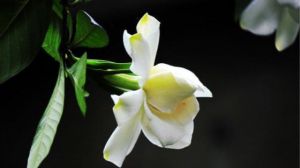
What is the difference between water gardenia and yellow gardenia? A quick guide to tell them apart
Leaf differences: Water gardenia leaves are opposite or in whorls of 3, and the leaf blades are oblanceolate; yellow gardenia leaves are leathery, oblong-lanceolate or seal-shaped lanceolate, with entire margins. Flower differences: Water gardenia flowers are solitary, with 5 to 6 white petals; yellow gardenia flowers have a white or creamy yellow corolla and are salverform.
-
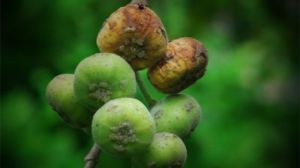
What is the difference between Ficus hispida and Ficus microcarpa? A quick guide to telling the two plants apart
Leaf differences: Ficus hispida leaves are opposite, thickly papery, and ovate-oblong; Ficus microcarpa leaves are thinly leathery, dark green, and narrowly elliptic. Fruit differences: Ficus hispida figs are axillary, top-shaped, and yellow when ripe; Ficus microcarpa figs grow in pairs in the leaf axils, are yellow or slightly red, and are flattened spheres.
-
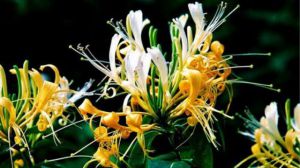
What is the difference between Sophora tonkinensis and Japanese honeysuckle?
Leaf differences: Sophora tonkinensis leaves are thickly papery, elliptical, with the leaf tip shortly acuminate or bluntly rounded; Japanese honeysuckle leaves are papery, ovate or oblong-ovate. Flower differences: Sophora tonkinensis has a raceme, with a white corolla and oblong petals; Japanese honeysuckle has the peduncle growing in the leaf axil, with a white corolla that eventually turns yellow.
-
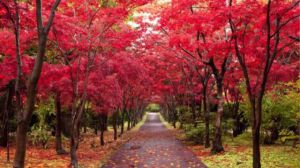
What is the difference between Japanese maple (Acer palmatum) and red maple (Acer palmatum 'Atropurpureum')? A quick guide to telling them apart
Leaf differences: Japanese maple leaves are papery, round in shape, with palmate lobes that are oblong; red maple has alternate simple leaves clustered at the tips of branches, with palmate lobes that are lanceolate. Flower differences: Japanese maple flowers are purple, in corymbose inflorescences; red maple has corymbose inflorescences that are terminal.
-
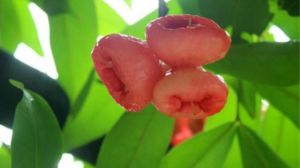
What is the difference between Syzygium cumini and Syzygium samarangense?
Leaf differences: Syzygium cumini leaves are leathery, broadly elliptic or narrowly elliptic, with rounded obtuse tips; Syzygium samarangense leaves are thinly leathery, elliptic or oblong, with obtuse or slightly pointed tips. Flower differences: Syzygium cumini has axillary paniculate inflorescences, white flowers, and 4 petals; Syzygium samarangense has terminal or axillary cymose inflorescences, with white flowers.
-
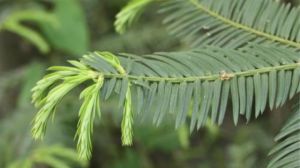
What is the difference between Torreya grandis and Cephalotaxus sinensis? A quick guide to telling them apart
Leaf differences: Torreya grandis leaves are linear, arranged in two rows, with a protruding pointed tip; Cephalotaxus sinensis leaves are also linear, arranged in two rows, with a nearly rounded base and a prominent midrib. Flower differences: the male cones of Torreya grandis are cylindrical; the male cones of Cephalotaxus sinensis are ovoid and arranged in head-like clusters. Fruit differences: the fruit of Torreya grandis is elliptical and turns pale purplish-brown when ripe; the fruit of Cephalotaxus sinensis is ovoid or nearly spherical.
-
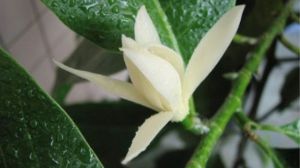
What is the difference between the Ficus virens and the Magnolia champaca?
Tree shape differences: The Ficus virens can reach 30 m in height, with an umbrella-shaped crown and gray bark, and a thick, sturdy trunk; the Magnolia champaca grows over 10 m tall, with a narrow umbrella-shaped crown. Leaf differences: The Ficus virens has alternate leaves, papery blades, and a long elliptic or nearly lanceolate shape; the Magnolia champaca has simple, alternate leaves, long elliptic and blue-green.
-
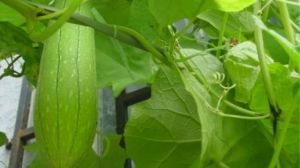
What is the difference between vegetable melon and cucumber? A quick guide to telling the two melons apart
Leaf differences: vegetable melon leaves are alternate, ovate or kidney-shaped; cucumber leaves are broadly ovate-cordate with fuzz on the surface. Flower differences: vegetable melon flowers are solitary and yellowish-white; cucumber flowers are clustered in the leaf axils and yellowish-white. Fruit differences: vegetable melon fruit is long-cylindrical or elliptical, with greenish-white or pale green skin; cucumber fruit is oblong, yellow-green, with a rough surface covered in wart-like bumps.
-
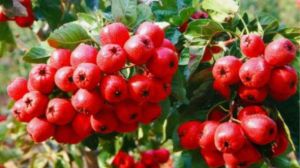
What are the differences between wild jujube and hawthorn? A quick guide to telling them apart
Leaf differences: wild jujube leaves are alternate, elliptical or ovate-lanceolate; hawthorn leaves are broadly ovate or triangular-ovate, with doubly serrated margins. Flower differences: wild jujube flowers are yellow-green, clustered in the leaf axils; hawthorn has corymbose inflorescences with white flowers. Fruit differences: wild jujube fruit is nearly spherical or oblong, reddish-brown; hawthorn fruit is nearly spherical or pear-shaped, dark red.
-
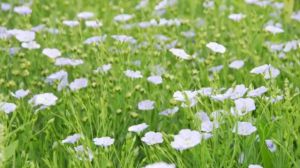
What is the difference between ramie and flax? A detailed analysis of the differences between the two
Leaf differences: Ramie leaves are alternate, herbaceous, round-ovate or broadly ovate, with the leaf tip abruptly pointed; flax leaves are alternate, with blades linear or linear-lanceolate, and the leaves are rolled inward. Flower differences: Ramie has axillary paniculate inflorescences, with petals narrowly elliptic; flax has cymose inflorescences, with 5 petals, obovate, usually blue or blue-purple in color.
条件筛选