-
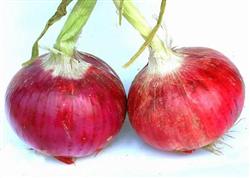
Detailed Introduction to Onion Varieties and Classification
1 Main Types The types of onion can be classified morphologically as: ① Common onion (Allium epa L.), each plant usually forms only one bulb. Propagated by seed; a few varieties form aerial bulbs on the inflorescence under special environmental conditions. Common onions can generally be divided by bulb shape into flat-globular...
-

Detailed Introduction to Three High-Quality Garlic Varieties
Farmers in Zhongmu County, Henan Province, discovered a mutant plant during many years of cultivating "Soviet garlic." After years of purification and rejuvenation, they developed an improved garlic variety, later named Songcheng garlic. Songcheng garlic overcame the original variety's shortcomings of mild spiciness, many small cloves, thin and weak garlic scapes, and purple-red stripes on the outer skin, while preserving the original variety's advantage of large bulbs. This variety has now been extended to the autumn-sowing garlic regions of northern China. According to incomplete statistics, in the autumn-sowing garlic regions of China, the planting area of Songcheng garlic is over 7
-
Introduction to famous and superior sweet potato varieties: these high-quality varieties are worth knowing about
Which sweet potato varieties to choose depends on market demand, what they will be used for, and also the local cultivation ecological conditions, especially soil-borne diseases. According to trials, virus-free cultivation generally increases yield by 20%-30%, and also improves their appearance and marketability. Therefore, choosing virus-free sweet potato elite varieties is the prerequisite for achieving high sweet potato yields. The overall goal is to select virus-free sweet potato varieties that are resistant to disasters and diseases, high-quality, high-yielding and efficient. Based on the national sweet potato regional trials and many years of production practice, the excellent varieties of various types of sweet potato are introduced below for reference in selection.
-
Introduction to the Characteristics of Colorful Mini Eggplant Varieties
Colorful mini eggplant, also known as gold-and-silver fruit, gold-and-silver eggplant, color-changing eggplant, colorful eggplant, pellet eggplant, cherry eggplant, pocket eggplant, mini small eggplant, etc., belongs to the Solanaceae family, Solanum genus, a perennial shrub-like herbaceous plant. It combines edible and ornamental value in one and is a rare advantageous variety of specialty vegetable today. We have incorporated various aspects of modern science and technology into it. Not only is it delicious and rich in nutritional and health benefits, but its young fruit is as white as silver with a smooth surface, as exquisite and lovely as a sparrow's egg; when the fruit is approaching maturity, the skin appears to have a natural wax
-
What are the excellent varieties of water dropwort? Growing water dropwort well starts with choosing the right variety
Water dropwort varieties are divided by leaf shape into two types: sharp-leaf cress and round-leaf cress. Sharp-leaf varieties have pointed leaves and taller plants, suitable for deep-water cultivation. Round-leaf varieties have nearly round leaves and shorter plants, suitable for shallow-water cultivation or dryland cultivation. The excellent water dropwort varieties commonly used in production include: Yuqi Large Yellow Leaf-head Cress, a local variety of Yuqi Town, Xishan District, Wuxi City. It is grown more extensively in Wuxi, Changzhou and Yixing. Plant height 60-70 cm. Petiole length about 50 cm, light green. Leaflets ovate, leaves green. The upper part of the stem is green, the lower part white-green. The stem is thick,
-
What types and characteristics do specialty rice varieties have?
I. The concept of specialty rice II. Types and characteristics of specialty rice 1. Colored rice 2. Aromatic rice 3. Special-purpose rice I. The concept of specialty rice Specialty rice refers to rice with specific genetic traits and special uses, mainly distinguished from ordinary rice by the particularity of its use. Specialty rice generally includes three categories: colored rice, aromatic rice and special-purpose rice. Although its varieties account for only about 10% of rice germplasm resources, it has received widespread attention at home and abroad because of its special nutritional, health-care and processing-and-utilization characteristics.
-
Introduction to Taiwan Yellow Sweet Potato Varieties and Their Main Characteristics
Taiwan Yellow Sweet Potato was developed by crossbreeding at the Chiayi Agricultural Experiment Station in Taiwan, China. It was introduced for trial planting in 2001, with high yield, high sugar content, and attractive color; it is crisp and sweet with no fiber when eaten raw, and sweet, fragrant, and soft when cooked. In 2000, trials across the country showed good performance. Characteristics: medium-vine type, prostrate plant shape, with 8-12 branches at the base. The top leaves are green, heart-shaped, large, green with slightly brown edges; the veins, petioles, and stems are all dark purplish-red. It sets tubers early and in a concentrated manner, with 3-5 tubers per plant. The tubers are long spindle-shaped, with yellow, smooth skin and deep orange-red flesh. The tubers sprout
-
Introduction to Bromegrass and Rescuegrass Forage Varieties
Mountain brome is a bunch-type perennial forage grass with tall plants, many leaves and high yields, but it has a short lifespan (usually useful for 2-3 years). It is suited to warm, humid regions, has poor cold and heat tolerance, and is not drought tolerant. Rescuegrass is an annual or short-lived perennial forage grass with many leaves in a leafy clump, and plant height can reach 0.8-1.2 m. It has relatively good heat tolerance but is not frost tolerant, and it adapts to warm, humid subtropical winters. Its yield is similar to that of mountain brome, and it can be sown in mixtures with clover, ryegrass
-
What varieties of water dropwort are there? A detailed introduction to common varieties
1. Wuxi water dropwort. Plant height 60-65 cm, leaflets narrowly ovate, 2.4 cm long, 1.5 cm wide, green, leaf margins serrate. Petiole green, 13 cm long. The upper part of the stem is green, the lower part white-green, thick and sturdy. Fewer fibers, good quality, winter harvest yield 3000-4000 kg/666.7 sq m. 2. Yangzhou long white cress. It is a heterophyllous water dropwort. The plant grows upright, plant height 65-757 cm, leaflets prismatic-ovate, margins sparsely obtusely serrate. Stem 0.7-1 cm thick, greenish white. Single plant weight 25
-
Comparative Analysis of 5 Wrinkled-Skin Linear Pepper Varieties
In order to screen and breed superior local varieties of wrinkled-skin linear pepper and promote the development of the traditional wrinkled-skin linear pepper industry in Duyun City, the Duyun City Vegetable Station, with the support of the Qiannan Prefecture Director's Fund, conducted a comparative screening trial of wrinkled-skin linear pepper varieties from March to November 2006 in Shazhai Township, known as the "Home of Peppers." 1 Materials and Methods 1.1 Test Varieties Five test varieties were used, all local varieties. Namely: 1) Sandu Zhouqin linear pepper; 2) Guiding Houchang linear pepper; 3) Dushan Mawei linear pepper; 4) Duyun Machang linear pepper;
条件筛选