-

Australian Tea Tree
Myrtaceae family, evergreen small shrub, densely branched, branches reddish-brown, relatively slender, new shoots usually covered with fine hairs, leaves alternate, leaf blades linear or linear-lanceolate. Native to New Zealand, Australia and other regions. Because its leaves resemble pine needles and its flowers resemble red sea. Although the flowers of the Australian Tea Tree are not large, they bloom profusely, and when in full bloom the whole tree is dotted with small flowers, bright and charming, giving people a feeling of a profusion of flowers. Besides being grown in pots, the Australian Tea Tree can also be used as a garden shrub and cut flower material. In addition, the Australian Tea Tree can be used to extract essential oil, which has strong sterilizing functions such as antiviral and antifungal
-
Key Technical Points for Autumn and Winter Management of Mulberry Trees, Tea Trees and Fruit Trees
I. Winter Management of Mulberry Fields Doing a good job of winter management of mulberry fields lays a solid foundation for the growth of mulberry trees in the coming year, and is also an important measure for improving the yield and quality of mulberry fields. 1. Clearing the field: After the mulberry leaves fall, collect all the residual leaves and weeds in the mulberry field to make compost or burn them, so as to eliminate pathogenic bacteria and overwintering pests hidden in the mulberry leaves and weeds. 2. Bundling: Before winter plowing, bundle the mulberry branches together with rice straw, which not only facilitates winter plowing and fertilizing, but also lures pests to hide in the bundled straw to overwinter, making it easier to capture and kill them.
-
What are the common diseases of the tea tree mushroom? Detailed explanation of prevention and control methods
The tea tree mushroom is a rare mushroom variety that has been very popular in domestic and international markets in recent years, but because pest and disease problems occur relatively often, growers often fail to accurately identify the symptoms and pathogens and blindly use chemical pesticides, resulting in damage to the mushroom bodies and poor cultivation returns. The symptoms, pathogens and control measures of common infectious diseases are introduced below: 1. Brown rot disease The affected fruiting bodies stop growing, and the caps and stipes rot and give off a foul odor. The pathogen is Mycogone perniciosa, which mainly spreads and causes disease through contaminated water or hands, tools, etc. that have come into contact with diseased mushrooms
-
Detailed Explanation of Key Pruning Techniques for Goji Berry Trees
I. Pruning in the Young Stage 1. Trunk-establishing pruning: During the bud-break period of the nursery stock, remove the buds below 40 cm (the branching zone) on the main trunk base stem, and cut the top at a plant height of 60 cm~70 cm. 2. Summer pruning: From late April to late July, at 15-day intervals, remove the shoots within the branching zone of the main trunk, and cut back the lateral branches retained on the branching zone at 20 cm~25 cm to promote the sprouting of secondary fruiting branches; from the strong upward-growing branches on the lateral branches, select and retain 2~3 branches growing in different directions close to the main branch, and cut and join them at 30 cm
-
Detailed Introduction to the Fuyun No. 6 Tea Tree Variety
It belongs to the clonal propagation line. It is a national-level improved variety. It was developed by the Fujian Tea Research Institute. It has been widely promoted and cultivated in Fujian, Zhejiang, Guangxi, Hunan, Sichuan, Guizhou, Jiangsu and other provinces. Morphological characteristics: small tree type, large-leaf, extremely early-budding variety. The plant is tall, the tree posture is semi-open, the branching is relatively dense, the leaf color is light green and lusterless, the young shoots have abundant white pubescence, the tenderness retention is relatively poor, and it buds extremely early. Spring tea can reach one bud and one leaf in early March, and the peak period of one bud and three leaves is in late March; the weight of 100 buds of one bud and three leaves is 69.0 grams. It has wide adaptability and is suitable for processing pre-Qingming famous teas such as "Maofeng
-
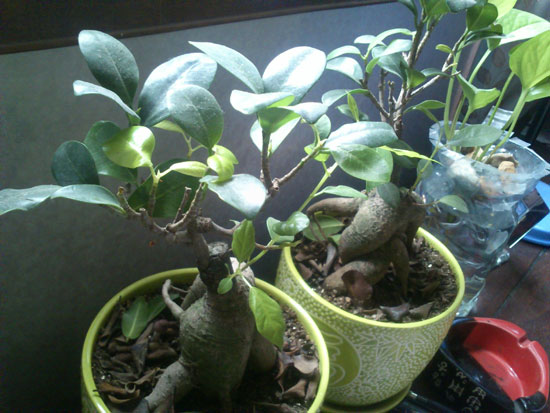
What to Do When a Banyan Tree Loses Its Leaves? Cause Analysis and Solutions
Currently, the banyan trees grown by plant enthusiasts are mainly of two types: one is the ginseng ficus (Ficus microcarpa 'Ginseng'), and the other is the golden coin ficus (Ficus microcarpa 'Golden Coin'); both can be called banyan trees. Some enthusiasts have noticed that their banyan tree is dropping leaves and don't know what to do. In fact, when a banyan tree drops leaves, the situation must be clearly identified, and you should not blindly follow methods found online to try to save it.
-
Neolitsea sericea is a native tree species of Shanghai
Neolitsea sericea (Bl.) Koidz. LAURACEAE Current status: rare species. Distributed only in a relatively narrow area along the eastern coast of China. According to literature records, it is also distributed in Chongming Sheyu, Shanghai. Due to excessive felling for firewood, few adult trees remain, and most of them have grown from sprouts. Morphological characteristics: Evergreen tree, up to 12 m tall; branchlets greenish, smooth, current-year branches often covered with brown-yellow silky hairs. Leaves alternate, leathery, oblong or ovate-oblong,
-
Characteristics and Cultivation Points of the Golden Pear Fruit Tree Variety
Bred in South Korea by crossing Nijisseiki and Shinko, registered in 1994. The fruit is round, with an average single fruit weight of 350 grams, ripening in mid-September, and a storage life of 100 days. At maturity the skin is yellow-green, turning golden yellow after a short period of storage. Bagged fruit has a golden yellow skin at maturity and appears translucent. Few fruit dots, beautiful appearance, few stone cells, fine and crisp flesh, sweet taste with aroma, sugar content 15%, excellent quality, and it commands a very high price on the market. Contact person: Li Sai. Contact phone: 03183556676. Work unit: Hebei Shenzhou Luyuan Fruit Tree Seedling Base.
-
Detailed Guide to Identifying and Controlling Peach Aphids on Peach Trees
The peach aphid, also known as the peach red aphid, cabbage aphid, or greasy bug, among other names. Its main hosts include broccoli, purple cabbage, cauliflower, Chinese cabbage, radish and other cruciferous vegetables as well as other vegetables. Adults and nymphs pierce and suck sap on the leaves, causing the leaves to curl and deform, affecting head formation. They damage the tender stems, tender leaves, flower stalks and tender pods of seed-producing plants, causing the flower stalks to twist and become deformed, so they cannot bolt, flower and set seed normally. In addition, aphids also transmit a variety of viral diseases. Occurrence characteristics: generation overlap is extremely severe. In heated greenhouses, they reproduce parthenogenetically on vegetables throughout the year. In the open field: in late April of the following spring
-
Detailed Explanation of High-Light-Efficiency Tree Shape Renovation Techniques for Kernel Apricot
In regions where kernel apricots are cultivated, we found that due to the influence of traditional habits, most fruit growers either do not prune or prune unreasonably. Each tree has an average of 8 to 10 large branches, the tree shape is chaotic, the proportion of complete flowers is low, the fruiting zone moves outward, the canopy is closed and shaded, and the small fruit-bearing branches in the lower part die prematurely due to shading, resulting in late fruiting, low yield and poor quality of kernel apricots. Therefore, high-light-efficiency tree shape renovation must be carried out to improve quality and efficiency. High-light-efficiency tree structure for kernel apricots After several years of exploration and practice, we believe that the high-light-efficiency tree shape for apricot should be
条件筛选