-
What are the technical key points for small-scale rice field eel (Monopterus albus) farming in a courtyard?
I. Construction of rice field eel farming facilities 1. Site selection: choose an open space in front of or behind the house, enclose a yard and build eel ponds, using groundwater or tap water as the farming water source. 2. Eel pond construction...
-

Detailed Explanation of Techniques for Self-Breeding Rice Field Eel Fry
1. Selection and Cultivation of Parent Eels. Eels used for breeding must have a robust physique and swim actively. The body color is best in coarse black mud, yellow-brown, or black speckled, green-brown. The source of parent eels should be those caught in cages the same day with relatively small wounds. Rice field eels (Monopterus albus) have sex reversal characteristics; 1-winter-age and 2-winter-age rice field eels are basically female, and after 2-winter-age rice field eels spawn, the proportion of males gradually increases, until at 6-winter-age they are basically male. During the non-spawning season, it is difficult to distinguish male from female; generally, body length and body weight are used as standards, generally body length 37-50 cm, weight 7
-
Occurrence and Prevention Methods of Rice Field Eel Diseases
Rice field eels live year-round in water bodies with complex environmental factors and are frequently attacked by pathogens such as viruses, bacteria and parasites. During the rearing process, sudden changes in water temperature, insufficient dissolved oxygen, excessively high water acidity, and poor feeding management, such as insufficient feed, malnutrition, or feeding rotten and spoiled feed, and deterioration of water quality, disrupt their physiological state, weaken the eel body and lower their resistance, and in severe cases often cause mass death. Even if they do not die, it directly affects the growth and development of the rice field eels. In some cases, it is also due to excessive stocking density, or
-
Principles and Methods of Oral Medication for Preventing Rice Field Eel Diseases
Also called the oral administration method, it generally involves mixing the medication to be used into the feed at the prescribed dose to make medicated bait, so that the rice field eel ingests the medication by eating the feed, thereby achieving the purpose of preventing and treating diseases. The problem with using this method is that usually once rice field eels become ill, it becomes a group outbreak, with generally reduced appetite or almost complete cessation of feeding, meaning that the amount of medication entering the rice field eels' bodies will not be very large, and the treatment effect will not be very good either. Therefore, certain technical measures need to be taken to do everything possible to get the sick rice field eels to better ingest the medicated bait, such as stopping feed
-
How to select brood rice field eels? Detailed selection methods and techniques
To select seedlings with high egg production, high fertilization rate and hatching rate, and good quality, you must choose rice field eels (Monopterus albus) of a certain age and body weight, with a strong constitution and no serious diseases or external injuries, as brood eels. In the non-breeding season, female and male eels are difficult to distinguish by appearance, so they are generally selected and retained by body length. When the body length of the rice field eel is 20 cm-35 cm, the vast majority are female eels, and when the body length is above 45 cm, most are male eels. Under normal circumstances, they can be selected and retained in a 3:1 ratio according to the above two body length groups.
-
Key points and precautions for building a rooftop rice field eel pond
What should be noted when building a rooftop rice field eel pond? Considering the load-bearing capacity of the rooftop, it is recommended that all rooftop ponds be built with bricks laid upright (wall thickness 6 cm); except for breeding ponds, all should use soil-free culture. From the perspective of cooling, the wall that is often exposed to the sun should be built higher than the height of the culture pond, and then the pond should be started about 10 cm back from it, to prevent prolonged sunlight on that pond wall from causing the water temperature in that pond to rise abnormally compared with other ponds, resulting in an undetected high water temperature that causes the death of rice field eels.
-
Disease Outbreaks and Emergency Treatment After Introducing Inferior Quality Rice Field Eels into Eel Ponds or Net Cages
(1) Disease outbreak situation: After inferior quality rice field eels are introduced into eel cages or eel ponds, they generally develop disease within 2 to 7 days, and mass mortality occurs around 12 days. When disease breaks out, a method combining Chinese herbal medicine and chemical fishery drugs should be used for treatment to control the infection. (2) Emergency handling: ① Search for and remove floating-head eels, exposed-body eels, and dead eels 2 to 3 times during the daytime each day; ② Change the water once every morning and thoroughly inspect for and remove dead eels; ③ At night each day, use electric light for illumination and search for and remove diseased eels from aquatic plants 1 to 2 times.
-
What technical points must be mastered for polyculture of fish, shrimp, ricefield eel, loach, crab, and crayfish?
1. Pond selection. The pond is nearly square, with surrounding ditches 8 m wide and 0.6 m-0.8 m deep, the beach surface can be raised with water to 1.2 m, the pond bottom is sandy soil, the water source and water quality are good, and water inlet and drainage facilities are complete. On the inner side of the pond, fine-mesh polyethylene netting is buried in the soil to prevent ricefield eels, loaches, red swamp crayfish, crabs, etc. from burrowing. Asbestos tiles are used as an escape-prevention wall. The pond must be strictly disinfected with quicklime and other drugs, sufficient base fertilizer applied, natural feed cultivated, and aquatic plants such as tarragon and tape grass planted. Around Qingming, a large amount of live river snails
-
How was the trial on early breeding of rice field eel fry in greenhouses carried out?
At present, cage culture of rice field eels is concentrated on collecting fry in July, which gives a high survival rate and low farming risk. But concentrating purchases means few fry sources, high prices, and a low weight-gain multiple. If fry are purchased earlier, the unstable temperature leads to a high mortality rate of the fry. How can this problem be solved? We carried out a trial on early breeding of rice field eel fry in greenhouses, and a brief summary of the trial is as follows: 1. Trial conditions 1. Trial pond: a newly excavated artificial water surface, 250 m long, 4 m wide and 1.5 m deep, with an area of 1000 sq m. The water source is lake
-
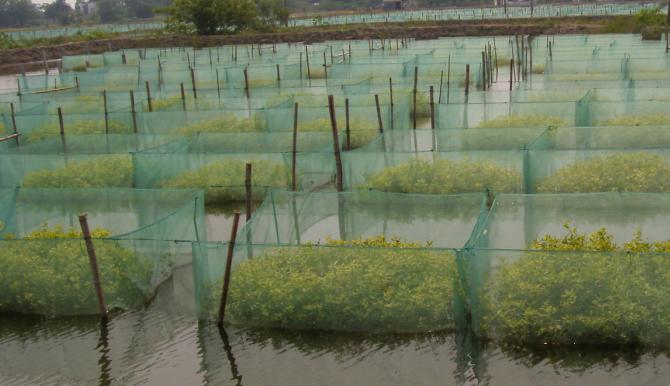
Tips for rice field eel farming to help you easily achieve big profits
Small tips, big profits - rice field eel farming techniques
条件筛选