-

Do rabbit droppings need to be cleaned up every day? A detailed explanation of rabbit dropping cleaning frequency
Teacher Xu Shangjin, a rabbit-raising expert from Heilongjiang, China, said he discovered that rabbit droppings have a thin film on the outside, and about ten minutes after the droppings fall onto the dropping board, this thin film dries up. If you do not break it, the droppings do not smell or give off odor! If you insist on a system of cleaning the droppings once every day, it will inevitably cause the dropping pellets to break and release foul and unusual odors. In addition, it also shows that cleaning droppings inside the rabbit house every day will inevitably affect the rabbits' rest. If rabbits do not rest well, they will not grow well. Therefore, cleaning droppings every day is not recommended, and at the same time it is strictly forbidden to
-
Do Pet Rabbits Need to Drink Water? A Guide to the Correct Way to Provide Water
Many people who keep rabbits have a misconception: they believe rabbits cannot drink water. Many friends have had this question before: "Can I give a rabbit water to drink? Will drinking water kill the rabbit?" In fact, this worry is unnecessary. Rabbits, like many other pets, certainly need to drink water. Normally, we should likewise prepare some fresh, clean drinking water for rabbits. If a rabbit goes without water for a long time, it will affect its health and can even lead to death. As for how much drinking water to prepare for a rabbit, it depends on what each rabbit eats. When eating dry
-
What to Do If a Rabbit Has a Cold? A Detailed Guide to Practical Prevention and Treatment Measures
Causes A sudden drop in temperature, or a cold, damp rabbit hutch, can easily trigger a cold in rabbits. Clinical symptoms The affected rabbit has a mild cough, sneezes, has a runny nose with clear or thick nasal discharge, difficulty breathing, listlessness, reduced appetite and a rise in body temperature. If not cared for properly, it can easily develop secondary pneumonia or haemorrhagic septicaemia. Preventive measures Keep the indoor area clean and hygienic. When the temperature changes, close the doors and windows to keep the warmth in. If there is strong wind and a drop in temperature, light a fire in the rearing room promptly to keep the temperature stable and prevent it from fluctuating up and down,
-
Detailed Explanation of Disinfection Methods and Steps for Rabbit Hutch Environments
I. Disinfection of the Floor The floor of the rabbit hutch is an important part of the hutch's micro-environment and is also the place where rabbits excrete droppings, so floor disinfection is very important. Droppings should be cleaned up promptly every day, quicklime can be spread on the floor, and the rabbit hutch should always be kept ventilated, dry, clean and hygienic. Regularly spray disinfectant drugs such as Lysol solution or 20% caustic soda solution. II. Disinfection of the Rabbit Hutch 2 to 3 days before introducing breeding rabbits, the rabbit hutch should be thoroughly disinfected. Fumigation disinfection is generally used, that is, take 25 grams of potassium permanganate and 70 to 100 milliliters of formaldehyde solution; when the two are
-
Precautions for Feeding Rabbits: What Can and Cannot Be Fed
1. The following grasses and wild vegetables must never be fed to rabbits at any time: potato vines, tomato vines, larch, globeflower, castor bean, ragwort, monkshood, wild grape vines, langdu chenopodium (Stellera chamaejasme), etc. 2. Some grasses and wild vegetables cannot be fed to rabbits during certain stages of growth and development, otherwise they can easily cause poisoning in domestic rabbits: yellow and white sweet clover are toxic and cannot be fed to rabbits when in bud and bloom; buckwheat and wild rape cannot be fed to rabbits when flowering; flax cannot be fed to rabbits when the seeds and crown stems are mature; potatoes cannot be fed to rabbits when they have sprouted.
-
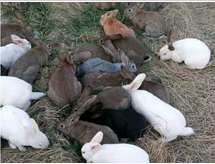
What are the specific signs of nutritional imbalance in female rabbits?
In what specific ways does nutritional imbalance in female rabbits manifest?
-
Detailed Explanation of Breeding and Development Technology for Dual-Purpose Medicinal and Meat Rabbits
1. Development prospects The dual-purpose medicinal and meat rabbit originated in Zhucheng, Shandong, and has a long history. It has strong bones and thick meat, and has the effects of tonifying the middle and replenishing qi, cooling the blood and detoxifying. It can nourish the complexion and soften the skin, strengthen the body, prolong life, lower cholesterol, prevent and treat cardiovascular and cerebrovascular diseases and obesity, and improve intelligence and nourish the brain. This rabbit is also a high-grade meat food. The rabbit meat is bright red and tender, without a gamey smell, rich in aroma, not greasy when eaten over a long period, and rich in nutrition, containing more than 21% protein. Since January 2002, when China's rabbit meat was banned by the EU due to drug residue issues, it has been the only green rabbit
-
Diagnosis and Treatment Methods for Rabbit Pasteurellosis and Bordetellosis
From May to July 2002, a disease characterized by rhinitis and acute death occurred successively at a certain rabbit farm. Through laboratory bacteriological examination, it was diagnosed as rabbit pasteurellosis. The report is as follows: 1. Basic information. The rabbit farm is located at the **Chabucha'er County Dairy Farm. Rabbit farming began in 2000. Currently, California rabbits, Belgian rabbits and other breeds are raised, with a total of more than 1,000 young and adult rabbits. All are raised in cages. No vaccines were injected, and no major epidemic had occurred in the past two years. In late May 2002, after continuous heavy rain, due to low temperature in the rabbit house
-
A Clever Treatment for Neonatal Rabbit Kits Refusing to Nurse
Neonatal rabbit kits refusing to nurse is caused by nutritional imbalance in the doe during late pregnancy. This condition develops 2 to 3 days after the kits are born, and within the same litter, some or all of the kits come down with it one after another. Affected kits show signs of not suckling, skin that is cool and dark, and a body that is soft and weak all over, finally dying in a comatose state. Treatment method: slip a 2 cm piece of bicycle valve-core latex tubing over the nozzle of a syringe, draw up 25% glucose solution, then insert the latex tubing into the mouth of the affected kit and slowly push the plunger, giving each kit 1 to 2 milliliters; for kits that can no longer swallow,
-
How should a sick rabbit be handled correctly after it is discovered?
(1) Detect promptly and handle as soon as possible. Each rabbit should be examined 1-2 times every day, and any disease found should be dealt with immediately; delaying will lose the opportunity for treatment. Therefore, the earlier a diseased rabbit is treated, the better. (2) Make a rough judgment and use medication as soon as possible. In addition to being able to make a clear judgment, targeted treatment measures can be taken for conditions such as sarcoptic mange, ringworm, and mastitis; for diseased rabbits with uncertain causes such as diarrhea, fever, and poor appetite, certain drug treatment should be given first. For diarrheal disease, oral or injectable anti-
条件筛选