-
Uncovering the Origins of Edible and Medicinal Mushrooms
Edible mushrooms generally refer to the large fungi that people can eat, collectively known as mushrooms and toadstools, such as shiitake, wood ear, straw mushroom, button mushroom, and so on. Naturally growing edible mushrooms number...
-

Detailed Explanation of Key Techniques for Off-Season Soil-Covered Bag Cultivation of Shiitake Mushrooms
Soil-covered bag cultivation of shiitake mushrooms is a new model of shiitake cultivation. Shiitake mushrooms cultivated with this model have the advantages of good mushroom shape, high yield, easy fruiting, and savings in time and labor. It is also a relatively advanced method in current shiitake cultivation, especially off-season soil-covered bag cultivation of shiitake, which produces high-quality summer and autumn shiitake mushrooms with high market prices and good economic returns. This technique has been tested and promoted in the northern Guangdong region of our province, with good results. The off-season soil-covered bag cultivation technique for shiitake mushrooms is introduced as follows: 1. Seasonal arrangement. Select varieties with high-temperature tolerance, large round and regular mushrooms, thick mushroom flesh, stout mushroom stipes, and high yield
-
B ag-cultivated shiitake mushroom off-season soil-covering cultivation technique
B ag-cultivated shiitake mushroom cultivation has always adopted the spring-planting, autumn-and-winter-mushroom model, with the fruiting period mainly concentrated from October to March of the following year, while April to September is a blank period for mushroom production. The total amount of fresh mushrooms cannot meet the growing consumer demand at home and abroad. In recent years, Zhukou Town, Qingyuan County, has explored a set of new techniques for off-season soil-covering cultivation of bag-cultivated shiitake mushrooms, achieving very good economic benefits and being very suitable for mushroom farmers' large-scale production. The technique is introduced below for reference by colleagues only: 1 Advantages The advantages of off-season soil-covering cultivation of shiitake mushrooms can be summarized in the following 5 aspects: 1.1 Year-round nature
-
Detailed Explanation of the Wall Soil-Covering Cultivation Technique for Oyster Mushrooms
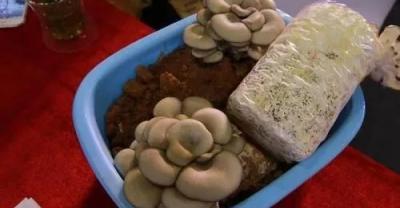
After oyster mushrooms produce three flushes, water and nutrients are heavily depleted, and yield drops sharply. With full soil-covering cultivation, not only do the mushrooms get covered in a lot of soil, but the mushroom quality is also brittle and the selling price is low. With the wall soil-covering method, oyster mushrooms not only increase in yield but are also good in quality and do not get covered in soil. The specific method is as follows. 1. Making the mushroom wall. Take the mushroom logs after the second and third flushes have been harvested, use a knife to cut one end of the mushroom bag into a 10 cm long bag tube, and slip it over the other end of the mushroom stick, arranging 2 sticks per row. Place the end with film on the outside, and in the middle of the two mushroom tubes the first layer is spaced 30
-
High-yield cultivation method of cutting oyster mushroom blocks into pieces, standing them upright and covering with soil
Mushroom farmers in Dongkan Town, Binhai County, Jiangsu Province, through years of oyster mushroom cultivation practice, worked out the six-character high-yield formula for oyster mushrooms of "cutting into blocks, standing upright, covering with soil", which increased the oyster mushroom yield per mu by more than 2000 jin compared with the past, with an increase rate of about 30%, and at the same time, production costs dropped greatly. Their high-yield experience mainly consists of three steps: "cutting into blocks, standing upright, covering with soil". The so-called "cutting into blocks" means that at the end of harvesting the second flush of mushrooms in furrow-bed cultivation, the dead mushrooms, stipes and the like remaining on the bed surface are cleaned up, and a sharp knife is used to cut the cultivation substrate into multiple pieces of about 50 cm
-
How to prevent and control contaminants in oyster mushroom cultivation? Covering with burnt mud ash is effective
Bed-style cultivation of oyster mushrooms: When bed-style cultivating oyster mushrooms, if contaminants appear sporadically on the surface of the substrate, they can be eliminated by smearing or covering the affected spots with thick quicklime slurry; if contaminants appear in large amounts on the substrate surface, cover the contaminated part with 2-3 cm thick burnt mud ash, making the covered area larger than the contaminated area, and pat it slightly firm to eliminate the contaminants; if contaminant contamination on the substrate surface is severe, cover the entire substrate surface with burnt mud ash and pat it firm, and after a few days the mycelium will resume normal growth. Bag-cultivated oyster mushrooms: first pick out the bags contaminated by unwanted organisms, then in a place with relatively high
-
What to do when oyster mushrooms grow contaminant fungi? Covering with mud and sand can prevent and control it
Contaminant fungal infections often occur during oyster mushroom cultivation, and are especially severe in hot seasons, causing reduced yields in mild cases and total crop loss in severe cases. Most of these contaminant fungi are aerobic and tolerant of high temperatures and high humidity. Covering with mud and sand can prevent and control them. The specific techniques are introduced below: 1. Prevention and control of contaminant fungi in bed-cultivated oyster mushrooms. When contaminant fungal contamination appears in large-bed oyster mushroom cultivation, the cause of contamination should first be identified. Common causes include sudden high temperatures, water entering the substrate, unclean surrounding environment, insect pests, etc. Based on the specific situation, remove the source of contamination, then treat the contaminated oyster mushrooms as follows: if contaminant fungi appear sporadically on the substrate surface, smear or cover the affected area with thick lime slurry. When a large amount of contaminant fungi appears, dig up mud and sand from more than 30 cm below the ground surface, crush it, add 2% lime powder and mix thoroughly, remove the plastic film, and cover the contaminated part of the substrate surface with the lime-mixed mud and sand to a thickness of 2-3 cm. The covered area should be slightly larger than the contaminated area, and the mud and sand should be patted slightly firm. When the substrate surface is severely contaminated, the entire bed surface should be covered with mud and sand, then covered with a plastic film that has been washed clean with disinfectant solution, and routine management should be resumed. After a few days, the mycelium will resume growth.
-
How to safely overwinter shiitake mushrooms through summer? These management points must be mastered
The quality of summer management for shiitake mushrooms directly affects yield and profitability. Doing a good job of summer management is a key step in shiitake mushroom production, and two methods can be used: indoor and outdoor. I. Indoor spawn running for summer survival (1) Minimize the number of shiitake bags indoors and the number of bag layers. Stack two bags in a cross pattern, with no more than 5 layers at most, and keep the spacing between stacks at more than 20 cm to facilitate ventilation and heat dissipation. (2) Build a shade canopy outside the window so that sunlight does not shine directly onto the window or indoors. (3) In hot weather, close doors and windows at 7 a.m. to prevent outside hot air from entering indoors, and in the evening
-
Detailed Explanation of Technical Measures for Safely Overwintering Shiitake Mushroom Logs Through Summer
Key Management Points for Safely Overwintering Mushroom Logs Through Summer. Outdoor summering. Outdoor shade shelters have good ventilation and cool down quickly, therefore, using outdoor shade shelters for mycelium running can effectively reduce the occurrence of "mushroom burning." Specific measures taken for summering and mycelium running using outdoor shade shelters: First, build trellises around the shade shelter and plant vine crops such as pumpkins and luffa to improve the shading effect; Second, install automatic rotating tap water sprinklers or spray pipes on the shelter roof, and spray water to cool down from 10 AM to 4 PM every day; Third, dig interconnected trenches 20 cm wide and 30 cm deep around the inside of the shelter and on both sides of the walkways, and run flowing water through the trenches to cool down.
-
Key Technical Points for Overwintering Management of Shiitake Mushroom Bags
After the Winter Solstice arrives, temperatures will drop noticeably. Regarding how to do a good job of overwintering management for shiitake mushrooms, the following technical suggestions are hereby put forward for mushroom growers' reference: 1. Remove the shade net originally used for cooling and heat insulation so that sunlight shines directly onto the plastic greenhouse, thereby raising the daytime temperature inside the greenhouse. 2. Reduce the number of ventilation times around the greenhouse, exchanging the air once every other day. For the small arched film inside the greenhouse, apart from when picking shiitake mushrooms, there is generally no need to lift the film for ventilation. After one flush of mushrooms is finished, let the mushroom bags dry and ventilate for 7-10 days, then inject water to stimulate pinning. During the pinning stimulation period, pay attention to heat preservation. Inside the mushroom shed
条件筛选