-

Introduction to the Characteristics of the Taohjian Hualianbian Orchid Variety
Originally named Heyixing Mabai Lianbian. The petals are off-white, with earthy purple vein lines. The main and secondary petals have slightly tight edges, gentle angles, narrow and abrupt bases, and petal tips that rise into a peach point with a slight inner hook, bearing seven vein lines. The surrounding petals (column petals) clasp together, leaving a slight clam gap, with red brushing on the inner side. The lip is broad, round, and hanging downward, with irregular red spots on it.
-
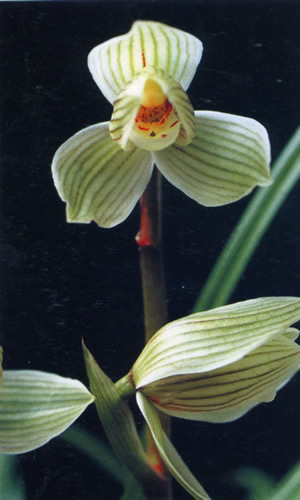
An Introduction to the Characteristics of the Yulonghe Lotus-Petal Orchid Variety
Originally named the lotus-type green lotus-petal orchid. The flower color is pale green, fresh and pleasing to the eye; the main and secondary petals have slightly tightened edges and broad surfaces, with peach-pointed tips; there are 11 veins, 9 distinct and 2 faint; the column petals (petals) are held together, closed like a clam shell. The lip is curled at the edges and hollowed at the center, with tiny reddish spots on it.
-
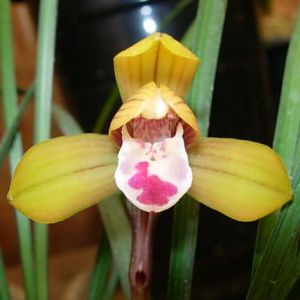
Introduction to the characteristics of the Round-Tongue Lotus-Petal Cymbidium (Lianban Lan) variety
Jinbi He (Golden Jade Lotus) looks like a Cymbidium goeringii (Chunlan), but it is actually a naturally occurring hybrid of Dandou Lan (Cymbidium faberi) from Yunnan, belonging to the richly fragrant Dandou type. It is very rare. When in bloom, the flower scape is tall, and the petals have a red base with golden-yellow markings, giving a sense of golden splendor and grandeur.
-
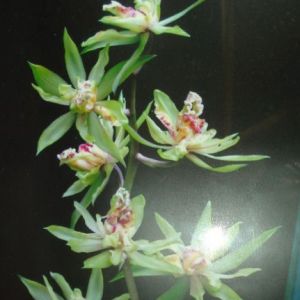
Introduction to the characteristics of the Heyang Mudan Cymbidium tortisepalum variety
A superb chrysanthemum-petal, thousand-form small grassy-type Cymbidium faberi, with thick, hard foliage and a beautiful plant form; the opened flowers have neat outer petals and the rich substance of peony-type petals, with large blooms held well above the foliage.
-
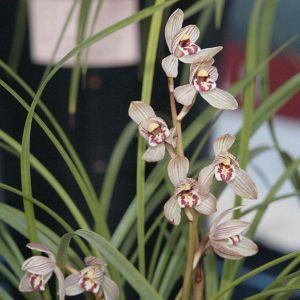
Introduction to the Characteristics of the Cangshan Red Lotus Cymbidium tortisepalum Variety
Gold Award at the Dali Pavilion of the 13th China (Dali) Orchid Expo -- Cangshan Red Lotus
-

Introduction to the Characteristics of the Lingmei Chunlan Variety and Its Cultivation and Care Methods
Lingmei, petal type: plum petal. History: discovered in 1990 by Zhao Yinquan of Tangdi, Shaoxing, who dug it up in Shangyu. Characteristics: the three outer petals have long stems and round tips with tightly rolled edges, silkworm-moth-style holding petals, a Liu Hai tongue, and three red dots on the tongue arranged in a regular pattern. The flower scape is tall, the flower is well-formed, and the leaves are slanted and upright.
-
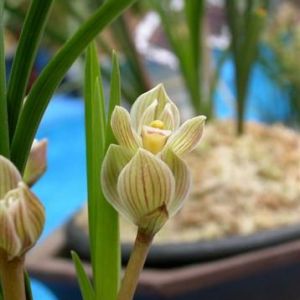
Introduction to the Kunhua He Cymbidium lianpan orchid variety and its characteristics
Kunhua He is a premium lotus-petal variety of Cymbidium lianpan from Baoshan. Its foliage is elegant and meets the traditional aesthetic standards of being short, wide, round and thick. The flower stem is upright and stands above the leaves. In good light the flower shows red, and it has an ovary (flower stalk), which makes up for the shortcomings of baogan grass, whose foliage is elegant but whose flowers have no stalk. Both flower and foliage are excellent.
-
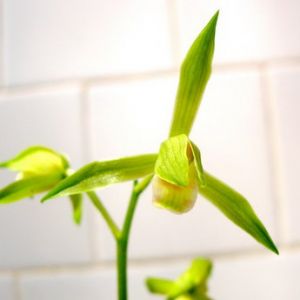
What kind of orchid is Fuxing Baomolan? A brief introduction to its variety characteristics
A solid-colored Cymbidium sinense variety - Fuxing Bao, with fine white striated variegation on the leaf surface, medium leaf material, flower spikes held above the leaves, and harmonious proportions. Both flowers and foliage are excellent.
-
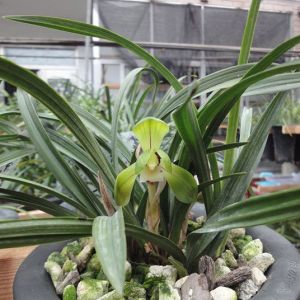
Introduction to the Datuyuan Hybrid Variety and Analysis of Its Characteristics
Because its leaf shape and flower shape closely resemble those of the Cymbidium goeringii cultivar "Dafugui," many unscrupulous sellers pass it off as Dafugui! Datuyuan is a hybrid variety; its fragrance is the same as that of ordinary Jiangsu-Zhejiang Cymbidium goeringii, it is easy to cultivate with no other special requirements, and it is inexpensive. It is still quite nice for viewing and enjoying the fragrance. Datuyuan has a greater proportion of Cymbidium goeringii bloodline, and its plant form and fragrance are very close to...
-
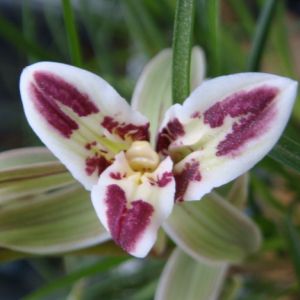
A Brief Introduction to the Characteristics of the Cymbidium lianpan 'Starry Brilliance' Variety
A true three-star butterfly Cymbidium lianpan from Yunnan: Starry Brilliance. Collected from the wild in 2005, originating within Yunlong County, Yunnan Province. It belongs to the fine-leaved Cymbidium lianpan type, with medium-tall foliage; leaves are about 30-40CM long and about 0.5CM wide, with 5-7 leaves per plant. The leaf posture is slanted and upright, scattered in an orderly way, elegant and calm, gently curving and winding. The leaf texture is medium-thick, and the leaf blades have relatively deep "V"-shaped grooves, with the lower part of the petiole narrowing to be quite slender. The central leaf and the two leaves beside it on the left and right sometimes show butterfly transformation; the leaf butterfly's bright red color patches appear as dotted or solid lines, running from the petiole all the way to the leaf tip. When the plant is strong, it will also produce the exquisite "flower within the leaf" (leaf butterfly), namely a veinless flower tongue. Starry Brilliance belongs to the butterfly-flower type, a true three-star butterfly. The flower form is dignified and generous, the column has degenerated to a flat shape, and the traits are stable. The two petals are completely tongue-transformed, and their shape is almost the same as a true lip, forming a highly symmetrical "three tongues." The "three tongues" are all thick and fleshy, extending outward to a moderate degree, symmetrically balanced without curling back, proper and well-proportioned, generous and fitting. On the "three tongues," the red moss appears as a thick "V" shape, with deep red distributed cleanly and neatly; the contrast between red and white is strong, dazzling and eye-catching, incomparably gorgeous. On the two lateral sepals, butterfly transformation sometimes flies in at the upper shoulder, as brilliant as a colorful sky, fantastically unmatched. Viewed as a whole, the flowers are many, each one gorgeous, each one similar, arranged at different heights and echoing one another nearby, with the flower posture facing the sky, radiating charm. It is truly a rare supreme grade among three-star butterflies.
条件筛选