-
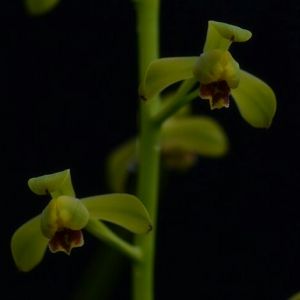
Introduction to the characteristics and care methods of the Qinghua Mei cymbidium variety
Now also called Lao Qinghua, Liu Mei! Petal type: Cymbidium green-shell plum petal. History: In the early years of the Republic of China, Che Qing from Shaoxing, Zhejiang, selected it at Huaxing Hotel, and Wu Enyuan of Hangzhou exchanged an old variety worth several tens of gold for it. Six years later, it bloomed with six flowers and was a fine plum-petal specimen. Characteristics: outer petals with short feet and round tips, thick petals, and level shoulders. The inner segments are divided-socket silkworm-moth segments, ...
-
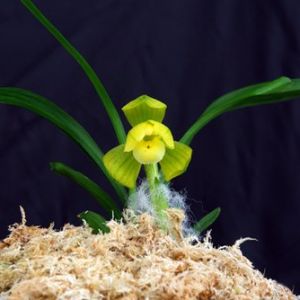
Tianyihe Cymbidium goeringii Variety Characteristics and Appreciation Introduction
Descended from the mountains in 1992 from the Meitan area of Guizhou. Selected and bred by Mr. Chen Jiwu, who also named it. Characteristics: a standard round-headed dwarf variety of Cymbidium goeringii, with a short and sturdy plant form. The flower color is golden yellow, the flower is large, lotus-petal type, solid-color center, with no mixed colors. This variety combines a dwarf type, lotus petals, and a yellow solid-color flower all in one. It can be called an unprecedented rare treasure. This...
-
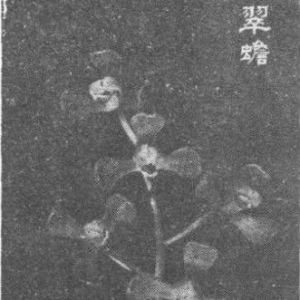
Hou Cuichan Huilan Variety Introduction and Care Points
Petal type: Green-shell plum petal. History: There was formerly a Cuichan, selected during the Qianlong reign of the Qing Dynasty by a person surnamed You in Yixing, Jiangsu, and that variety has since become extinct. In the seventh year of the Xianfeng reign, Zhang Shenglin of Fuyang brought it from Shaoxing, and it was cultivated by Mr. Xu Jilou, author of "Lan Hui Tong Xin Lu". Because the flower shape resembles Cuichan, and to commemorate the old variety, it was also named Cuichan, and the orchid community thus...
-
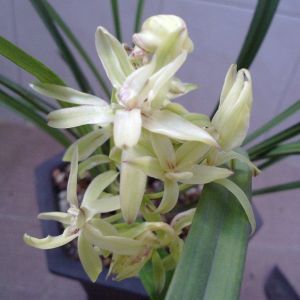
Introduction to the characteristics of the Bao Dao Jin Long (Treasure Island Golden Dragon) Jianlan (Cymbidium ensifolium) variety
Tree-type unusual flower, medium-long leaves, leaf blades upright, leaf tips drooping, pseudobulbs very large, 3--4 leaves per stem; multi-petaled flower, flower stalk very long, bracts 5--12, at first opening 2--4 small flowers borne on a single flower stalk, after fully blooming it produces twenty-plus petals and column, several pouches, column tip incomplete, flowering period up to two months, and after the flowers fade they still...
-
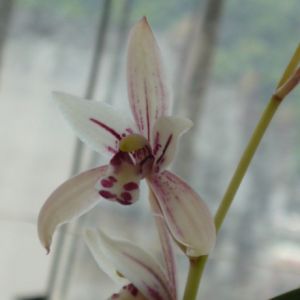
Introduction and Appreciation of the 'Guifuren' Cymbidium ensifolium Variety
Discovered in the mountain area of Taitung in 1984, it was named 'Guifuren' (Noble Lady) because its petals are broad and thick, its colors are delicate and gorgeous, and its overall impression is as graceful and luxurious as a noble lady; this variety is one of the fairly well-known lines among the four-season water-red flower strains produced in Taiwan, China. Characteristics: medium drooping leaf habit, deep red leaf sheaths on new shoots, young leaves with tender yellow full-spot variegation, slightly tinged with red, gradually turning green as they grow...
-
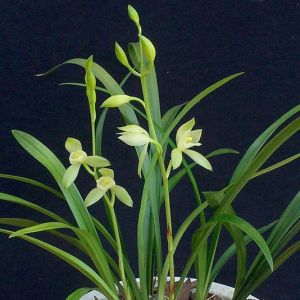
Cymbidium ensifolium 'Zhude Su' (Broad-leaf Renhua Large-flowered Suxin) Variety Introduction
The Zhude Su plant is robust, with dark green leaves, 30-45 cm long, 1.2-2 cm wide, semi-upright, with rounded blunt leaf tips, inconspicuous fine serrations along the leaf margins, and a thick, fleshy leaf texture that is smooth, fine and glutinous, rich in luster. The flowers are large, nearly twice the size of ordinary Dahe Su, intensely fragrant, with a long blooming period; flowers can be seen from June to November. This orchid...
-
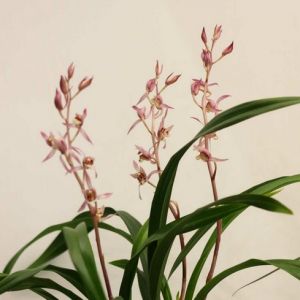
Introduction to the Characteristics and Care Methods of the Taohime Orchid (Cymbidium sinense) Variety
Origin: Taiwan, China. Discovered in 1963, registered in Taiwan, China in 1977 as a new "variety"; in 982 it was entered into the "Record of Famous Chinese Orchid Varieties," and was named Taohime by Mr. Peng Shuangshong (a representative of the red-flower series), beloved for its vivid flower color, delicate pink beauty, and elegant, graceful foliage. Taohime once won a special gold award in Japan and gained wide...
-
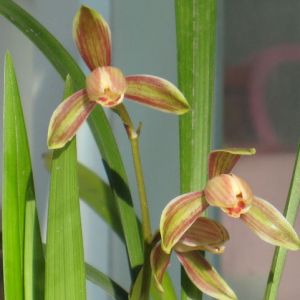
Detailed introduction to the characteristics of the Laocaixian Jianlan (Cymbidium ensifolium) variety
Bicolor Narcissus -- Laocaixian, the flower shape and flower color are good, and the flower form is impeccable as well -- among them, the large lip occasionally opens as a "liuhai tongue" (it can be seen that the tongue markings are relatively uniform: one large red dot at the tip of the tongue, and one large red dot on each side going back near the mid-lobe, slightly smaller than the one at the tip of the tongue, forming an inverted "pin" shape when viewed from the front), and usually most open as a "longtun tongue"; while its two petals, whether in large or normal bloom, almost uniformly remain tightly fitted, and remain unchanged until fading; the outer petals arch and embrace to a moderate degree, with vivid colors.
-
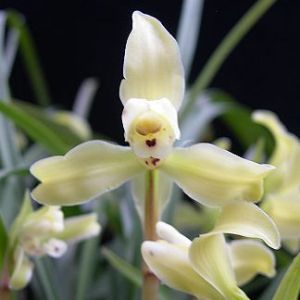
Cymbidium goeringii 'Xiao Huangmei' (Xiao Baihe) Variety Characteristics Introduction
Sichuan Cymbidium goeringii famous variety Xiao Huangmei, discovered in the wild some years ago. Because the flower shape resembles a lily, it is also called Xiao Baihe. The characteristic of this orchid flower is that the middle of all three outer petals has a pair of symmetrical small notches. The flower has a strong fragrance.
-
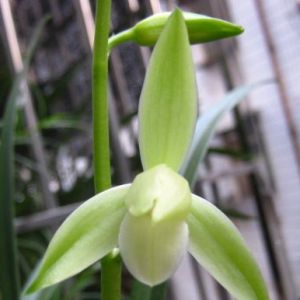
Introduction to the Characteristics of the Jianlan 'Shisan Taibao' Variety
Among the many-flowered celebrated varieties of the Jianlan (Cymbidium ensifolium) white-lipped type, Shisan Taibao ranks third. It may have been named for the number of flowers on its scape, which can reach as many as thirteen, borrowing the allusion of the "Taibao." This variety originates in western Fujian. There can be a large-leaf type and a fine-leaf type. Among the four great many-flowered celebrated varieties of the Jianlan white-lipped type, relatively speaking, this variety has smaller pseudobulbs and longer leaf stalks, ...
条件筛选