-
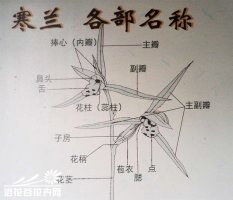
Illustrated Guide to Identifying Kanran Orchid Leaf Variegation, Leaf Types, and Flower Types
Kanran orchid, Kanran orchid, of the genus Cymbidium in the family Orchidaceae. Scientific name: Cymbidium Kanran Mak. The plant is slender and well-proportioned, the leaves elegant and graceful, the flower colors brilliant and varied, and the fragrance pure and long-lasting....
-

How to identify the petal types of Cymbidium goeringii (spring orchid)? Let's discuss it together with fellow orchid growers.
Knowledge should be concise. Here is a brief summary of how to identify the petal types of Cymbidium goeringii (spring orchid): Three characteristics of the lotus petal type: the three outer petals are broad and wide, thick and substantial in texture, shaped like lotus petals. ...
-
Introduction to Identifying Symptoms of Orchid Stem Rot and Its Prevention and Treatment Methods
For the prevention and treatment of orchid stem rot, prevention comes first, treatment second; prevention is key, and treatment can only be called rescue. In summer and autumn, with frequent rain and high humidity, orchids are especially prone to stem rot infection, making this an important stage for preventing the disease. Ventilation should be increased, and the orchid-growing area should be regularly sterilized. Starting from May, fungicides (carbendazim, chlorothalonil, junbingqing, Score, etc.) should be sprayed once a week for sterilization, including foliar spraying and comprehensive spraying of the orchid-growing area; the foliar spray should be slightly dilute, and the site spray slightly concentrated. Through years of practice, the author has found that this method can effectively prevent the occurrence of stem rot. [Treatment Methods] First, pull out the entire pot of orchids, wash them clean, and cut off both the diseased plants and the already infected orchid plants...
-
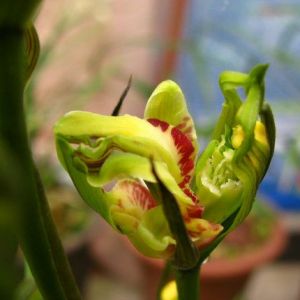
A detailed explanation of methods for identifying Cymbidium faberi varieties, teaching you to distinguish varieties with ease
One of the ten great odd flowers of Cymbidium sinense: an odd-form flower with "multiple noses" and "multiple tongues." Although quite a few odd-form flowers have been found in this province, no similar variety can be found; its unique distinction is that it maintains a "standard flower form" while still having variation, combining the classical and the novel, and it is very popular among lovers of odd-form flowers. This type has large flowers, plump and moist petals, multiple noses, multiple...
-
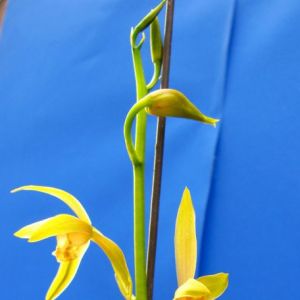
What are the methods for identifying orchids? Teaching you how to identify orchids
Cymbidium sinense 'Jinbi Huihuang' is a yellow-flowered variety of Cymbidium sinense, relatively few in number, with flower spikes already tall, blooming as beautifully as its name suggests, worth collecting.
-

To identify orchid varieties, master the three-look method
Variety identification is an appraisal of an orchid's overall qualities and the branch of knowledge that best demonstrates a grower's skill. For this reason, orchid masters through the ages have been especially cautious about it, never jumping to conclusions, and have always upheld the "three looks" principle. First, look at the leaf shape: "enjoy the flowers for a time, admire the leaves all year round." In the flowerless season, people identify famous orchid varieties...
-
How to Identify Orchid Roots? A Few Practical Identification Methods
The roots of orchids in the genus Cymbidium are relatively thick and fleshy. Generally, there is no distinction between a main root and lateral roots. The internal structure of orchid roots is a typical monocotyledonous type. Its cortical cells are relatively well developed, and it has symbiotic fungi called root fungi. Those growing underground are called terrestrial roots, and those growing in the air are called aerial roots. Whether terrestrial roots or ae...
-
How to identify orchids? Learn to recognize common orchid varieties
In some larger flower markets, you can often see various beautiful orchids for sale. How do you identify these orchid species? Here are several commonly cultivated orchids introduced below, for flower enthusiasts to refer to when making purchases. Cymbidium goeringii: roots fleshy, white; leaves narrowly linear, about 20 cm to 25 cm long, with fine sharp serrations along the edges...
-
How can you tell real orchids from fake ones? These few methods help you identify them easily
In recent years, some unscrupulous flower vendors have stopped at nothing, making and selling fakes to pocket ill-gotten gains, with ever-changing tricks that leave people unable to guard against them. The author now summarizes here personal experiences and the lessons learned by surrounding orchid friends who fell victim in transactions, hoping orchid friends can take warning. Tiger-stripe seedlings 'tiger-stripe variegation' is what many orchid friends pursue...
-

Council of Agriculture submits Beinong market closure review report, acknowledges failure to identify risks early, proposes 6 future response measures
Council of Agriculture submits Beinong market closure review report, acknowledges failure to identify risks early, proposes 6 future response measures
条件筛选